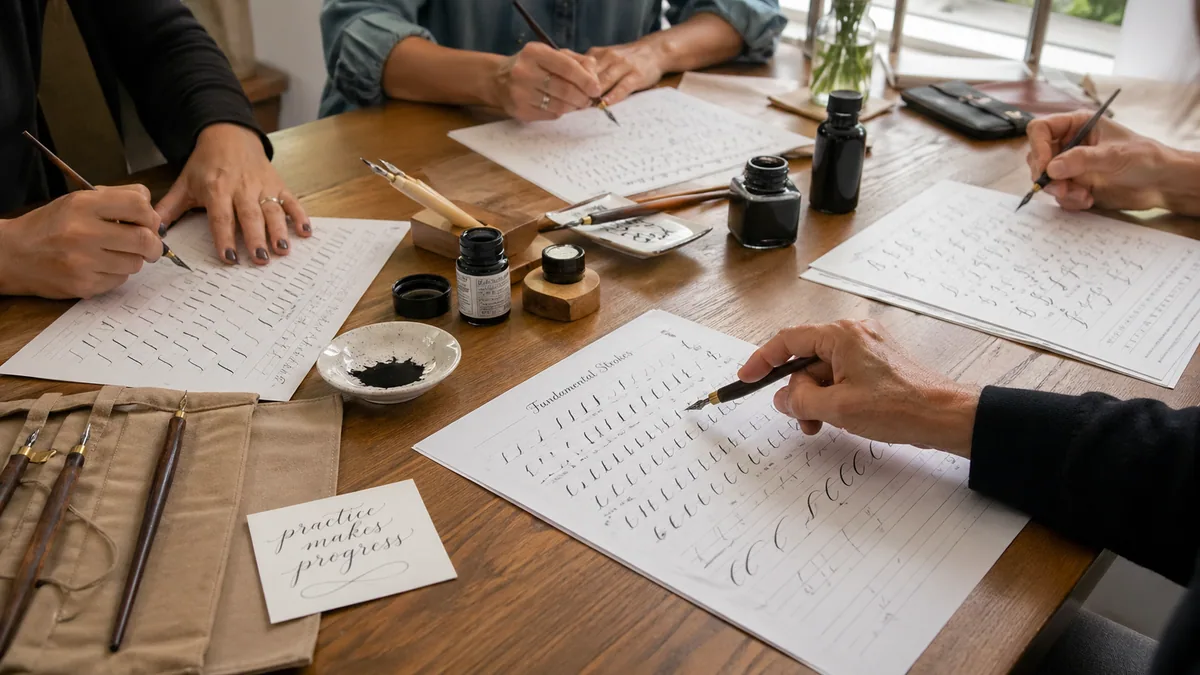
A practical guide to turning calligraphy into paid work. Learn how to price services, market carefully, find clients, and build a sustainable lettering business.
17 min readIntermediate Level
Table of Contents
Affiliate Disclosure: This page contains affiliate links to products selected for practical fit. When you purchase through these links, we may earn a commission at no additional cost to you. Recommendations are based on the registry's stated features, price, level, pros, cons, and best-for labels. We do not imply hands-on testing without an explicit page-level record. See our complete Tools Guide for comparison notes and selection criteria.
Calligraphy can generate real income—but the path from hobbyist to paid professional requires more than just pretty handwriting.
Treat paid lettering as a business: track costs, define the service, and agree on scope before accepting work. This guide offers planning examples, not a documented record of client results or business mentoring.
Before you start taking client work, you need solid technical skills. If you're still struggling with basic letterforms, spend time with our beginner's guide and structured practice routines. You can start a business at the intermediate level—you don't need to be a master—but clients expect consistency and professionalism.
Local demand and competition need separate investigation. Compare the services, lead times, and prices customers actually request. Neither market growth nor an unsaturated market is established here.
Realistic Income Expectations
Build a budget from your available hours, realistic order capacity, costs, and accepted quotes. Revenue is not take-home income: subtract materials, fees, overhead, and taxes.
No income survey or year-by-year earnings forecast is verified here. Keep other financial commitments separate from speculative sales until you have your own trading record.
Essential Foundations Before Accepting Paid Work
You need three things before charging for calligraphy: consistent technical skills, a portfolio that shows range, and basic business infrastructure.
Technical Skill Assessment
Here's the honest test: can you write the same word ten times with nearly identical results? If there's significant variation in your letterforms, spacing, or stroke quality, you're not ready for paid work yet. Clients aren't paying for your practice—they're paying for reliability.
Most professional calligraphers recommend mastering one complete alphabet style before taking clients. That means both uppercase and lowercase, plus numerals and basic punctuation. You should be comfortable with that style on at least three different paper types, because clients will send you their own materials.
Minimum Skill Checklist
One complete alphabet style mastered (uppercase, lowercase, numbers)
Consistent spacing between letters and words without visual measuring
Clean, smooth strokes without shakiness or visible hesitation
Experience with at least three paper types (smooth pads like Rhodia Dot Pad A4, cardstock, and textured stock) and two ink brands
Comfortable with a reliable workhorse nib like the Nikko G Nib for pointed pen work
Basic layout skills for centering and aligning text
Ability to complete a 50-envelope project without major errors
Sheila Waters, one of the most respected contemporary calligraphers and Fellow of the Society of Scribes and Illuminators, has said that professional-level work requires "the muscle memory that comes from writing each letterform hundreds of times." That's not exaggeration—it's the reality of manual skill acquisition. Our 30-day practice calendar can help you build this consistency systematically.
Portfolio Development
Your portfolio needs 12-20 pieces that demonstrate range, not just your best work in one style. Include envelope addressing, signage, place cards, and at least one larger layout piece. Photograph everything in natural light against a neutral background—visual presentation matters as much as the calligraphy itself when clients are evaluating your work online.
If you don't have real client work yet, create sample projects for fictional clients. Address 50 envelopes for an imaginary wedding. Design a menu for a made-up restaurant. The work is what matters, not whether someone paid for it. Label sample projects as samples rather than implying they were commissioned client work.
Business Infrastructure
You don't need much to start, but you do need these basics: a way to accept payments (PayPal, Venmo Business, or Square), a simple contract template that outlines project scope and timeline, and an invoice template. Free templates exist for both contracts and invoices—don't overthink this part. You can upgrade to platforms like HoneyBook or Dubsado later when you have consistent client volume.
You'll also need a dedicated Instagram account. I know everyone has opinions about social media, but Instagram is how most calligraphers get discovered. It's not optional if you want consistent client inquiries. Use our cursive generator to preview different styles for your portfolio posts and the font pairing assistant to develop a cohesive brand aesthetic.
Services You Can Offer (And What Actually Sells)
Wedding work is one possible service category. Compare it with other work using your own demand, costs, and available time.
Demand and seasonality vary by location. No interview study or market share estimate is documented here. Check local enquiries and bookings before relying on a service for full-time income.
Wedding Services (Primary Revenue Source)
Quote each deliverable separately. Envelope addressing depends on the number of envelopes or households, not the number of guests. Place cards, return addresses, signage, materials, and delivery are separate units or services. Prices in this guide are illustrative assumptions, not verified market averages.
Wedding Envelope Addressing
Illustration: 80 envelopes at $4 each total $320 for guest addressing. This excludes return addresses, materials, delivery, tax, and any rush fee. Confirm envelope count before quoting; 150 guests do not necessarily need 150 envelopes.
Use actual enquiries and accepted quotes to assess demand. No verified percentage of couples hiring a calligrapher is established by the sources for this guide.
Place Cards, Table Numbers, and Signage
Place cards run $1.50-$3.00 each, table numbers $10-$25 per number, and welcome signs $75-$250 depending on size. These are high-margin items because material costs are low relative to the time invested. Many calligraphers bundle these services with envelope addressing at a slight discount to increase overall package value.
Our complete wedding calligraphy guide covers client communication, timeline management, and addressing common wedding-specific challenges. Understanding different calligraphy styles helps you offer couples options that match their wedding aesthetic.
Custom Stationery and Invitations
Beyond weddings, there's steady demand for birthday invitations, baby announcements, and holiday cards. This work is less lucrative per project but more consistent throughout the year. A set of 50 custom birthday invitations might bring in $150-$300, with the client providing the card stock.
Corporate holiday cards are surprisingly profitable if you can land those clients. Companies order 100-500 cards at a time and often become repeat customers. One calligrapher I know does $15,000 in revenue every November and December just from corporate holiday cards she's been doing for the same six companies for years.
Corporate and Commercial Work
Corporate clients pay well and care less about your Instagram following than your reliability. Restaurant menus, retail window displays, certificate design, and corporate event materials all need calligraphy. These projects often pay $200-$1,000+ and can lead to ongoing relationships.
The catch is that corporate work is harder to find—you can't just post on Instagram and wait for inquiries. You need to actively reach out to event planners, graphic design firms, and marketing agencies who serve corporate clients. It's a longer sales cycle but worth it for the higher project values.
Workshops and Teaching
Teaching can be genuinely profitable once you have an established reputation. In-person workshops run $50-$100 per person for 2-3 hour sessions. With 10-15 students, that's $500-$1,500 for an afternoon—better hourly rate than most client work.
Private lessons command $75-$150 per hour depending on your market. Corporate team-building events pay even better—$800-$2,000 for a 2-hour session teaching a group of 15-30 people. The content needs to be beginner-friendly, which means you're not teaching advanced technique but rather giving people a fun introduction to the craft.
Digital Products and Passive Income
Everyone talks about passive income, and it can work—but it requires significant upfront investment. Creating a custom font takes 40-100 hours of work before you sell a single license. Developing an online course requires filming, editing, platform setup, and marketing. Practice sheet templates sell for $5-$15 on Etsy but require ongoing marketing to generate consistent sales.
That said, successful digital products can generate $500-$3,000 monthly with minimal ongoing effort once they're established. Our practice sheet generator shows you what professional-quality practice materials look like if you're considering creating your own templates to sell.
Starting Service Recommendation
Begin with wedding envelope addressing and one other service (custom stationery or signage). These require similar skills but serve different markets, giving you year-round income potential. Add teaching or corporate work once you have an established portfolio and client testimonials.
Pricing Strategy: How to Charge What You're Worth
Underpricing is the most common mistake new calligraphers make. Here's how to price intelligently from the start.
I see new calligraphers charge $1.00 per envelope because they're "just starting out" and feel they can't charge professional rates yet. This is destructive—to them, to other calligraphers, and to the profession. If you're taking someone's money, you're a professional. Price like one.
The pricing formula that works: (Time × Hourly Rate) + Materials + Complexity Factor. Your hourly rate should be $50-$80 as a beginner, $80-$120 with 1-2 years experience, and $120-$180+ once you're established. Yes, even beginners deserve $50/hour for skilled manual labor that requires years of practice to develop.
Time Tracking Reality
Most beginners drastically underestimate how long things take. Addressing one envelope might take you 3-5 minutes when you're new. That's 12-20 envelopes per hour. At $2.50 per envelope, you're making $30-$50/hour before materials. Factor in setup time, client communication, and packaging, and your effective hourly rate drops to $20-$35. That's why $2.50-$3.50 per envelope is the minimum for beginners—it barely covers your actual time.
As you get faster, your effective hourly rate increases even if your per-envelope price stays constant. Experienced calligraphers address 25-35 envelopes per hour. At $3.50 per envelope and 30 envelopes per hour, that's $105/hour—now you're being paid appropriately for skilled work.
2024 Pricing Benchmarks (United States)
Envelope Addressing
• Guest addressing: $2.50-$5.00/envelope
• Return addressing: $1.50-$2.50/envelope
• Both sides: $3.50-$6.50/envelope
• Rush orders: add 50-100%
Place Cards & Table Items
• Place cards: $1.50-$3.00/card
• Escort cards: $1.25-$2.50/card
• Menu cards: $3.00-$6.00/card
• Table numbers: $10-$25/number
Signage
• 8×10″: $50-$100
• 11×14″: $75-$150
• 16×20″: $125-$225
• 24×36″: $200-$400
Workshops & Teaching
• Group workshops: $50-$100/person
• Private lessons: $75-$150/hour
• Corporate events: $800-$2,000/session
• Virtual classes: $35-$75/person
Ranges based on rates posted publicly by working calligraphers and wedding-vendor directories. Prices vary by region - major metro areas typically command 25-50% higher rates.
Materials Markup
Always charge for materials, and include a 20-30% markup. If you're providing envelopes, paper, or specialty items, you're saving the client sourcing time and ensuring quality. That service has value. For a 150-envelope wedding where you're providing the envelopes at $0.75 each, charge the client $1.00-$1.15 per envelope ($150-$172.50 total).
Some projects warrant higher pricing: difficult paper that bleeds or resists ink (+20%), extremely long names or addresses (+15%), metallic or specialty inks (+25%), tight timelines (rush fees of 50-100%), or complex layouts requiring custom design (+30-50%). These aren't gouging—they reflect real additional time and difficulty.
Pricing Mistakes That Kill Businesses
Undercharging to attract clients: You'll attract clients who only care about price, not quality. These are the worst clients—demanding, high-maintenance, and likely to complain. Charge professional rates and attract professional clients.
Not charging for revisions: Include 1-2 rounds of revisions in your quote, then charge $50-$75 per additional revision round. Clients who get unlimited free revisions will use them.
Forgetting about shipping and packaging: Quality packaging costs $5-$15 per shipment. Shipping can run $10-$30. Build these into your quote or add them as separate line items.
No deposit policy: Require 50% deposit upfront, especially for large orders. This filters out unserious inquiries and protects you from cancellations.
Giving discounts too easily: Every discount trains clients to expect discounts. Save them for repeat customers, large orders (150+ envelopes), or slow season promotions.
Research what other calligraphers in your area charge by looking at their websites and social media. If you're $0.50-$1.00 more expensive, that's fine—quality work commands premium pricing. If you're significantly cheaper, you're probably undervaluing your time.
Finding Clients: Marketing That Actually Works
Instagram isn't optional for calligraphers—it's where 70-80% of your inquiries will come from.
I wish there were five equally effective marketing channels for calligraphers, but there aren't. Instagram dominates because calligraphy is inherently visual and the platform's algorithm favors craft content. Every successful calligrapher I know has a strong Instagram presence. Not a single one has succeeded without it.
Instagram Strategy (Primary Channel)
Posting pretty pictures isn't enough. The Instagram algorithm in 2024-2025 prioritizes video content (Reels) over static images by a factor of 3-5x. That means process videos showing you addressing envelopes, writing out names, or creating layouts. These don't need to be perfectly edited—authenticity performs better than polish.
Post 4-6 times per week minimum. Mix Reels (60% of content), carousel posts showing before/after or multiple angles (30%), and single images (10%). Use 15-25 hashtags per post, mixing popular tags (#calligraphy, #modernlettering, #weddingcalligraphy) with niche tags (#[yourcity]calligrapher, #envelopeaddressing, #placecards).
What Actually Gets Engagement
Process videos: Time-lapses or real-time footage of you writing. These consistently get 3-5x more views than finished product photos.
Before/after comparisons: Show the blank envelope and the finished product. People love transformations.
Mistakes and corrections: Show how you fix errors. This builds trust and relatability.
Real wedding projects: Post actual client work (with permission) and tag vendors. Other vendors see this and refer you.
Educational content: "3 things to know before hiring a calligrapher" or "How I price wedding calligraphy." This positions you as an expert.
Save Instagram Highlights for business-critical information: pricing and services (even if just starting ranges), FAQ addressing common questions, portfolio showcasing your best work, and reviews/testimonials once you have them. Potential clients check Highlights before DMing you—make it easy for them to get the information they need.
Wedding Industry Networking
Wedding planners, stationery designers, and venue coordinators are referral goldmines. They work with 15-30 couples per year, and many of those couples need calligraphy. Building relationships with 5-10 vendors can generate 20-40 referrals annually.
Reach out to wedding planners in your area via email or Instagram DM. Introduce yourself, link to your portfolio, and offer a 10-15% referral commission on any clients they send. Some planners don't want commission—they just want reliable vendors to recommend. Either way, make it easy for them to refer you by providing high-quality images they can share with couples.
Collaborate on styled shoots with photographers, florists, and planners. These are staged wedding setups designed specifically for portfolio building. You provide calligraphy services for free or at cost, and everyone involved gets professional photos for their portfolio. The images get shared across all participants' social media, expanding your visibility significantly.
Online Marketplaces and Directories
List your services on The Knot, WeddingWire, and Zola. These platforms charge $200-$600 annually for vendor listings, but they connect you with couples actively searching for calligraphers. The conversion rate is lower than Instagram inquiries, but the clients are further along in their decision-making process.
Etsy works better for digital products (practice sheets, printable templates) than custom services, but some calligraphers do maintain Etsy shops for custom work. The platform takes 6.5% of each sale, and you're competing with international sellers who may charge less. If you go this route, emphasize your location, turnaround time, and quality in your listings.
Local Marketing
Bridal shows can work if you're in a major market, but booth fees run $300-$1,000 for a single day. You need to book 2-4 weddings from the show to break even, which is possible but not guaranteed. If you do a bridal show, have live calligraphy demonstrations at your booth— passive displays don't attract attention.
Partner with local stationery stores, gift shops, or boutiques to display your work or offer in-store calligraphy services on weekends. Retail partnerships give you visibility with customers who are already in a buying mindset for related products.
Client Retention: Easier Than Acquisition
Getting referrals from satisfied clients costs nothing and converts at 40-60% compared to 10-20% for cold leads. Here's how to encourage them:
Send a handwritten thank-you note after completing every project
Ask for testimonials and permission to share their project on social media
Respond to all inquiries within 24 hours, even if it's just acknowledging receipt
Deliver work 1-2 days early when possible—exceeding expectations builds loyalty
Offer returning customers a 10% discount on their next project
Create a referral program: "Refer a friend and you both get 15% off your next order"
Business Operations: Systems That Scale
The difference between a hobby and a business is systems. You need infrastructure that works when you're busy.
Legal and Financial Foundation
Start simple: if you're operating under your own name, you probably don't need to register anything immediately. If you're using a business name ("[YourName] Calligraphy Studio"), you need to file a DBA (Doing Business As) in most states. This costs $50-$150 and takes 2-4 weeks.
Consider forming an LLC once you're making $15,000+ annually. LLC formation costs $100-$500 depending on your state and provides liability protection. It also makes tax filing cleaner when you're treating this as a real business. Consult with a tax professional in your area about the right structure—advice varies by state.
Set aside 25-30% of every payment for taxes if you're in the United States. Self-employment tax hits harder than people expect. Open a separate bank account for your business income and transfer your tax allocation immediately when you get paid. Use tools like QuickBooks Self-Employed ($15/month) or Wave (free) to track income and expenses.
Tax-Deductible Business Expenses
Keep receipts for everything business-related. Common deductions for calligraphers:
All supplies: pens, nibs, ink, paper, envelopes, practice materials
Equipment: lightboxes, cameras for photography, laptops used for business
Professional services: Website design, accountant fees, attorney consultations
Disclaimer: Tax laws vary by location and change regularly. Consult with a tax professional about your specific situation.
Client Management Tools
You need three systems: inquiry management, contracts/invoicing, and project tracking. When you're starting out, this can be Gmail, Google Docs templates, and a spreadsheet. Once you're booking 2-3 projects monthly, upgrade to a proper client management system.
HoneyBook ($390/year) and Dubsado ($200/year) are the two dominant platforms for creative businesses. Both handle inquiry forms, automated email sequences, contracts, invoices, and payment processing. They save you 3-5 hours per week once you have consistent client volume. The automation is worth it—template responses for common questions, automatic payment reminders, and organized client files.
For payment processing, use PayPal, Venmo Business, Square, or Zelle. All have business accounts with transaction fees around 2.9% + $0.30 per transaction. Build these fees into your pricing— they're a cost of doing business. Never ask clients to "send as friends and family" to avoid fees. It's against most platforms' terms of service and leaves you with zero recourse if there's a dispute.
Contract Essentials
Every project needs a contract, even small ones. Your contract should cover: scope of work (exactly what you're providing), timeline (when you'll deliver), pricing (total cost and payment schedule), revision policy (how many rounds included), cancellation policy (what happens if they cancel), and liability (what you're responsible for and what you're not).
Generic contract templates work fine when you're starting out. Modify them for your specific services. Once you're established, consider having an attorney review your contract—costs $300-$800 but protects you from expensive disputes.
Workflow Systems
Create templates for everything repetitive: inquiry response email, quote template, onboarding email after booking, final delivery email. These save enormous time and ensure consistency. Your inquiry response should go out within 2-4 hours maximum—clients are shopping around, and fast response increases booking rate by 30-40%.
Use project management tools like Trello or Asana (both have free tiers) to track multiple projects simultaneously. When you're juggling 3-5 weddings at once, you need systems that prevent things from falling through the cracks. A simple Trello board with columns for "Inquiries," "Quoted," "Booked," "In Progress," and "Completed" works well.
Advanced Marketing Strategies
Once you have the basics working, these strategies help you reach the next revenue tier.
Content Marketing and SEO
A simple website with portfolio, services, pricing, and contact information is table stakes. But adding a blog or resources section can bring organic traffic from Google. Write articles about topics your ideal clients search for: "How much does wedding calligraphy cost?", "Addressing wedding envelopes etiquette", "Modern vs. traditional calligraphy styles for weddings".
These articles position you as an expert and bring qualified traffic. Someone searching "wedding calligrapher [your city]" is a hot lead. Make sure your website is optimized for local search: include your city name in page titles, mention specific neighborhoods or venues you serve, and claim your Google Business Profile.
Use tools like our color palette tool and letter spacing guide as free resources on your website. These provide value to visitors and improve your search rankings by increasing time on site and reducing bounce rate.
Email Marketing
Build an email list from day one. Add a newsletter signup form to your website offering a free resource (practice sheet, guide to working with calligraphers, envelope addressing etiquette guide). Send monthly emails showcasing recent work, sharing calligraphy tips, or announcing availability.
Past clients are your best source of future business through referrals. Keep them engaged with occasional emails—not sales pitches, but valuable content. "5 ways to preserve your calligraphy pieces" or "Calligraphy trends for 2025 weddings" keeps you top of mind when their friends get engaged.
Paid Advertising
Instagram and Facebook ads can work for calligraphers, but they require testing and budget. Start with $300-$500 for your first campaign targeting engaged women aged 25-35 in your metro area. Promote a Reel that shows your process or a carousel post of wedding work.
Google Ads can be effective for local search terms like "wedding calligrapher [city]" but costs $2-$8 per click in competitive markets. Unless you're in a smaller market with lower competition, organic SEO and social media usually provide better ROI.
Collaboration and Cross-Promotion
Partner with complementary businesses: invitation designers, wedding planners, photographers, florists. Create package deals where you refer clients to each other. If a photographer sends you a client, send them a thank-you gift and return the favor when you can.
Co-host workshops with other vendors. A "Wedding Planning 101" workshop with a planner, florist, and calligrapher attracts engaged couples and gives all three vendors exposure to qualified leads. Split the venue cost and marketing effort.
Real-World Insights: What They Don't Tell You
The messy truth about running a calligraphy business that most guides gloss over.
Seasonal Revenue Fluctuation
Wedding season runs April through October in most U.S. markets. You'll make 70-80% of your annual wedding revenue in those seven months. November through March can be painfully slow if wedding work is your only service. That's why diversification matters—corporate holiday cards, teaching, and custom stationery fill the off-season gaps.
Plan your finances accordingly. If you make $30,000 from April-October, you're not making $30,000 every seven months—you're making $30,000 for the entire year with very little coming in during winter months. Save aggressively during wedding season to cover slow months.
Difficult Client Management
You will encounter difficult clients. Ones who request endless revisions. Ones who don't provide their address list until two weeks before their wedding. Ones who dispute charges after you've completed the work. This is why you need clear contracts, deposit policies, and boundaries.
Learn to recognize red flags during initial consultations: clients who balk at your pricing, ask for significant discounts, or want to skip the contract. Walk away from these inquiries. A difficult client costs you more in time and stress than they're worth financially. One bad project can burn you out for months.
Physical Toll
Long writing sessions can become uncomfortable. Adjust your work position and take breaks rather than writing through pain. No calligrapher-specific injury prevalence or risk-reduction percentage is established here.
Take 5-minute breaks every 30-45 minutes. Stretch your hands, wrists, and forearms. Use proper posture—ergonomic chair, desk at correct height, good lighting to prevent hunching. Consider alternating between different styles or types of work to vary the motion patterns. If you experience persistent pain, see a doctor immediately. Ignoring it makes it worse.
The Comparison Trap
Instagram makes it seem like every other calligrapher is booking $5,000 weddings every week. They're not. People share their best work and biggest wins, not the weeks where they had zero inquiries or the projects that didn't work out. Remember that you're seeing highlight reels, not reality.
Focus on your own progression. Compare yourself to where you were six months ago, not to someone who's been doing this professionally for seven years. Building a sustainable business takes 2-3 years of consistent effort. Anyone who tells you they built a full-time calligraphy income in six months either had exceptional circumstances or isn't telling you the whole story.
When to Raise Your Prices
Raise your prices when you're consistently booked 3-4 weeks out. If you can't take new clients without overloading yourself, your prices are too low. Increase them by 15-25% and see what happens. You'll lose some price-sensitive inquiries, but you'll attract clients who value quality over cost.
Most calligraphers wait too long to raise prices. They worry they'll lose all their clients or stop getting inquiries. In reality, raising prices usually increases perceived value. Clients assume higher-priced calligraphers are more skilled and experienced. Often, booking rate stays the same or increases after a price raise.
Professional Development Never Stops
Continuing education keeps your work fresh and your skills competitive. Consider:
IAMPETH membership ($50/year) provides access to resources, conferences, and networking
Workshops from established calligraphers ($200-$800) teach new styles and techniques
Historical manuscript study improves understanding of traditional forms
Business courses specific to creative professionals help with marketing and operations
Peer critique groups (online or local) provide feedback and community support
Budget $500-$1,500 annually for professional development. This is tax-deductible and pays for itself in improved skills and confidence.
Growth Timeline: What to Expect Each Year
Here's what typical business growth looks like for calligraphers who work consistently at marketing and skill development.
Year 1: Foundation Building ($3,000-$12,000)
Your first year is about building portfolio, establishing systems, and learning to work with clients. Expect 6-15 projects total if you're actively marketing. Most Year 1 calligraphers take whatever comes—small projects, last-minute requests, friends and family at discounted rates.
This year, focus on: creating 15-20 portfolio pieces (even if they're practice projects), establishing presence on Instagram with 100+ posts, developing contract and invoice templates, mastering 1-2 styles thoroughly, and getting comfortable with client communication. Revenue is secondary to building infrastructure.
Challenges this year: underpricing your work, inconsistent quality, slow turnaround times, nervousness during client consultations, and disorganized project management. These are all normal and fixable with experience.
Year 2: Establishing Credibility ($15,000-$35,000)
By year two, you should have 15-25 projects under your belt, testimonials from satisfied clients, and a cohesive portfolio. Your technical skills are more consistent, you're faster, and you've learned to manage client expectations better.
This year, focus on: raising prices to reflect your improved skills, building relationships with 5-10 wedding vendors for referrals, adding a second service category (if you started with envelopes, add signage or teaching), and systemizing your workflow to handle 2-3 simultaneous projects. Expect 20-40 projects annually at this stage.
Many calligraphers start considering the transition from side business to primary income source during year two. If you're making $25,000-$35,000 in year two while working another job, you're on track for full-time viability by year three.
Year 3+: Professional Sustainability ($40,000-$100,000+)
By year three, you're an established professional. You have repeat clients, consistent referrals, and a reputation in your local market. You can be selective about projects—you don't need to take everything that comes in.
Focus this year on: diversifying income streams (teaching, digital products, corporate clients), potentially hiring an assistant for high-volume work, developing packages and signature offerings, and possibly specializing in a niche (luxury weddings, corporate branding, specific ethnic wedding traditions).
Full-time calligraphers at this stage typically handle 40-70 projects annually, depending on project size and pricing. A $60,000 annual income might come from 25 weddings averaging $2,000 each plus $10,000 from workshops, corporate work, and other services. A $90,000 income might be 30 high-end weddings at $2,500-$3,000 each.
Scaling Beyond Solo Practice
Some calligraphers scale past $100,000 annually by:
Hiring assistants: Train others to address envelopes or create place cards to your standards, allowing you to take on higher-volume projects
Premium positioning: Specializing in luxury weddings with budgets of $100,000+ where calligraphy packages run $4,000-$8,000
Teaching at scale: Developing online courses that sell without your active involvement
Product development: Creating and licensing original fonts or selling practice materials
Studio model: Opening a physical studio offering workshops, retail supplies, and hosting events
Variables That Affect Growth
These timelines assume consistent marketing effort (4-6 Instagram posts weekly, vendor relationship building, responding to inquiries promptly), continuous skill development, professional pricing from the start, and treating this as a business rather than a hobby. If you're inconsistent with marketing or only work on client projects sporadically, expect slower growth.
Your market also matters significantly. Calligraphers in major metro areas (New York, Los Angeles, Chicago, San Francisco) can charge 30-50% more than those in smaller markets. But smaller markets often have less competition, making it easier to become the local go-to calligrapher.
Remember that these figures represent successful practitioners who treat this as a business. Many calligraphers remain part-time by choice, earning $10,000-$20,000 annually as supplemental income while maintaining other careers. That's legitimate too—not everyone wants or needs a full-time calligraphy business.
Final Thoughts on Business Viability
A calligraphy business is viable if you treat it seriously. That means professional pricing, consistent marketing, excellent client service, and continuous skill development. It's not passive income—it requires active work—but it can provide satisfying creative work at good income levels.
Success comes from the intersection of three things: technical skill that clients can't get elsewhere, business systems that allow you to deliver consistently, and marketing that makes potential clients aware you exist. Master all three, and you'll build something sustainable.
For a handwritten client note, the thank-you card sets provide fixed Marck Script or Dancing Script designs with blank writing space. They are personal-use stationery, not client templates for resale or business training.
How much should I charge for calligraphy services?▾
Build a quote from quantity, measured working time, materials, revisions, overhead, and delivery. For illustration, 80 envelopes at $4 each total $320 for guest addressing alone. This is not a market average. Count envelopes, not guests, and state what is excluded.
How do I find my first calligraphy clients?▾
Start by offering services to friends and family at discounted rates to build your portfolio. Create an Instagram or Pinterest account showcasing your work. Join local wedding vendor groups and connect with wedding planners and photographers. List services on Etsy or your own website. Attend local craft fairs and bridal shows to network and display your work.
Do I need a business license to sell calligraphy?▾
Requirements vary by location, but generally yes for legitimate business operations. Most areas require a business license for regular income-generating activities. Check your local and state requirements for business registration, sales tax collection, and any home business permits. Starting as a sole proprietorship is simplest, but consider an LLC as your business grows for liability protection.
What calligraphy services are most profitable?▾
Profit depends on demand, working time, materials, fees, and overhead. Compare completed jobs using revenue minus costs rather than assuming weddings or workshops are automatically most profitable. No service-level profit benchmark is verified here.
How long does it take to start making money with calligraphy?▾
There is no verified earnings timeline. Build representative samples, confirm you can deliver the promised quality, and test demand with clearly scoped work. Do not base financial commitments on an assumed date for full-time income.
Continue Reading
Related Articles
Continue your calligraphy journey with these guides