Want a short buying list? See our brush-pen quick picks for pressure-based lettering, or fountain-pen quick picks for stubs, broad edges and refill systems. Stay here to compare the different pen types before choosing one.
Narrowing a purchase? Compare Pentel Fude Touch with Fudenosuke for small brush lettering, Sakura Professional Brush with Tombow Dual Brush for ink behavior, or LAMY joy with the Metropolitan stub for fountain-pen practice.
Your choice of calligraphy pen determines everything—from the quality of your letterforms to how quickly you'll progress. The right pen matches your skill level, artistic goals, and preferred scripts.
Start with the pen type your chosen lesson uses. Broad-edge, pointed-nib, and brush techniques are different; an unsuitable tool can make the exercise harder to follow. Equipment alone does not determine progress, and no classroom comparison is documented here.
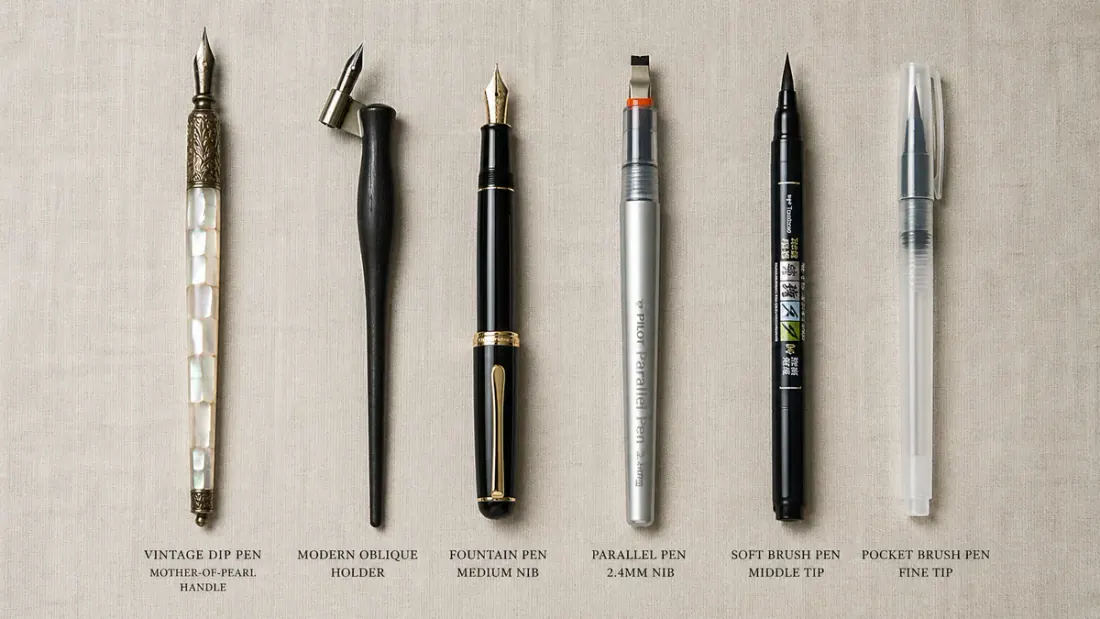
This guide examines every major pen type used by professional calligraphers: traditional dip pens with pointed and broad-edge nibs, fountain pens, Pilot Parallel pens, brush pens, felt-tip markers, and digital styluses. You'll learn which pens work best for Copperplate, Gothic, Italic, modern calligraphy, and hand lettering. We'll cover specific brand recommendations, realistic price ranges, honest pros and cons, and maintenance requirements based on actual use—not manufacturer claims.
Whether you're selecting your first pen or expanding your toolkit, this guide provides expert insights grounded in professional practice. The International Association of Master Penmen, Engrossers and Teachers of Handwriting (IAMPETH) emphasizes that mastering different pen types builds versatility and deeper understanding of calligraphic principles. Pair your pen selection with appropriate papers and inks for optimal results, explore our complete tools guide, and see our beginner's guide for foundational techniques. Try our cursive generator to visualize different styles before choosing your pen.
Affiliate Disclosure: This page contains affiliate links. If you purchase through one, we may earn a commission at no additional cost to you. Product selections are based on the details recorded in our product registry: stated features, listed price, category, level, pros, cons, and intended use. We do not claim hands-on testing unless a page says so explicitly.
Quick Decision: Which Calligraphy Pen Should You Buy First?
Start with the script you want to write, not the biggest kit. One correct first pen beats a drawer full of near-misses.
Selection Methodology
These recommendations prioritize beginner fit, script compatibility, replacement cost, availability, maintenance burden, and whether the tool teaches transferable technique. Prices in this guide are approximate street ranges and can change; check current seller pricing before buying.
What Are the Different Types of Calligraphy Pens?
Calligraphy pens fall into six categories, each offering distinct advantages for specific writing styles and skill levels.
Dip Pens
Traditional pens requiring ink dipping, offering maximum control and line variation. Best for traditional scripts such as Copperplate, Spencerian, Gothic, and Italic. Typical starter cost: $15–50 for holder plus nibs.
Fountain Pens
Self-contained ink reservoir pens with consistent flow and portability. Best for practice, travel, modern calligraphy, and everyday use. Typical range: $20–150.
Parallel Pens
Pilot's parallel-plate nib system creates sharp, crisp letterforms with almost no setup. Best for Gothic, Italic, Uncial, and modern block lettering. Typical range: $10–15 per pen.
Brush Pens
Flexible brush tips for modern calligraphy and expressive hand lettering. Best for bouncy scripts, travel practice, and quick projects. Typical range: $2–8 per pen.
Felt-Tip Markers
Rigid tips in various widths for consistent, bold calligraphic strokes. Best for posters, signs, faux calligraphy, and casual practice. Typical range: $3–10 per marker.
Digital Pens/Styluses
iPad and tablet styluses support digital calligraphy with pressure sensitivity. Best for digital art, iPad calligraphy, and commercial design. Typical range: $30–130 before the tablet.
Each pen type serves different purposes in a calligrapher's toolkit. Dip pens remain the professional standard for formal work, while brush pens dominate modern Instagram-style lettering. Fountain pens and Parallel pens bridge the gap, offering convenience without sacrificing too much quality. Before diving into specific pens, explore our styles guide to understand which scripts interest you most, and try our practice sheet generator to create custom practice materials for any pen type.
What Are Dip Pens and How Do They Work?
Dip pens consist of a pen holder and removable nib that must be repeatedly dipped in ink. They offer maximum line variation, precise control, and unlimited ink color options.
Here's what nobody tells beginners: dip pens are harder to use, but they're worth the effort. The thick-thin line variation you see in traditional calligraphy? That only comes from dip pens. Fountain pens and brush pens approximate it, but dip pens deliver the real thing.
How Dip Pens Actually Work
Dip pens hold ink through surface tension and capillary action between the nib tines—the two split points at the tip. When you apply pressure, the tines spread apart, releasing more ink for thick downstrokes. Lighten the pressure, and the tines close for thin upstrokes. This pressure modulation is what creates the characteristic thick-thin contrast of traditional calligraphy. Unlike fountain pens, dip pens require re-dipping every few letters or words, depending on nib size and ink viscosity. This interrupts your flow, but it also teaches you to be intentional with every stroke.
Edward Johnston, who revived formal calligraphy in the early 20th century, insisted that students master dip pens before moving to any modern alternatives. His reasoning: dip pens force you to understand pressure control, ink flow, and letter structure at a fundamental level. These skills transfer to every other pen type you'll ever use.
Why Professional Calligraphers Still Use Dip Pens
Maximum line variation tops the list. The contrast between hairline upstrokes and swelled downstrokes simply can't be matched by modern pens. You also get unlimited ink choices—any calligraphy ink, gouache, or watercolor works with dip pens. Fountain pens limit you to fountain pen-safe inks. Brush pens lock you into whatever ink comes in the pen.
Direct ink-to-paper contact gives you precise control. There's no cushioning or spring between your hand and the writing surface. This matters for formal invitations, certificates, and artwork where every hairline needs to be exactly right. The Society of Scribes and Illuminators, a respected organization founded in 1921, still treats dip pens as the standard for professional-quality work, particularly in Copperplate and Spencerian scripts.
One holder works with dozens of nib types. Buy a $15 holder once, then experiment with different nibs at $0.50-$1.50 each. This versatility beats buying multiple specialized pens. Easy cleaning helps too—a quick water rinse between colors or at the end of your session, and you're done.
The Honest Downsides
Frequent re-dipping interrupts your rhythm. Every few words, you stop to load more ink. Some calligraphers find this meditative; beginners usually find it annoying. You need a stable workspace with an ink well within reach, which rules out travel or casual lettering on the couch.
The learning curve is real. Pressure control takes practice. Too much pressure and the nib catches on the paper. Too little and you get weak, spidery lines. Expect to spend 20-30 hours of practice before dip pens feel natural. Ink drips, splatters, and occasional spills come with the territory. Keep paper towels handy.
Nibs wear out and need replacement. Pointed nibs last 6-20 hours depending on paper roughness and pressure. Broad-edge nibs last longer—30-50 hours typically. Setup time adds friction too. Before each session, you prepare ink, test flow, and sometimes remove the manufacturer's oil coating from new nibs.
Despite these challenges, dip pens remain the preferred choice for professional calligraphers creating formal invitations, certificates, and fine art pieces. There's no faster way to internalize traditional script structure or to feel what pressure and ink flow really do. If you're serious about calligraphy, invest time learning dip pen technique early. The skills transfer to all other pen types and give you a solid foundation. For detailed guidance on technique, see our techniques guide and structured practice methods.
Essential Dip Pen Setup
Traditional pointed pen essentials for Copperplate and Spencerian
We may earn a commission when you buy through these links. See all recommendations →
Pointed Pen Nibs: Which Nib Should You Use?
Pointed pen nibs feature a sharp, flexible tip that creates line variation through pressure. They're the right tool for Copperplate, Spencerian, and modern pointed pen calligraphy.
Walk into any calligraphy supply store, and you'll face dozens of nib options. Most look identical to beginners. The differences matter though. Some nibs are forgiving and durable—perfect for learning. Others are delicate and finicky—frustrating for beginners but prized by experts for their expressive potential.
$0.50-1.00/nib
Pack of 10: $8-12
This is the industry standard for good reason. Originally designed for manga artists (who need to draw for hours without hand fatigue), the Nikko G offers medium flexibility, exceptional durability, and forgiving feedback. It produces consistent hairlines and swells without excessive pressure.
Nikko G is an option for beginner pointed-pen practice. It can still snag or be damaged by excess pressure. Use a compatible holder and light strokes; no retention-rate comparison with other nibs is established here.
Best For:
Copperplate, Spencerian, modern pointed pen, beginners
Characteristics:
Medium flex, durable, smooth, forgiving
Replaceable pointed nibTest your ink and paper
Compared with Zebra G: check the linked variants, task fit and evidence limits.
$0.50-1.00/nib
Pack of 10: $8-12
Published comparisons describe Zebra G as more flexible than Nikko G, with some reports of scratchiness. See the chrome Zebra G review and Nikko G review for the sources and setup caveats; neither has a measured lifespan here.
The Nikko vs. Zebra debate is personal preference—like choosing between two excellent coffee beans. Try both if you can, but don't stress about the decision. Either will serve you well for your first 100 hours of practice.
Compared with Nikko G: check the linked variants, task fit and evidence limits.
The linked offer is one Hunt 101 nib. John Neal Books recommends it for larger pointed-pen writing, but published descriptions of its pressure response differ. We have no measured lifespan comparison against G nibs.
Read the Hunt 101 review for the attributed observations and a documented holder combination. Keep the paper and ink unchanged when trying a new point.
Best For:
Traditional Copperplate, Spencerian, fine flourishing
Characteristics:
Sharp pointed nib; pressure response depends on the setup
Individual nibBronze-finish steelRequires smooth paper
Compared with Gillott 303: check the linked variants, task fit and evidence limits.
Check on Amazon/nib
Pack of 5: $6-8
A European-made nib favored for ultra-fine, delicate work. The Brause EF66 produces extremely thin hairlines and requires very light pressure. Excellent for small-scale calligraphy, miniature writing, and intricate flourishes. Often called the "rose pointed nib" for its shape.
Use this nib for envelope addressing where you need small, elegant script, or for adding fine details and flourishes to larger pieces. Not recommended for beginners—the ultra-fine point catches easily on paper texture and requires a very light touch.
Gillott 303 Nib
Classic British NibJohn Neal Books describes fine hairlines and smaller Copperplate as reasons to try the 303, with a warning about catching on upstrokes. Use a confirmed holder and a light touch.
The Gillott 303 review links to a verified non-affiliate retailer. There is no matching Amazon offer in our verified records.
Compared with Hunt 101: check the linked variants, task fit and evidence limits.
Practical Nib Recommendation
Start with the Nikko G or Zebra G for your first 50-100 hours of practice. These nibs are forgiving, affordable, and teach proper technique without frustration. Once you've mastered pressure control and consistent letterforms, experiment with Hunt 101 or Brause EF66 for specific artistic effects. Buy nibs in bulk (10+ at a time) to always have fresh nibs available—and don't feel guilty about replacing them. Worn nibs teach bad habits.
For nib technique and pressure control exercises, see our techniques guide. Generate custom practice sheets specifically designed for pointed pen practice, and track your progress with our 30-day practice calendar.
Broad-Edge Nibs: What Are They Used For?
Broad-edge nibs (also called flat nibs or chisel-point nibs) have a flat, wide writing edge that creates thick and thin lines based on stroke direction rather than pressure.
If pointed pens are about pressure and flexibility, broad-edge nibs are about geometry and precision. Line variation comes from the nib's orientation, not from flexing the metal. Vertical strokes are thick (full nib width), horizontal strokes are thin (nib edge), and diagonal strokes are medium width.
How Broad-Edge Nibs Work
Unlike pointed nibs that flex under pressure, broad-edge nibs maintain a consistent width. The pen angle—typically 30°, 45°, or 90° depending on the script—determines the overall character of your writing. Gothic scripts use a 30-40° angle for dramatic, angular letters. Italic scripts use a 45° angle for balanced elegance. Uncial scripts use a nearly flat angle (0-20°) for rounded, Celtic-style letters. Broad-edge calligraphy emphasizes geometric precision and consistent pen angle rather than pressure modulation.
Hermann Zapf, the renowned German typeface designer and calligrapher, created some of the 20th century's most elegant fonts using broad-edge pens. His work demonstrates how broad-edge nibs can produce everything from formal, traditional scripts to experimental, modern letterforms. The tool doesn't limit creativity—it provides a framework for exploring letterform design.
Popular Broad-Edge Nib Brands
$3-5 per nib
Pack of 5: $12-18
The most popular broad-edge nibs in North America, and for good reason—they're affordable, readily available, and compatible with standard pen holders. Available in sizes C-0 (largest, 6mm) through C-6 (smallest, 0.75mm). The C-2 (3mm) and C-3 (2.5mm) are excellent starting sizes for most scripts.
These nibs have been around since the 1960s and remain largely unchanged because the design works. They're not the highest quality—Mitchell and Brause nibs feel smoother—but they're consistent and dependable. Most calligraphy classes in the U.S. use Speedball nibs as the standard teaching tool.
Best for Gothic, Italic, Uncial
British-made nibs favored by traditionalists. Available in sizes 0 (largest) through 6 (smallest), plus larger poster nibs. Known for smooth writing, consistent ink flow, and durability. Slightly more expensive than Speedball but highly regarded for quality.
The Mitchell company has manufactured nibs since 1822, and many professional calligraphers swear by them for formal work. The nibs feel smoother on paper and hold more ink than Speedball nibs, which means less frequent dipping. If you're creating finished pieces for clients, the extra cost pays for itself in time saved and better results.
Premium qualitySmooth ink flow
German precision nibs with exceptional sharpness. Available in sizes 0.5mm through 5mm. Creates extremely crisp letterforms with sharp edges. Popular among professional calligraphers for formal certificates and invitations.
These are the sharpest broad-edge nibs you can buy. The edges are so precise they almost cut the paper—which sounds bad but actually produces incredibly clean, crisp letters with no fuzzy edges. Use them on smooth paper only. On textured paper, they'll snag and splatter.
Professional qualityUltra-crisp edges
Tape Nibs & Automatic Pens
Extra-wide nibs for large-scale lettering and posters. Available in widths from 6mm to 50mm. These specialized tools create dramatic, bold letterforms for signage, banners, and decorative work. Require more ink loading and careful technique.
Most calligraphers will never need nibs this large, but they're useful for specific applications like wedding signage, poster lettering, or large certificates. The technique changes at this scale—you're almost painting rather than writing. Fun for special projects, not for everyday calligraphy.
Price: $8-25 per nibLarge format workSpecialty tool
Broad-Edge Nib Size Guide
Choosing the right nib size affects both your letterforms and your learning experience. Larger nibs show errors more clearly, which makes them better for learning. Smaller nibs are better for finished work and envelope addressing.
| Size | Width | Best For | Example Uses |
|---|
| C-6 / Mitchell 6 | 0.75-1mm | Small work, miniatures | Tiny illuminated letters, detailed work |
| C-4 / Mitchell 4 | 1.5mm | Small scripts | Place cards, small certificates |
| C-3 / Mitchell 3 | 2-2.5mm | Practice, envelopes | Most practice, envelope addressing |
| C-2 / Mitchell 2 | 3mm | All-purpose | Beginner practice, general calligraphy |
| C-1 / Mitchell 1 | 3.5-4mm | Certificates, titles | Formal documents, invitations |
| C-0 / Mitchell 0 | 5-6mm | Display work | Posters, large certificates, banners |
Broad-Edge Nib Recommendation
Start with a Speedball C-2 (3mm) nib for learning Gothic, Italic, and Uncial scripts. This size produces clear letterforms at a comfortable scale for practice without straining your eyes. Add a C-1 (larger) for display work and C-3 (smaller) for envelope addressing once you're comfortable. Broad-edge nibs last longer than pointed nibs—typically 30-50 hours of use when properly maintained.
Explore different calligraphy styles that use broad-edge nibs, from Gothic to Italic to Uncial. Our complete alphabet guides show you exactly how to form each letter with proper pen angles.
Pen Holders: Straight vs. Oblique Holders
Pen holders secure your nibs and affect writing comfort, control, and letter angle. Choosing between straight and oblique holders depends on your dominant hand and intended calligraphy style.
Many beginners underestimate how much the holder matters. A poorly balanced holder causes hand fatigue. An incorrectly angled holder makes proper letter slant impossible. The right holder feels natural in your hand and positions the nib exactly where it needs to be.
Straight Holders
Simple wooden or plastic holders that align the nib directly with the barrel. Universal holders fit most nibs and work for broad-edge calligraphy, casual pointed pen work, and left-handed calligraphers.
Straight holders are versatile. One holder works for both pointed and broad-edge nibs (though you might want separate holders to avoid constantly swapping nibs). They're also the only practical option for left-handed calligraphers, who need to position the nib differently than right-handed writers.
Best For:
- Broad-edge calligraphy (all styles)
- Modern pointed pen calligraphy
- Left-handed writers
- Casual practice
Recommended Straight Holders:
- Speedball Standard Holder - $3-5, universal fit
- Tachikawa T-36 Holder - $8-12, comfortable grip
- General's Cork Grip Holder - $5-8, ergonomic
Oblique Holders
Specialized holders with an angled metal flange that positions the nib at approximately 55° for proper letter slant in Copperplate and Spencerian scripts. The standard tool for traditional pointed pen styles.
Oblique holders solve a geometric problem: human hands naturally write at about a 90° angle to the paper, but Copperplate letters need a 55° slant. The oblique flange offsets the nib so you can hold your hand naturally while the nib writes at the correct angle. Simple solution, huge impact.
Best For:
- Copperplate calligraphy
- Spencerian script
- Traditional pointed pen work
- Right-handed calligraphers
Recommended Oblique Holders:
- Speedball Oblique Holder - documented fit for #22B, #56, #99, #100, #101 and #103; the linked set includes six nibs, not a verified adjustable flange
- Hourglass Oblique - $35-75, handcrafted, premium
- John Neal Oblique - $25-45, traditional design
Left-Handed Calligraphers
Left-handed writers typically achieve better results with straight holders or left-handed oblique holders (which angle the opposite direction). The traditional right-handed oblique positions the nib awkwardly for lefties. Many successful left-handed calligraphers use straight holders exclusively and adjust their paper angle instead. Underwriters (hand below the writing line) and overwriters (hand above the writing line) need different approaches. See our left-handed calligraphy guide for detailed techniques and holder recommendations.
What Makes a Good Pen Holder?
Comfortable grip matters most. Adequate thickness (8-12mm diameter) prevents cramping during extended writing sessions. Too thin and you'll squeeze; too thick and you'll strain. The holder should feel natural when you grip it lightly.
Secure nib fit prevents frustration. Universal holders work for most nibs, but some nibs need specific flange sizes. A loose nib wobbles and catches on paper. An overly tight fit makes nib changes difficult. The nib should slide in smoothly and stay firmly in place.
Balanced weight affects control. Holders shouldn't be too heavy (under 20g) for extended writing. Some weight is good—it helps stabilize your strokes. But excess weight causes fatigue. Proper length (140-180mm total) provides comfortable control without feeling unwieldy.
Pen Holder Recommendation
Right-handed pointed pen beginners: Start with a Speedball Oblique Holder (Check on Amazon) for Copperplate practice. Once comfortable, consider upgrading to a handcrafted oblique ($40-80) for better balance and aesthetics. The upgrade isn't necessary, but many calligraphers find that a well-balanced premium holder reduces hand fatigue and improves control.
Broad-edge calligraphers and left-handed writers: A simple Speedball Standard Holder ($3-5) or Tachikawa T-36 ($8-12) serves all your needs. Invest in multiple holders to keep different nib types ready—switching between a pointed nib and broad-edge nib mid-project becomes much easier when you don't have to swap nibs constantly.
For specific package checks, read the Speedball set review and Manuscript Deluxe review. Similar names can refer to different sets.
Fountain Pens for Calligraphy: Are They Worth It?
Calligraphy fountain pens combine the convenience of built-in ink reservoirs with the line variation of broad-edge nibs. They're excellent for practice, travel, and everyday calligraphic writing.
Fountain pens split the calligraphy community. Traditionalists dismiss them as training wheels. Pragmatists love them for uninterrupted practice sessions. The truth is somewhere in between—fountain pens serve specific purposes well, but they're not replacements for dip pens.
I use fountain pens for about 60% of my practice time. They let me focus on letter shapes and rhythm without the constant interruption of dipping. For finished pieces and client work, I switch to dip pens for maximum control and line variation. Different tools for different purposes.
Advantages Over Dip Pens
Fountain pens eliminate the need for constant re-dipping, allowing uninterrupted writing flow. They're portable, less messy, require no external ink well, and maintain consistent ink flow. Perfect for practicing drills, writing letters, journaling, and on-the-go calligraphy. However, they typically offer less dramatic line variation than dip pens and limit your ink choices to fountain pen-safe inks.
Best Fountain Pens for Calligraphy
The linked Black Classic variant has a 1.0 mm stub, brass barrel and stainless steel clip. Confirm compatible filling accessories; converter inclusion is not established. Read the Metropolitan review before ordering ink or refills.
1.0mm stub availableCartridge/converterBeginner-friendly
Compared with LAMY joy: check the linked variants, task fit and evidence limits.
This offer is one 1.1 mm joy, not all the widths in the product family. Its long resin body and triangular grip suit a dedicated practice format if the shape works for your hand. The joy review covers its cartridge system and separately sold Z28 converter.
Linked 1.1 mm variantSwappable nibsTriangular grip
Compared with Pilot Metropolitan: check the linked variants, task fit and evidence limits.
Taiwanese fountain pen with large ink capacity (1.5ml) and available stub nibs (1.1mm). Piston-fill mechanism eliminates cartridges for maximum ink efficiency. Excellent build quality, smooth writing, and demonstration barrel lets you see ink level.
1.1mm stub availablePiston fillerLarge capacity
Complete starter set with 2 pens and 6 interchangeable nibs (Fine, Medium, Broad, 2B, 3B, 4B). Includes ink cartridges and instructions. Good introduction to fountain pen calligraphy at an accessible price point. Quality is adequate for learning and practice.
6 nibs includedComplete starter setBudget-friendly
Fountain Pen Recommendation
For practice and everyday calligraphy, the Lamy Joy (1.5mm nib) offers the best balance of quality, calligraphic line variation, and user-friendliness at Check on Amazon. For budget-conscious beginners, the Pilot Metropolitan with 1.0mm stub (Check on Amazon) provides excellent performance. Serious enthusiasts should consider TWSBI Eco with 1.1mm stub for maximum ink capacity and smooth writing experience.
Best Calligraphy Fountain Pens
Convenient fountain pens for practice and daily calligraphy
We may earn a commission when you buy through these links. See all recommendations →
The four-width Pilot Parallel review explains the linked bundle, refill checks, and when one pen is enough.
Pilot Parallel Pens: The Modern Calligraphy Innovation
The Pilot Parallel Pen revolutionized calligraphy with its unique parallel-plate nib design that produces ultra-sharp, crisp letterforms impossible to achieve with traditional broad-edge nibs.
When Pilot released the Parallel Pen in the early 2000s, traditional calligraphers were skeptical. The design seemed too modern, too convenient, too... plastic. Twenty years later, these pens appear in workshops at IAMPETH conferences alongside $300 vintage Mitchell nibs. They earned that respect.
Two parallel metal plates form the nib's ink channel. This is an option for broad-edge lettering without dipping between strokes, not proof of cleaner results than a dip pen.
How Parallel Pens Work
Unlike traditional broad-edge nibs with a single flat edge, Parallel Pens use two parallel metal plates that create an ultra-thin gap for ink flow. This design produces razor-sharp edges, consistent line width, and smooth writing with minimal pressure. The pens can also be touched together nib-to-nib to transfer and mix ink colors, creating unique gradient effects impossible with other tools.
Pilot Parallel Pen Sizes
All four sizes run roughly $10-12 individually and share the same dual-plate design; only the writing edge changes. The 1.5mm is the small-work pen, suited to envelope addressing and detailed scripts where you need a tight stroke. The 2.4mm is the most popular size and the one most teachers reach for first: it's the right scale for learning Italic and Gothic without exaggerating your mistakes. The 3.8mm is the easiest size for beginners to read back, which is why it shows up in so many practice sheet recommendations - large enough to see what your pen angle is actually doing, but still usable on standard paper. The 6.0mm is the display tool, made for posters, banners, and dramatic single-word pieces.
Why Parallel Pens Are So Popular
Parallel Pens dominate beginner recommendations for good reasons. The combination of ultra-crisp edges, consistent ink flow, forgiving technique requirements, and color-mixing capability makes them unmatched for learning. They work immediately with included cartridges (no setup), produce sharper letterforms than traditional nibs, and cost $10-12 per pen.
The color-mixing feature turns practice sessions into creative exploration. Touch two Parallel Pen nibs together and watch ink transfer from one to the other, creating gradients impossible with any other tool. This single feature converted more casual doodlers into serious calligraphers than any other innovation in recent decades.
Pilot Parallel Pen Set Options
Buy all four sizes (1.5mm, 2.4mm, 3.8mm, 6.0mm) as a set for $50.42. This gives you maximum versatility for all project sizes and allows color mixing between pens. Most serious calligraphers own the complete set.
4 pens includedAll sizes12 cartridgesBest value
Parallel Pen Recommendation
Start with the 2.4mm or 3.8mm Parallel Pen as your first calligraphy tool. These sizes produce clearly visible letterforms at a comfortable scale for learning pen angle, letter proportions, and consistent spacing. The 2.4mm is ideal if you plan to address envelopes or create small certificates. The 3.8mm is better for large practice sheets and display work. Once comfortable, add the other sizes to your collection.
Compare the Fudenosuke black two-pack with the Pentel Fude Touch color set. The reviews explain tip and ink differences without claiming comparative hands-on testing.
Brush Pens: Best Tools for Modern Calligraphy
Brush pens combine flexible brush-like tips with self-contained ink, making them the most popular choice for modern calligraphy, hand lettering, and bouncy scripts.
Instagram changed everything for brush pens. Around 2015, as modern calligraphy exploded across social media, brush pens became the default tool. They photograph beautifully, work on any surface, travel easily, and produce those dramatic thick-thin strokes that drive engagement.
Brush pens offer a portable way to practise pressure contrast without a separate ink bottle. They are a different tool from broad-edge or pointed dip pens, not a lesser form of calligraphy.
Top Brush Pens for Calligraphy
The most popular brush pen for modern calligraphy beginners. Available in two tip firmness options: Hard Tip (black barrel) for more control and consistent lines, or Soft Tip (colored barrel) for maximum flexibility and dramatic line variation. Water-based, non-refillable ink in black.
The two tip options serve different temperaments. The Hard Tip (black barrel) flexes less, which gives you more control on small lettering and makes it the safer first pen for anyone still learning to modulate pressure. The Soft Tip (colored barrel) flexes much more readily, producing the dramatic thick-thin contrast that defines bouncy modern calligraphy. Most calligraphers end up owning both and reaching for whichever matches the day's project.
Water-basedPrecise tip3-6 month lifespanPerfect for practice
Compared with Pentel Fude Touch: check the linked variants, task fit and evidence limits.
The linked Primary ten-piece set has brush and fine tips with water-based dye ink. Choose it for color blending rather than waterproof outlines. The Dual Brush review distinguishes this pack from the whole color range and explains the manufacturer's UV-fading warning.
Primary ten-piece setDual tipsBlendableProfessional quality
Compared with Sakura Pigma Professional: check the linked variants, task fit and evidence limits.
Affordable brush pen with flexible felt brush tip. Available in multiple colors with water-based ink. Good for beginners experimenting with brush lettering without major investment. Less durable than Tombow but excellent value for practice.
AffordableMultiple colorsWater-basedGood for practice
Compared with Tombow Fudenosuke: check the linked variants, task fit and evidence limits.
Japanese brush pen with ultra-soft, flexible tip for maximum expression. Water-based ink in beautiful muted colors. Refillable design extends lifespan. Popular among professional hand letterers and calligraphers who want premium quality and unique color options.
Ultra-soft tipRefillablePremium colorsProfessional quality
The verified offer is a black Professional Brush three-pack. Confirm the individual tip sizes with the seller; it is not documented here as one medium pen or a sepia assortment. The Sakura review covers pigment-ink uses, storage and paper trials.
Archival qualityWaterproofBlack three-packFlexible brush nibs
Compared with Tombow Dual Brush: check the linked variants, task fit and evidence limits.
Brush Pen vs. Traditional Calligraphy
Brush pens offer instant use and portability without setup or cleanup. They're ideal for modern calligraphy, travel, and quick projects. Traditional dip pens provide maximum line variation and unlimited ink options but require stable workspaces and more technique. Most calligraphers eventually own both—brush pens for convenience, dip pens for finished pieces.
Brush Pen Recommendation
Start with the Tombow Fudenosuke Hard Tip (black barrel) for Check on Amazon. This gives you excellent control while learning pressure modulation and modern calligraphy techniques. Once comfortable, add the Soft Tip for more dramatic effects. For colorful projects, invest in a small Tombow Dual Brush Pen set (10-20 colors, $25-50). Brush pens are perfect for travel, journaling, and daily practice challenges.
Top Brush Pens for Modern Calligraphy
Compare small-tip pens for compact letters with a refillable bristle brush for expressive strokes.
We may earn a commission when you buy through these links. See all recommendations →
Felt-Tip Calligraphy Markers
Felt-tip calligraphy markers feature rigid chisel or wedge tips that create consistent calligraphic strokes without flexibility or pressure variation.
Felt-tip markers aren't technically calligraphy pens—they lack the pressure sensitivity that defines true calligraphic writing. But they're incredibly useful for faux calligraphy, signage, posters, practice, and projects where durability matters more than artistic subtlety.
Crayola Calligraphy Markers
Price: $5-8 for pack of 8
Budget-friendly markers with wedge tips. Perfect for kids, crafts, and experimenting. Not archival quality but excellent for casual use.
Sharpie Chisel Tip Markers
Price: $8-12 for pack of 12
Permanent markers with chisel tips. Good for signage, posters, and bold lettering. Available in many colors.
Zig Calligraphy Markers
Price: $12-18 for set
Quality felt-tip markers specifically designed for calligraphy. Available in various colors and tip widths (2mm, 3.5mm, 5mm).
Manuscript CalliCreative Markers
Price: $10-15 for set
Dual-tip markers with broad chisel and fine bullet tips. Water-based ink, good for practice and colorful projects.
Felt-tip markers work best for faux calligraphy (monoline lettering with manual thick strokes added), posters, signs, and projects where precision isn't critical. They don't provide true calligraphic line variation but offer convenience and bold, consistent results.
Digital Pens & Styluses for iPad Calligraphy
Digital styluses paired with iPad calligraphy apps (Procreate, Adobe Fresco, Affinity Designer) enable professional-quality digital calligraphy with pressure sensitivity, infinite undo, and easy corrections.
Digital calligraphy exploded around 2015 when the iPad Pro and Apple Pencil launched. Suddenly, calligraphers could work with authentic pressure sensitivity, tilt detection, and near-zero lag on a portable device. The combination transformed professional calligraphy work—most wedding invitations today start digitally, even if they're printed on letterpress.
Top Digital Calligraphy Tools
Apple Pencil (2nd Gen)
Best for iPadIndustry standard for iPad calligraphy. Features pressure sensitivity, tilt detection, palm rejection, and pixel-perfect precision. Pairs instantly with compatible iPads and charges magnetically. The default choice for serious digital calligraphy work.
Pressure sensitiveTilt detectionMagnetic charging
Wacom Intuos Pen Tablet
Desktop SolutionGraphics tablet for desktop/laptop calligraphy. Pressure-sensitive pen with 4,096 levels of pressure. Works with Photoshop, Illustrator, and desktop calligraphy software. Better value than iPad setup for desktop-only use.
4,096 pressure levelsDesktop useProfessional quality
Generic iPad Styluses
Budget OptionThird-party iPad styluses (Logitech Crayon, Adonit Note+) offer basic pressure sensitivity at lower prices. Good for casual digital calligraphy and experimentation, but lack the precision and responsiveness of Apple Pencil.
AffordableBasic featuresGood for beginners
Benefits of Digital Calligraphy
Digital tools offer infinite undo/redo, easy corrections, unlimited colors, commercial-ready output, layers and effects, and no physical storage needs. You can experiment fearlessly, adjust letterforms instantly, access millions of colors, export high-resolution files, and store thousands of pieces digitally.
Digital calligraphy is increasingly popular for commercial work (logos, branding, social media), wedding stationery (easy revisions), and teaching (screen recording tutorials). However, many calligraphers emphasize the importance of mastering traditional pen-and-ink techniques before transitioning to digital tools.
Digital Calligraphy Recommendation
For serious digital calligraphy, invest in an iPad (9th gen or newer, $329+) with Apple Pencil (2nd gen, $130) and Procreate app ($13). This $470+ investment provides professional-quality tools with pressure sensitivity, portability, and access to the largest calligraphy community. For desktop-only work, a Wacom Intuos tablet ($80-200) with Adobe Illustrator or Affinity Designer offers excellent value.
Complete Calligraphy Pen Comparison
| Pen Type | Price Range | Skill Level | Line Variation | Portability | Best For |
|---|
| Dip Pens (Pointed) | $15-50 | Intermediate-Advanced | 5 / 5 | 1 / 5 | Copperplate, Spencerian, formal scripts |
| Dip Pens (Broad-Edge) | $15-40 | Beginner-Intermediate | 4 / 5 | 1 / 5 | Gothic, Italic, Uncial, traditional scripts |
| Fountain Pens | $20-150 | Beginner-Friendly | 3 / 5 | 5 / 5 | Practice, travel, modern calligraphy |
| Parallel Pens | $10-15 | Best for Beginners | 4 / 5 | 4 / 5 | All broad-edge styles, practice, display work |
| Brush Pens | $3-8 | Best for Beginners | 3 / 5 | 5 / 5 | Modern calligraphy, hand lettering, travel |
| Felt-Tip Markers | $5-15 | Beginner | 2 / 5 | 5 / 5 | Faux calligraphy, posters, signs, crafts |
| Digital Styluses | $30-130 | Intermediate | 5 / 5 | 4 / 5 | Digital art, commercial work, teaching |
Which Pen Should I Use for Different Calligraphy Styles?
Different calligraphy styles require specific pen types to achieve authentic results. Match your pen to your intended script for best outcomes.
One of the most common beginner mistakes is choosing the wrong pen for a specific style. You can't write authentic Copperplate with a Parallel Pen, and Gothic lettering looks awkward with a pointed nib. Understanding these relationships saves frustration and wasted money.
Copperplate / Spencerian (Pointed Pen Scripts)
Required: Dip pen with Walfront Oblique Dip Pen Holder and pointed nib (Nikko G, Zebra G, Hunt 101)
Why: These scripts depend on pressure-based line variation only achievable with flexible pointed nibs. The oblique holder positions the nib at the correct angle for proper letter slant.
Alternative: None—brush pens and fountain pens cannot replicate authentic Copperplate.
Gothic / Blackletter (Medieval Scripts)
Best: Pilot Parallel Pen (2.4-3.8mm) or broad-edge dip pen (Mitchell 2-3, Speedball C-2)
Why: Gothic calligraphy requires sharp, angular letterforms best achieved with parallel pens or quality broad-edge nibs at 30-45° pen angle.
Alternative: Lamy Joy fountain pen (1.5mm nib) for practice
Italic (Chancery Cursive)
Best: Pilot Parallel Pen (1.5-2.4mm), Lamy Joy (1.1-1.5mm), or broad-edge dip pen
Why: Italic features graceful, moderately-angled letterforms requiring medium-width broad-edge nibs at 45° pen angle.
Alternative: TWSBI Eco with 1.1mm stub nib for extended practice
Modern Calligraphy / Hand Lettering
Best: Tombow Fudenosuke brush pen or pointed dip pen (Nikko G with straight holder)
Why: Modern calligraphy emphasizes expressive, bouncy letterforms with varied baseline and thick-thin contrast. Brush pens offer immediate results; dip pens provide more control.
Alternative: Tombow Dual Brush Pens for colorful projects
Uncial (Celtic/Irish Scripts)
Best: Pilot Parallel Pen (2.4-3.8mm) or broad-edge dip pen at flat pen angle
Why: Uncial requires broad-edge nibs held at 0-20° pen angle for characteristic rounded letterforms.
Alternative: Mitchell roundhand nibs (2-3) with straight holder
Foundational / Carolingian
Best: Broad-edge dip pen (Mitchell 2-4, Speedball C-2 to C-4) at 30° pen angle
Why: These classical scripts demand precise pen angle consistency and clean letterforms best achieved with traditional broad-edge nibs.
Alternative: Pilot Parallel Pen (2.4mm) for learning basics
How Do I Care for My Calligraphy Pens?
Proper maintenance extends the life of your pens, ensures consistent performance, and prevents frustrating ink flow problems.
The calligraphy community learned these maintenance practices through expensive mistakes. A $2 nib rusts from improper storage. A $100 fountain pen clogs from wrong ink. A brush pen tip frays from heavy-handed pressure. Following basic care protocols prevents all these problems.
Dip Pen Nib Care
1. Remove Manufacturing Coating
New nibs have protective oil coating. Remove by briefly passing nib through flame (1-2 seconds), dipping in rubbing alcohol for 30 seconds, or washing with dish soap. This ensures proper ink adhesion and prevents beading.
2. Clean After Each Session
Rinse nibs in water immediately after use. Dried ink clogs nib tines and prevents proper ink flow. For stubborn ink, use mild soap and soft brush.
3. Dry Completely
Pat nibs dry with lint-free cloth or paper towel. Store in dry location. Moisture causes rust which destroys nibs permanently.
4. Replace When Necessary
Replace nibs showing rough edges, lost flexibility, consistent catching on paper, or rust spots. Pointed nibs last 6-20 hours; broad-edge nibs last 30-50 hours.
Fountain Pen & Parallel Pen Care
Flush regularly with water every 4-6 weeks or when changing ink colors. Fill and empty multiple times until water runs clear. Use proper inks—only fountain pen-safe inks. Never use India ink or acrylic inks which permanently clog feed systems.
Store cap-up or horizontally to prevent ink pooling or leaking. Always cap pens when not in use. Don't over-tighten caps and converters—hand-tighten only to avoid cracking plastic components.
Brush Pen Care
Cap immediately after use—brush tips dry out quickly. Store horizontally to prevent ink pooling and maintain even distribution. Use light pressure—excessive pressure frays and flattens tips.
Brush pens are consumables lasting 3-12 months depending on usage. Replace when tips fray, split, or lose spring.
Should beginners buy a brush pen, dip pen, or fountain pen?
Most beginners should start with a brush pen for modern lettering or a fountain-style Parallel pen for Italic and Gothic. Choose a dip pen first only if you specifically want traditional pointed-pen scripts and can tolerate a slower first month.
The wrong first pen kills enthusiasm faster than anything else. Beginners who start with flexible pointed nibs and Copperplate usually quit within two weeks—the learning curve is too steep. Those who start with Parallel Pens typically stick with calligraphy for months or years. Tool choice matters enormously for success, so match the pen to the script before you buy a larger beginner starter kit.
Decision Framework
Absolute Beginner (First Pen)
Recommendation: Pilot Parallel Pen (2.4mm or 3.8mm) OR Tombow Fudenosuke brush pen
Rationale: These pens provide immediate success, require minimal technique, work straight out of the package, and cost $10-15. Success builds confidence and motivation to continue learning.
Total Cost: $10-15 (pen) + $10 (practice paper) = $20-25 to start
Beginner Learning Traditional Scripts
Recommendation: Speedball oblique holder + Nikko G nibs (pointed pen) OR Mitchell/Speedball broad-edge nibs + straight holder
Rationale: Traditional tools teach proper technique from the start. Once you master dip pens, all other tools feel easier. Invest in learning correctly rather than developing bad habits with easier tools.
Total Cost: $15-25 (holder) + $8-12 (nibs) + $12-15 (ink) + $15 (paper) = $50-65 complete setup
Intermediate Expanding Skills
Recommendation: Add variety—if you started with brush pens, add dip pens; if you started with dip pens, add Parallel Pens or fountain pens for practice convenience
Rationale: Diversify your tool set to understand how different pens affect letterforms, explore new styles, and discover your preferences and strengths.
Total Cost: $30-60 for additional pen types
Advanced/Professional
Recommendation: Curated collection including premium oblique holders, multiple nib types, quality fountain pens, complete Parallel Pen set, and digital setup
Rationale: At this level, you understand your style preferences and can invest in specialized, high-quality tools that match your professional needs and personal aesthetic.
Total Cost: $200-500+ for complete professional toolkit
Budget-Based Recommendations
Under $25
- Pilot Parallel Pen (1 size)
- Tombow Fudenosuke (2-pack)
- Speedball holder + C-2 nib
- Crayola calligraphy markers
$25-75
- Pilot Parallel 4-pen set
- Complete dip pen setup
- Lamy Joy calligraphy set
- Tombow Dual Brush 10-pack
- TWSBI Eco fountain pen
$75-200
- Complete pen collection (all types)
- Premium oblique holders
- Apple Pencil + iPad
- Multiple fountain pens
- Large brush pen collection
Final Buying Tip
Don't buy everything at once. Start with one pen type, practice for 20-40 hours until comfortable, then add another pen type. This staged approach prevents overwhelm, lets you focus on technique development, and helps you understand what tools work best for your personal style. Quality practice with one good pen beats casual experimentation with a dozen mediocre tools.
Where to Buy Calligraphy Pens
Amazon: Wide selection, fast shipping, competitive prices. Check our tools guide for specific product links.
JohnNealBooks.com & PaperInkArts.com: Specialty calligraphy suppliers with expert curation, deep stock, and the kind of customer service that recognizes a Mitchell nib by name.
JetPens.com: Fantastic selection of Japanese pens (Pilot, Tombow, Pentel) with detailed product information and reviews. Dick Blick & Michaels: In-person shopping to test pen weight and feel before buying.