Table of Contents
Affiliate Disclosure: This page contains affiliate links to products selected for practical fit. When you purchase through these links, we may earn a commission at no additional cost to you. Recommendations are based on the registry's stated features, price, level, pros, cons, and best-for labels. We do not imply hands-on testing without an explicit page-level record. See our complete Tools Guide for comparison notes and selection criteria.
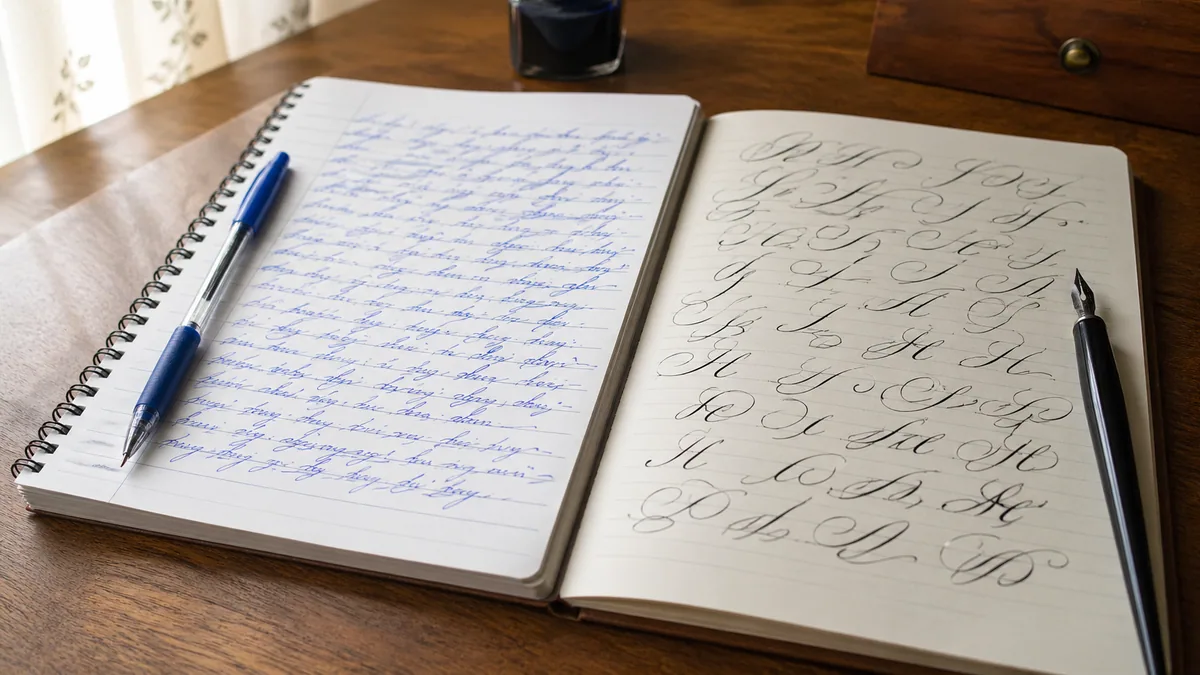
Cursive writing and calligraphy are not the same thing, despite what most people assume. One is a practical writing system designed for speed. The other is a deliberate art form where every stroke matters.
Cursive writing is what you learned (or should have learned) in elementary school—a handwriting style where letters flow together, designed for taking notes quickly during a meeting or jotting down your grocery list. Calligraphy, on the other hand, is what you'd hire someone to do for your wedding invitations. It's slow, artistic, and requires specialized tools that most people don't own.
According to research by Dr. Virginia Berninger at the University of Washington, cursive writing activates different neural pathways than print writing, specifically areas related to working memory and sequential processing. Meanwhile, calligraphy has been practiced as a meditative art form for over 4,000 years, with the earliest examples found in ancient China and Egypt.
Here's the thing most guides won't tell you: cursive makes you faster at writing. Calligraphy makes you slower on purpose. If you're trying to decide which one to learn, that's really what it comes down to. Need better everyday handwriting? Start with the step-by-step cursive handwriting guide. Want to create finished lettering for cards or art? Explore our complete guide to calligraphy styles. Or do both—plenty of modern calligraphers started with regular cursive before getting into the artistic side.
Should you learn cursive or calligraphy first?
Learn cursive first if you want faster, more readable everyday handwriting. Learn calligraphy first if you want decorative lettering for cards, envelopes, artwork, or design projects.
If you want both, start with a few weeks of cursive joins so your hand learns rhythm and spacing. Then move into calligraphy strokes and tools. If you only need a polished phrase for a project, use the cursive generator to preview script styles before spending time on a new hand.
| Your goal | Learn first | Good next step |
|---|---|---|
| Improve everyday handwriting | Cursive | Build joins and spacing with the practice sheet generator. |
| Make cards, quotes, or simple art | Calligraphy | Choose one beginner hand from the calligraphy styles guide and practice the basic strokes slowly. |
| Teach a child handwriting | Print, then cursive | Keep drills short. The practice sheet generator works well for names, words, and alphabet rows. |
| Address wedding envelopes | Calligraphy | Learn spacing and pen choice before envelopes. The calligraphy pens guide will save trial and error. |
| Build a foundation for lettering | Cursive, then calligraphy | Work through basic cursive, then use the calligraphy beginner guide for strokes and tool setup. |
| Use digital script fonts | Neither one | Try the cursive generator; learn handwriting later if you enjoy the look. |
- Weeks 1-2: practice lowercase cursive joins and even spacing.
- Weeks 3-4: write short words and sentences with a printable sheet from the practice sheet tool.
- Weeks 5-6: practice basic calligraphy strokes with the beginner calligraphy guide before you pick a project.
- Weeks 7-8: pick one project and one style from the styles guide. Do not switch hands every day.
Treat this as a guide, not a rule. If your goal is school notes or signatures, stop after cursive. If your goal is envelopes or artwork, keep going into calligraphy.
Key Differences at a Glance
The confusion between cursive and calligraphy has real consequences—people buy the wrong tools, follow the wrong tutorials, and get frustrated when their "calligraphy" looks like rushed handwriting.
Understanding these differences will save you time and money. The International Association of Master Penmen, Engrossers and Teachers of Handwriting (IAMPETH) distinguishes between "business writing" (cursive) and "ornamental penmanship" (calligraphy) based on intent, tooling, and execution speed. Here's what actually separates them:
| Aspect | Cursive Writing | Calligraphy |
|---|---|---|
| Primary Purpose | Efficient, legible everyday writing | Artistic expression and decorative lettering |
| Speed | Fast—designed for quick note-taking | Slow—deliberate, measured strokes |
| Tools | Regular pen, pencil, ballpoint | Specialized nibs, brush pens, dip pens |
| Letter Formation | Connected, flowing letters (often simplified) | Individual letterforms with artistic variations |
| Stroke Variation | Consistent line width throughout | Intentional thick/thin contrast (pressure control) |
| Learning Time | Weeks to months (basic proficiency) | Months to years (basic to intermediate) |
| Typical Applications | Notes, letters, journaling, signatures | Invitations, certificates, art pieces, branding |
If you're still not sure which one you need, think about it this way: cursive is for writing faster than you type by hand. Calligraphy is for creating something people will frame and hang on a wall. Want to test both? Try our font generator to compare cursive and calligraphy styles side-by-side, or explore our custom practice sheet generator to start learning either skill.
What is Cursive Writing?
Cursive writing is what happens when you connect letters together to write faster. That's it. No special pens required.
The word "cursive" comes from the Latin currere, meaning "to run"—because your pen runs across the page without lifting. Most English-speaking schools taught cursive between the 1850s and early 2000s as a mandatory skill. Then computers happened, and schools started dropping it. In 2010, the Common Core State Standards made cursive optional, which means most kids born after 2005 can't read their grandparents' birthday cards.
According to research published in the Journal of Learning Disabilities (2016), students who write in cursive show better spelling accuracy and text composition than those who print or type. The physical act of connecting letters helps the brain process language differently. Dr. Virginia Berninger's studies at the University of Washington found that cursive activates both visual and motor brain regions simultaneously, which improves learning retention.
- Connected letters: Most letters within a word flow together without lifting the pen, which is the whole point—speed through continuous motion.
- Slanted orientation: Written at roughly 15-20 degrees to match the natural angle of your hand resting on paper.
- Speed-optimized letterforms: Some letters get simplified compared to print (looking at you, capital Q and Z).
- Personal variation: Everyone's cursive looks different after a few months because muscle memory develops individual quirks.
- Declining in schools: Only 14 U.S. states mandate cursive instruction as of 2024, down from all 50 states in 1990.
Why Learn Cursive in 2024?
Good question. You probably won't use it for note-taking if you type faster than you write. But there are still practical reasons. You need cursive for signatures (yes, printed signatures exist, but they look unfinished). Reading historical documents requires it—anything handwritten before 1980 is probably in cursive. And despite the digital takeover, some professional contexts still expect handwritten thank-you notes or personal correspondence in cursive.
Adults who learned cursive as children often report less hand fatigue during long writing sessions than those who only learned print, because the continuous motion reduces the repetitive strain of lifting and repositioning the pen. Check out our structured practice guide to start building muscle memory, or use our custom worksheet generator for daily drills.
- ✓ Writing speed: 20-30% faster than print once you're proficient
- ✓ Fine motor skills: Builds hand strength and coordination
- ✓ Letter recognition: Helps dyslexic learners distinguish b/d and p/q
- ✓ Spelling accuracy: The continuous motion reinforces word patterns
- ✓ Reduced fatigue: Less pen lifting means less repetitive strain
- ✓ Signature development: You need one that doesn't look like a 5-year-old signed
- • Zaner-Bloser: Most widely taught in U.S. schools, simplified letterforms
- • D'Nealian: Bridges print and cursive with slanted print letters
- • Palmer Method: Business standard from 1900-1950, all about arm movement
- • Spencerian: Ornate 19th-century style with lots of flourishes (basically calligraphy)
For more on different writing styles, see our guide on calligraphy styles and their histories.
What is Calligraphy?
Calligraphy is the art of making letters beautiful on purpose. Every stroke is intentional. The thick-thin contrast isn't an accident—it's the whole point.
The word comes from Greek: kallos (beauty) + graphein (to write). Unlike cursive, which optimizes for speed, calligraphy optimizes for aesthetics. You use specialized tools—pointed nibs, broad-edge pens, brush pens—to create deliberate variation in stroke width. Heavy pressure on downstrokes makes them thick. Light pressure on upstrokes keeps them thin. This contrast is what makes calligraphy look "fancy" compared to regular handwriting.
Master penman Michael Sull, former president of the International Association of Master Penmen, Engrossers and Teachers of Handwriting (IAMPETH), describes calligraphy as "the art of giving form to signs in an expressive, harmonious, and skillful manner." The Society of Scribes and Illuminators, founded in 1921, maintains that calligraphy requires three elements: proper tools, systematic study of historical hands, and thousands of hours of deliberate practice.
Calligraphy has existed for over 4,000 years. The earliest examples come from ancient China (oracle bone script, 1200 BCE) and Egypt (hieratic script). Islamic calligraphy became a major art form because the Quran forbids depicting human figures—so Arabic script became the visual art instead. European calligraphy peaked during the manuscript era (500-1500 CE) before printing presses made hand-copying obsolete. For a deep dive into these historical styles, read our complete history of calligraphy.
- Intentional stroke variation: Thick downstrokes and thin upstrokes create the visual contrast that defines calligraphy. Without this, you're just writing neatly.
- Specialized tools required: Pointed nibs (Copperplate, Spencerian), broad-edge pens (Gothic, Italic), or brush pens (modern calligraphy). Regular pens won't work.
- Deliberate execution: Calligraphy is slow. A wedding invitation might take 20 minutes per envelope. You can't rush it without ruining the letterforms.
- Style adherence: Traditional calligraphy follows strict rules for each historical hand—Gothic, Italic, Copperplate. Modern calligraphy is more flexible.
- Artistic practice: The goal is beauty, not communication efficiency. People frame calligraphy. Nobody frames cursive notes.
Traditional vs. Modern Calligraphy
There's a divide in the calligraphy world. Traditional calligraphers study historical scripts and follow established letterform rules. Modern calligraphers (sometimes called "faux calligraphers" by the traditional crowd) use brush pens and make up their own rules. Both are valid, but they're solving different problems. Traditional calligraphy is what you'd see in medieval manuscripts or formal certificates. Modern calligraphy is what you see on Instagram wedding signage.
According to Jake Weidmann, one of only 11 living Master Penmen designated by IAMPETH, mastering a single traditional hand like Engrosser's Script requires 5,000-10,000 hours of focused practice. Modern calligraphy can look good much faster—maybe 100-200 hours to get commercial-quality work. The trade-off is depth versus accessibility. Learn more about both approaches in our modern calligraphy guide.
- • Gothic/Blackletter: Medieval European scripts (Textura, Fraktur), extremely vertical and angular
- • Italic: Renaissance humanist script, elegant and slightly slanted
- • Copperplate: 18th-century English script with extreme thick-thin contrast
- • Uncial: Early Christian manuscripts (4th-8th century), rounded letterforms
- • Arabic: Multiple styles including Naskh, Thuluth, and Diwani
- • Chinese/Japanese: Brush calligraphy with thousands of years of tradition
Each style has specific ductus (stroke order) and historical context. See our complete styles guide.
- ✓ Wedding invitations and envelope addressing (biggest market)
- ✓ Logo design and brand identity for boutique businesses
- ✓ Fine art prints sold on Etsy, galleries, or commissioned pieces
- ✓ Certificates, diplomas, and formal awards
- ✓ Product packaging for premium brands (cosmetics, spirits)
- ✓ Social media graphics for Pinterest, Instagram aesthetic accounts
Interested in professional work? Check our calligraphy business guide.
Tools & Materials: What You Actually Need
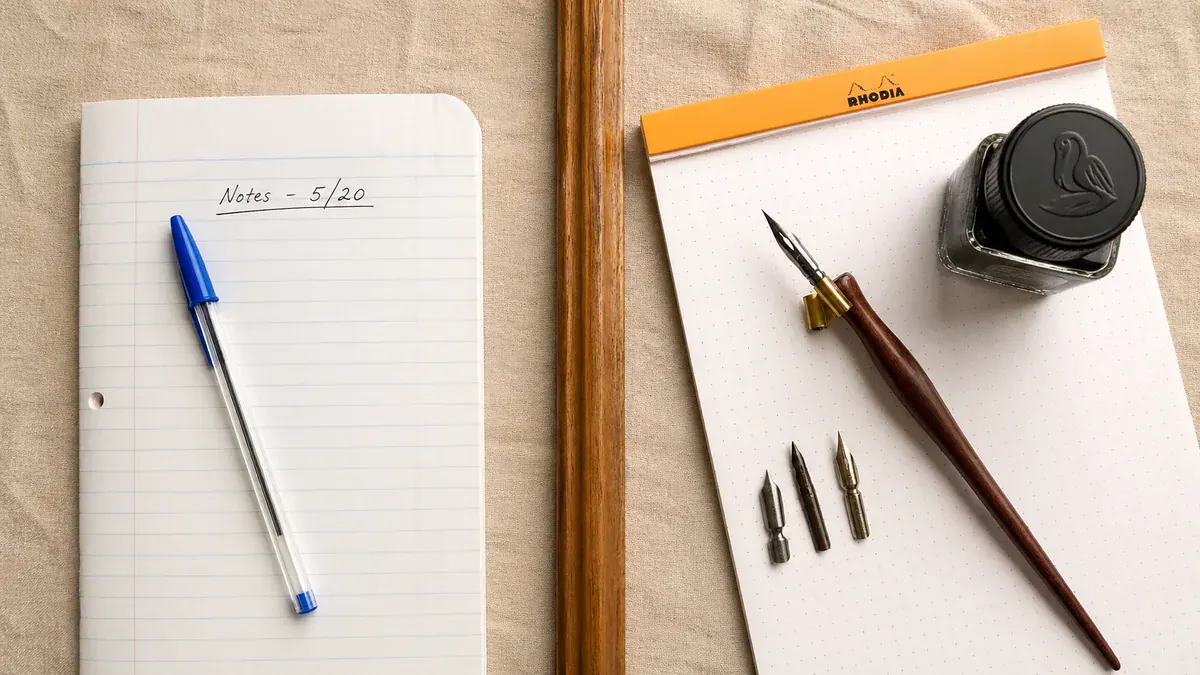
The tools determine which skill you're learning. If you're using a regular ballpoint pen, you're writing cursive. If you've got ink-stained fingers and a holder with interchangeable nibs, you're doing calligraphy.
This is where beginners get tripped up. You cannot do calligraphy with a normal pen—the stroke variation requires flex (for pointed pen) or a chisel edge (for broad pen). Conversely, calligraphy pens are terrible for cursive because they're too slow and require constant ink refills. Let's break down what you actually need for each, with real costs and tool recommendations from professional scribes.
Before buying, use the calligraphy pens guide to compare pointed nibs, broad-edge pens, and brushes. Pair your chosen tool with a suitable surface from the paper guide; an everyday handwriting setup does not need the same supplies as a dip-pen one.
Basic Supplies (Everything You Need)
- • Any ballpoint or gel pen that feels comfortable (pilot G2, Uni-ball Signo)
- • Regular pencil if you're just starting and want to erase mistakes
- • Lined notebook paper (the lines help keep consistent slant and size)
- • Eraser if using pencil
Optional Upgrades (Nice but Not Necessary)
- • Fountain pen for smoother writing (Pilot Metropolitan, Lamy Safari)
- • Rhodia or Clairefontaine paper for fountain pens (prevents bleed)
- • Cursive practice worksheets with guidelines
Generate custom worksheets instantly with our practice sheet tool.
Total Investment:
$5-20
You probably already own most of this
Essential Supplies (Pointed Pen Calligraphy)
- • Oblique or straight nib holder ($8-25)
- • Pointed nibs: Nikko G or Brause EF66 to start ($0.50-2 each, buy 5+)
- • Calligraphy ink: Sumi ink or Dr. Ph. Martin's Bombay India ($6-12)
- • Smooth paper: Rhodia dot pad or HP 32lb Premium ($8-15)
- • Guideline sheets or lightbox ($0-30)
Beginner Alternative (Modern Calligraphy)
- • Brush pens: Tombow Fudenosuke or Pentel Fude Touch ($3-5 each)
- • Smooth cardstock or marker paper ($5-10)
- • Practice worksheets (free downloads or purchase)
This is easier to start with, but has less stroke control than pointed pen.
Total Investment:
$30-100
Starter kit to intermediate setup
Learning Curve & Timeline
Cursive takes weeks. Calligraphy takes years. That's not gatekeeping—it's just how motor skill acquisition works.
According to research on motor learning published in the Journal of Motor Behavior, complex fine motor skills like calligraphy require 10,000+ repetitions to achieve automaticity. Cursive writing, being less complex, requires around 2,000-3,000 repetitions. Translation: you can be decent at cursive in 2-3 months of daily practice. Professional-quality calligraphy takes 1-3 years of focused study.
Dr. B.J. Fogg's research on habit formation at Stanford shows that starting with 15-minute daily sessions produces better long-term results than sporadic 2-hour marathons. Consistency beats intensity. The timelines below assume 15-30 minutes of daily practice—if you practice twice a week, multiply everything by three.
Week 1-2: Letter Formation
Learn lowercase and uppercase alphabet, practice connecting strokes. Your hand will cramp. That's normal.
Week 3-4: Word Building
Write simple words and short sentences. Focus on consistent slant and spacing. Still looks awkward.
Month 2-3: Fluency Development
Daily journaling or note-taking. Speed increases. Personal style starts emerging. Looks decent now.
3-6 Months: Automaticity
Cursive becomes default. No conscious thought required. Speed matches or exceeds print.
Recommended Practice: 15-30 min/day
Use our daily practice sheets or 30-day challenge calendar.
Month 1-2: Basic Strokes
Master pressure control, basic strokes, simple letterforms. Expect lots of bad letters and ink blobs.
Month 3-6: Consistency
Full alphabet with even spacing and consistent angles. Write words and short phrases. Still messy but recognizable.
6-12 Months: Refinement
Add flourishes, try multiple styles, work on composition. Good enough for wedding envelopes (with practice).
1-3 Years: Professional Quality
Develop personal style, take commissions, create portfolio-quality work. Still learning—always.
5-10 Years: Mastery
Multiple historical hands, museum-quality work, potential Master Penman designation. Only a few hundred people worldwide reach this level.
Recommended Practice: 30-60 min/day
See our structured practice guide and technique breakdown.
Practical Applications & Uses
Use cursive for speed. Use calligraphy when someone's paying you to make it pretty.
Most people learn one or both skills without a clear sense of when they'd actually use them. Cursive is for personal efficiency—things you write for yourself or informal contexts. Calligraphy is for public display—things other people will see, judge, and potentially pay for. Here's when each makes sense:
When to Use Cursive Writing
- Daily
Meeting notes and lecture notes
Faster than typing when you need to draw diagrams or annotate
- Daily
Personal journaling
More intimate than typing, helps with emotional processing
- Common
Thank-you notes and personal letters
Shows effort without needing artistic skill
- Essential
Signatures on legal documents
Cursive signatures are harder to forge than printed names
- Academic
Essay exams and standardized tests
Some contexts still require handwritten responses
When to Use Calligraphy
- Special
Wedding invitations and envelopes
Biggest commercial market for calligraphers ($50-150/hour)
- Formal
Certificates, awards, diplomas
Adds gravitas and legitimacy to formal documents
- Creative
Art prints and gallery pieces
Sell as standalone art on Etsy, galleries, commissions
- Business
Logo design and brand identity
Hand-lettered logos command premium pricing
- Events
Signage, place cards, menu boards
Event calligraphy is a growing side hustle market
Interested in professional calligraphy work? Read our business guide and wedding calligraphy guide.
Which Should You Learn First?
If you need to ask, start with cursive. It's faster to learn, cheaper, and immediately useful. You can always add calligraphy later.
The decision comes down to goals and timeline. Cursive is practical skill-building that pays off in weeks. Calligraphy is artistic development that pays off in months to years. Here's how to decide:
- ✓ You want faster, more efficient everyday handwriting
- ✓ You take notes by hand for school or work meetings
- ✓ You have 2-3 months to see results, not 1-2 years
- ✓ Your budget is under $20 for supplies
- ✓ You need a legible, professional signature
- ✓ You're relearning a skill you had as a kid
- ✓ You journal regularly and want a more fluid writing style
Start here: Beginner's guide to cursive or generate custom practice sheets.
- ✓ You're interested in visual art and creative lettering
- ✓ You want to create wedding invitations or event materials
- ✓ You're willing to invest 6-12 months before seeing results
- ✓ You can budget $50-100 for specialized tools and paper
- ✓ You're considering a calligraphy side business or career
- ✓ You enjoy slow, meditative, detail-focused work
- ✓ You want to develop a marketable creative skill
Start here: Modern calligraphy guide or explore traditional styles.
Combining Both Skills
Modern calligraphy is basically what happens when someone who learned cursive picks up a calligraphy pen and stops following all the historical rules.
The "modern calligraphy" movement (roughly 2010-present, fueled by Instagram and Etsy) blends cursive's flowing connectivity with calligraphy's artistic thick-thin strokes. This hybrid style breaks traditional calligraphy rules—inconsistent slant angles, exaggerated flourishes, bouncy baselines—but that's the point. It's accessible, expressive, and commercially popular for weddings and events.
Traditional calligraphers sometimes dismiss modern calligraphy as "faux calligraphy" or "brush lettering" rather than "real" calligraphy. They have a point—modern calligraphy often ignores centuries of established letterform principles. But dismissing it misses why it works: most people want pretty letters for wedding invitations, not historically accurate 18th-century Copperplate. Both approaches are valid for different contexts. For more on this debate, see our guide on calligraphy vs. hand lettering.
- ✓ Write quickly for personal use (cursive) and slowly for client work (calligraphy)
- ✓ Understand letterform structure from both efficiency and aesthetic perspectives
- ✓ Develop a unique modern calligraphy style influenced by your natural handwriting
- ✓ Offer wider range of services if doing professional calligraphy work
- ✓ Build stronger fine motor control through varied practice methods
- ✓ Mix formal and casual lettering styles for different project needs
Recommended Learning Path (If You Want Both)
Based on teaching methods used by calligraphy instructors at The Postman's Knock and IAMPETH workshops:
- Start with basic cursive for 2-3 months
Develop flowing hand movement, letter connections, and consistent rhythm. Use our practice sheet generator daily. - Practice until cursive feels automatic
You should be able to write full sentences without thinking about individual letters. This takes 15-30 minutes daily for 8-12 weeks. - Introduce brush pen calligraphy
Start with modern calligraphy using Tombow Fudenosuke or Pentel Fude Touch. Easier than pointed pen for beginners. - Learn pressure control and stroke variation
Practice basic strokes daily: thick downstrokes, thin upstrokes, compound curves. See our techniques guide. - Combine techniques to develop personal style
Use cursive connections with calligraphic stroke variation. Experiment with flourishes and composition. Try our font pairing tool to see how styles work together.
Cursive and calligraphy aren't competitors—they solve different problems. Cursive optimizes for speed and everyday legibility. Calligraphy optimizes for beauty and visual impact. Most people benefit from at least basic cursive for signatures and note-taking. Only some people need calligraphy, usually for specific creative or professional goals.
If you're reading this trying to decide which to learn, think about your actual use cases. Writing faster in meetings? Cursive. Creating wedding invitations? Calligraphy. Developing a unique handwriting style you like? Start with cursive, then explore modern calligraphy. Want a creative side business? Go straight to calligraphy and skip cursive entirely.
The good news is that neither skill takes decades to become useful. Cursive gives you results in weeks. Modern calligraphy can look professional in 3-6 months if you practice consistently. Traditional calligraphy mastery takes years, but you don't need mastery to create work people will pay for.
Ready to Start?
Try our font generator to compare cursive and calligraphy fonts side-by-side, create custom practice sheets for daily drills, or join our 30-day calligraphy challenge to build consistent practice habits.