
Affiliate Disclosure: This page contains affiliate links to products selected for practical fit. When you purchase through these links, we may earn a commission at no additional cost to you. Recommendations are based on the registry's stated features, price, level, pros, cons, and best-for labels. We do not imply hands-on testing without an explicit page-level record. See our complete Tools Guide for comparison notes and selection criteria.
The One-Sentence Difference
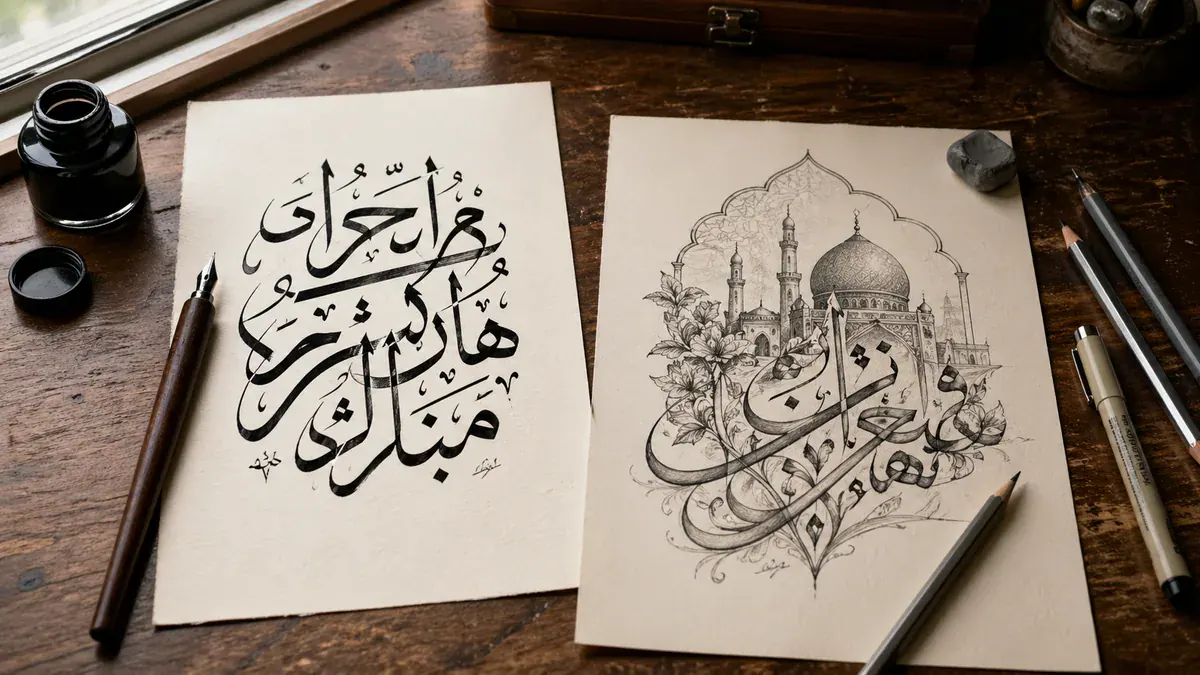
Calligraphy is writing—you execute letters in continuous motion with a pen. Hand lettering is drawing—you build each letter deliberately, often with multiple tools and corrections.
You're writing beautiful letters with specialized strokes, executed in real-time. Think of addressing wedding envelopes where each letter flows naturally from your pen in one motion. Master calligraphers like Edward Johnston (who revived modern calligraphy in the early 1900s) spent years developing muscle memory for consistent letterforms. Start learning with our beginner's guide.
- • Written in flowing, continuous strokes
- • Follows established script traditions (Copperplate, Spencerian, Gothic)
- • Uses specialized calligraphy pens with specific nibs
- • Hard to correct mistakes—you nail it or start over
You're drawing letters, which means you can sketch, erase, refine, and add embellishments. Picture creating a custom logo where you spend 20 minutes perfecting the curve of a single 'S'. You're not bound by historical scripts—if you want your 'A' to look like a tiny house, that's your call. Try visualizing different styles with our cursive generator.
- • Letters are constructed, not written
- • No rules—mix serif, sans-serif, script, whatever works
- • Use pencils, markers, tablets, brushes, or combinations
- • Erase and redraw until it's right
Wedding invitation addressing? That's calligraphy—you need consistent, elegant letterforms written at speed. The couple wants 150 envelopes done in a reasonable timeframe. Custom wedding sign with their names intertwined with florals? That's hand lettering—you'll sketch it five times, scan it, refine it digitally, and the couple doesn't care if it takes three days. Learn about wedding calligraphy services and pricing.
Quick Comparison
This comparison is based on traditional definitions used by professional calligraphers and organizations like the International Association of Master Penmen, Engrossers and Teachers of Handwriting (IAMPETH) and the Society of Scribes and Illuminators. These aren't arbitrary distinctions—they reflect centuries of development in letter arts.
| Aspect | Calligraphy | Hand Lettering |
|---|---|---|
| Definition | Writing beautiful letters | Drawing beautiful letters |
| Approach | Continuous flowing strokes | Constructed letter by letter |
| Speed | Faster once mastered | Slower, more deliberate |
| Rules | Follows traditional script rules | Free-form, creative interpretation |
| Tools | Dip pens, fountain pens, brush pens | Pencils, markers, pens, any drawing tool |
| Editing | Difficult to correct mistakes | Can erase and redraw easily |
| Learning Curve | Steeper, requires muscle memory | Gentler, more forgiving |
| Best For | Invitations, certificates, formal documents | Logos, posters, custom designs, illustrations |
What It Actually Feels Like
Process & Technique
The physical experience of doing calligraphy versus hand lettering feels completely different. Calligraphy has a rhythm to it - once your muscle memory kicks in, you're writing at a steady pace, maintaining consistent pen angle and pressure. Building that procedural memory takes weeks of consistent short sessions; most beginners report a recognisable rhythm developing somewhere around 30-60 hours of focused practice.
- • You write in real-time, letters flowing from your pen
- • Pen angle stays consistent (usually 45° for Italic, 55° for Copperplate)
- • Letters connect naturally as you write
- • Mistakes mean starting the whole word over
- • Speed increases dramatically with practice
- • Your hand learns the movement patterns
"The pen wants to go where it's been before." — Sheila Waters, master calligrapher and author of Foundations of Calligraphy
- • You sketch each letter, often multiple times
- • Work at your own pace—minutes per letter is fine
- • Add flourishes, shadows, textures after the base form
- • Mix styles mid-word if your design needs it
- • Erase and adjust until it looks right
- • Build the composition layer by layer
Hand lettering artists often start with rough pencil sketches, then refine with ink or digital tools like those in our font pairing assistant.
Drawing and filling a letter outline is one hand-lettering approach. In calligraphy, stroke contrast comes from the pen and movement: broad-edge angle or pointed-tool pressure, depending on the script. Writing slowly is not inherently wrong; follow the construction in your chosen lesson. Check out fundamental calligraphy techniques to understand these mechanics.
Tools & Materials
Tool choice matters more in calligraphy than hand lettering. With calligraphy, the nib size and flexibility directly determine your letterforms. A pointed flexible nib creates the hairline-to-swell contrast of Copperplate, while a broad-edge nib creates the geometric strokes of Gothic. You can't swap tools mid-style. Learn more about selecting calligraphy pens and understanding essential materials.
Starting calligraphy costs $30-50 (nib holder, a few nibs, ink, practice paper). Quality increases your price—professional calligraphers often use $40-80 inks and $8-12 nibs they replace frequently. Hand lettering can start with pencils and paper you already have, though serious practitioners invest in Copic marker sets ($200-400 for a good range) or digital setups ($300-900 for tablet and software). Generate practice sheets with our practice sheet generator to start with minimal investment.
Style & Aesthetics
Calligraphy styles have names and history. When you learn Copperplate, you're learning a script developed by English writing masters in the 18th century. The letterforms follow specific proportions—x-height, ascenders, descenders, slant angle. These rules exist for a reason: they create optical balance and readability. Breaking them means you're doing modern calligraphy or your own variation, which is fine, but you should know what you're breaking. Explore different traditional and modern calligraphy styles.
Each style has specific nib angles, x-height ratios, and stroke sequences taught by organizations like IAMPETH.
No historical rules to follow. Style guides come from graphic design, not penmanship history. Explore style mixing with our font pairing tool.
The aesthetic difference shows up clearly in wedding work. Traditional calligraphy gives you timeless elegance that says "formal event." Hand lettering can give you that or make it quirky, rustic, modern, illustrated—whatever fits the couple's vibe. Neither is better, but they signal different things. Check out modern calligraphy trends to see how some artists blend both approaches.
Which One Should You Actually Learn?
This depends on what you want to create, not which sounds more impressive. Both have their place, and honestly, learning one makes you better at the other because you develop different but complementary skills.
- • Want to address wedding or event invitations professionally
- • Enjoy repetitive practice (this is meditation for some people)
- • Like the idea of historical scripts and connecting to tradition
- • Want to write faster once you've got the technique down
- • Appreciate the constraint of working within established styles
- • Plan to offer calligraphy services (better hourly rate than hand lettering typically)
Reality check: The first 20 hours are frustrating. Your hand will hurt. Your letters will look terrible. This is normal. Every calligrapher goes through it. Use our practice sheet generator and 30-day challenge calendar for structured practice.
- • Want to design logos, posters, or custom graphics
- • Like the freedom to invent your own letter styles
- • Prefer working slowly and deliberately on each piece
- • Plan to work digitally eventually (easier transition)
- • Want to combine lettering with illustration
- • Need something more forgiving while learning (you can erase!)
Reality check: Hand lettering takes longer per project. That custom logo might take 4-6 hours. But you have control every step of the way, and clients appreciate the custom, one-of-a-kind result. Explore different lettering styles with our hand lettering generator.
Most professional letter artists do both. They use calligraphy for volume work (addressing 200 envelopes) and hand lettering for custom pieces (one-of-a-kind wedding sign). The skills complement each other: calligraphy teaches you rhythm and flow, hand lettering teaches you letterform construction and design principles.
Practical approach: Start with hand lettering basics for 2-3 weeks to understand letter anatomy without technical pressure. Then add calligraphy fundamentals. Within 2-3 months of regular practice, you'll have a foundation in both. Check out our complete calligraphy beginner guide for a structured learning path.
Common Mistakes People Make
Check whether your tools and construction match the approach you intend to practise. The examples below show where those approaches can become confused.
Beginners try to slowly draw calligraphy letters. That's not how it works. Calligraphy requires continuous motion at a consistent speed. The thick-and-thin contrast comes from pen angle and pressure, not from filling in letters carefully.
Fix: Practice basic strokes at a moderate speed before attempting full letters. Use drills from our practice sheet generator to build muscle memory.
Pointed pen calligraphy on textured paper is misery. The nib catches, ink bleeds, and you'll blame yourself when it's actually the paper. Hand lettering is more forgiving—most paper works fine because you're not using a sharp flexible nib.
Fix: For calligraphy, use ultra-smooth paper (HP Premium32, Rhodia). For hand lettering, almost any drawing or marker paper works. Read about paper selection.
Everyone wants to write words immediately. But if you can't consistently execute basic strokes (upstrokes, downstrokes, ovals, curves), your letters will never look good. This applies to both disciplines but especially calligraphy.
Fix: Spend your first 5-10 practice hours on strokes only. It's boring but essential. Our 30-day challenge structures this properly.
Instagram shows you polished work from people with 1,000+ hours of practice. Your first attempts will look rough. That's not a sign you're bad at this; it's a sign you're at the beginning. Most learners need dozens of hours of focused practice before either craft starts to feel natural, and there's no shortcut around that.
Fix: Track your progress weekly. Compare your work to your own earlier work, not to professionals. Check out common calligraphy mistakes others make too.
Your Practical Starting Path
You don't have to choose just one. Most letter artists work in both. Here's a practical 90-day plan if you want to learn both simultaneously:
Weeks 1-3: Hand Lettering Foundation
Start with hand lettering because it's less technical. Learn letter anatomy (baseline, x-height, ascenders, descenders), practice drawing consistent letterforms with pencil, and understand spacing. This builds confidence without the pressure of calligraphy technique. Use our alphabet reference guide.
Weeks 4-6: Add Calligraphy Basics
Introduce calligraphy fundamentals—pen angle, pressure control, basic strokes. Practice 15-20 minutes daily on just strokes, not full letters yet. Your hand lettering knowledge helps because you already understand letterform structure. Follow structured lessons in our beginner's guide and track progress with practice techniques.
Weeks 7-9: Alternate Between Both
Practice calligraphy on even days, hand lettering on odd days (or whatever split works for you). This prevents burnout and lets each skill inform the other. Start combining them in projects—calligraphy for main text, hand lettering for decorative elements.
Weeks 10-12: Pick Projects That Use Both
Create practical projects: birthday card with calligraphy greeting and hand-lettered name, quote poster with mixed styles, place cards for a dinner party. Real projects expose your weak spots better than endless practice sheets. Get inspiration from our examples gallery and experiment with our color palette tool.
Expect to practice 15-30 minutes daily. That's 7-15 hours per month. Within 3 months (roughly 45 hours total), you'll have basic proficiency in both crafts. Within 6 months, you can start taking on small paid projects. Professional-level work takes 200-500+ hours, typically spread over 1-2 years.
This timeline aligns with research from Stanford professor Dr. B.J. Fogg on habit formation and motor skill development studies published in the Journal of Motor Behavior. Consistency beats intensity—30 minutes daily outperforms 3-hour weekend binges.
The Bottom Line
Calligraphy is writing letters beautifully with flowing strokes and specialized pens, following historical scripts. Hand lettering is drawing letters deliberately, mixing any styles you want, using whatever tools work. Neither is better or harder—they're different tools for different jobs.
The distinction matters when you're choosing what to learn or explaining to a client what service you offer. But plenty of accomplished letter artists blur-sm the lines, combining calligraphic flow with hand-lettered embellishments. That's the beauty of understanding both—you can use them together.
Start with whichever excites you more right now. Your first few hours of practice matter more than which one you pick. Both crafts reward patience, regular practice, and willingness to make ugly letters for a while before they get good. The process is the same: show up, practice deliberately, track your progress, repeat.
- • Read our complete beginner's guide to calligraphy
- • Understand essential calligraphy tools before buying supplies
- • Generate custom practice sheets for daily drills
- • Try different styles with our font generator
- • Join our 30-day calligraphy challenge
- • Learn about turning your practice into a business
Pens and Markers for Lettering
Versatile markers for brush lettering, faux calligraphy, and signage
Crayola Super Tips Washable Markers (50ct)
The 50-count entry-level Super Tips pack — the right size for someone trying brush-lettering practice without committing…
Sharpie Brush Tip Permanent Markers (8ct)
A surprisingly capable brush pen from Sharpie, with a genuine flexible synthetic brush tip that produces real thick-and-…
Uni Posca Paint Markers 5M (Set of 29)
The professional standard for chalk lettering, sign painting, and surface lettering. Posca's water-based pigment ink is …
Karin Brushmarker Pro (12pc Basic Colors)
A favorite among professional brush letterers and bullet journalists. The Brushmarker Pro's long, springy synthetic brus…
Sakura Pigma Micron PN Black Pens
Plastic-nib pens for everyday monoline lettering, outlines, and filling faux-calligraphy downstrokes. The nib has some g…
Pilot G2 0.7 mm Gel Pens, Black and Blue
Everyday gel pens for cursive drills and monoline writing. The fixed point does not create brush-calligraphy thick and t…
Tombow Dual Brush Grayscale Set
A grayscale brush-and-fine-tip set for letter shadows and tonal studies. Use smooth, non-textured paper; this is a shadi…
Chalkola Liquid Chalk and Metallic Markers
For lettering on suitable nonporous signs and glass, not paper practice. Test an inconspicuous spot first: porous chalkb…
We may earn a commission when you buy through these links. See all recommendations →