A step-by-step beginner's guide to cursive handwriting — posture, basic strokes, every letter family, joining letters, common mistakes, and a 30-day practice plan you can actually finish.
18 min readBeginner Levellearn · beginner
Table of Contents
Affiliate Disclosure: This page contains affiliate links to products selected for practical fit. When you purchase through these links, we may earn a commission at no additional cost to you. Recommendations are based on the registry's stated features, price, level, pros, cons, and best-for labels. We do not imply hands-on testing without an explicit page-level record. See our complete Tools Guide for comparison notes and selection criteria.
How to Write in Cursive (Quick Answer)
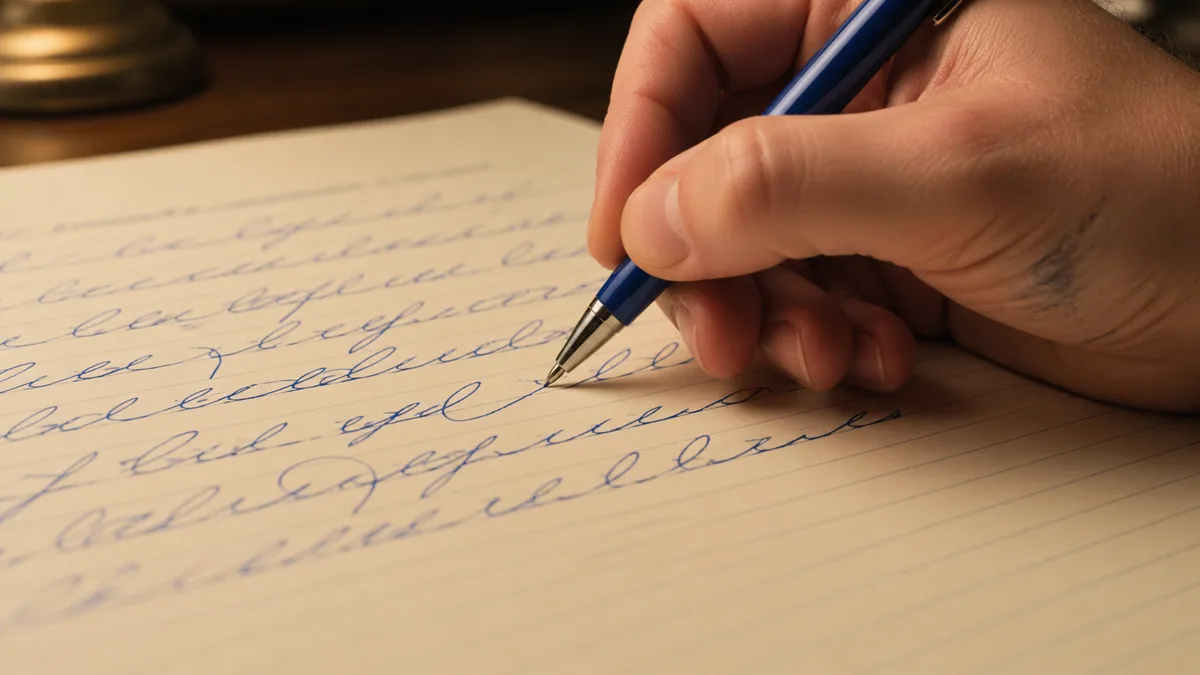
To write in cursive, set up good posture and paper angle, learn the five basic strokes that every letter is built from, practice lowercase letters in families that share a shape, then join those letters with connecting strokes — keeping a single, consistent slant throughout.
Here is the whole workflow in order. Each step links to the detailed section below:
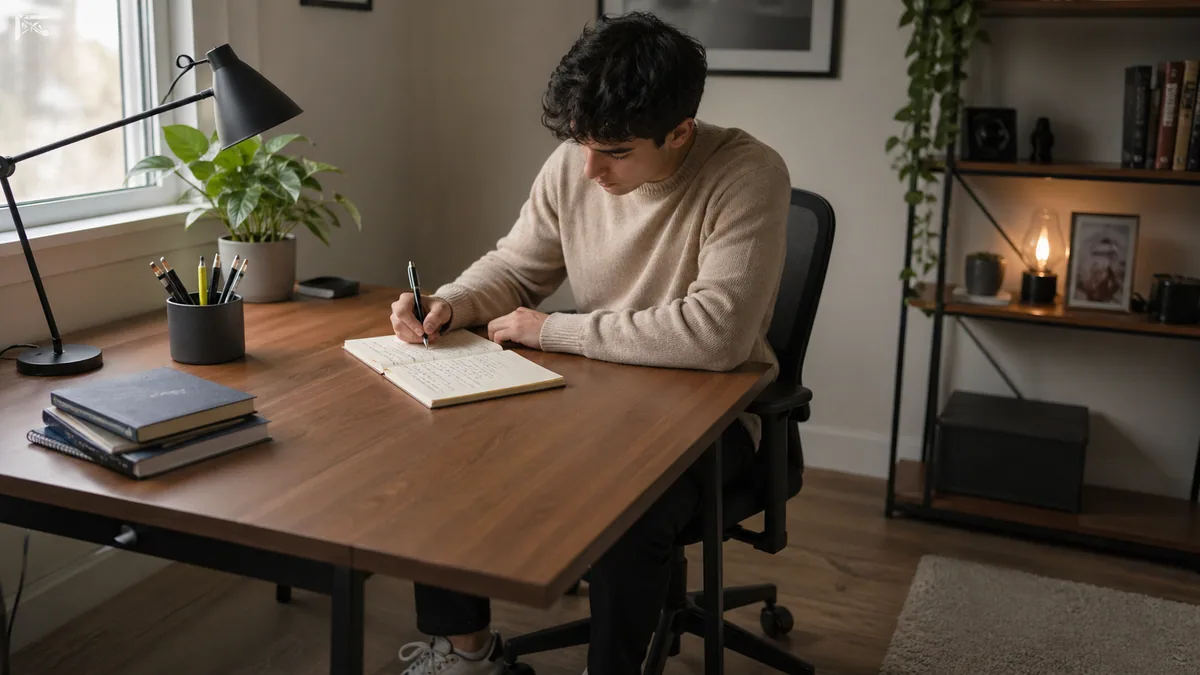
Set up your body and paper. Sit tall, tilt the page about 30°, and hold the pen with a relaxed grip so you write from the arm, not the fingers.
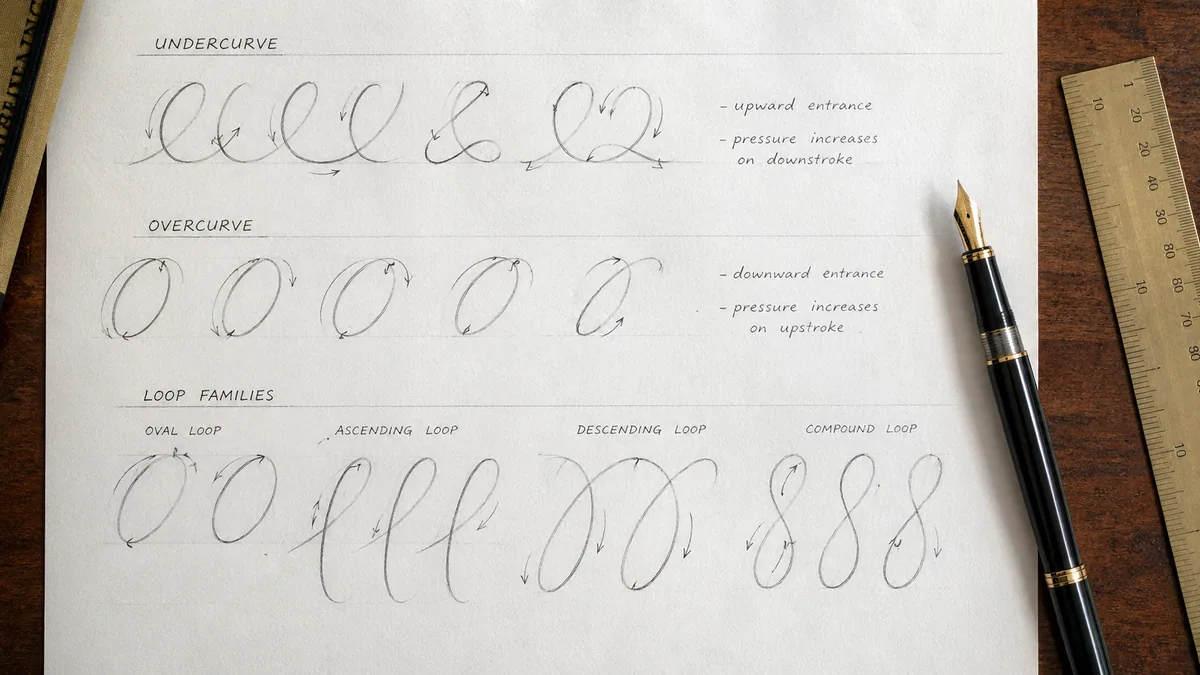
Master the five basic strokes. The undercurve, overcurve, oval, and ascending and descending loops make up every cursive letter.
Practice lowercase by letter family. Group letters that share a shape so muscle memory transfers from one to the next.
Add the uppercase letters. Learn capitals after lowercase, since you use them far less often.
Join letters with connecting strokes. Keep the pen moving and let the exit stroke of one letter flow into the next.
Use the practice schedule as prompts, not a deadline for fluency. For an overview of script families, see the calligraphy alphabet reference covers four styles. You can preview a word in a flowing script with the cursive generator for design inspiration, not as a verified stroke model.
Why Bother Learning Cursive in 2026?
Cursive is useful for personal notes, letters, and reading familiar connected forms. It is not necessarily faster than print for every writer.
You may be learning connected handwriting for the first time, returning to it, or supporting someone else's practice. Choose a model suited to that goal and take time with unfamiliar shapes.
This lesson offers practice suggestions, not a claim that cursive improves memory or produces a particular neurological effect. Compare your own samples for legibility, spacing, and comfortable movement.
What this guide will (and won't) do
This lesson uses descriptive everyday-handwriting variants, including a high-exit b. It is not a certified Palmer or Spencerian alphabet. Follow one teacher-selected exemplar; qualified educator review of these descriptions and all 26 letter records is pending. If you want pointed-pen Copperplate or broad-edge Italic, head over to the calligraphy styles guide or our deeper beginner's guide to calligraphy instead. Cursive first, fancy stuff later.
Step 1: Posture, Paper Position, and Grip
Before you write a single letter, set up your body. Bad posture is the single biggest reason adults complain that their hand cramps after half a page. Sit so your feet are flat on the floor, hips slightly higher than your knees, and the desk hits you somewhere around mid-rib. Keep both forearms resting lightly on the desk — your writing arm should be free to slide, not pinned in place.
Paper position matters more than you think
Right-handed writers should tilt the top of the paper roughly 30° to the left. Left-handed writers tilt it 30° (or more) to the right, which keeps the wrist below the baseline and stops you from smudging fresh ink. If you're left-handed, our full left-handed calligraphy guide covers underwriter vs. overwriter grips, paper angle, and pen choices in much more detail.
The tripod grip — relaxed, not crushed
Hold the pen between thumb and index finger, resting it on the side of your middle finger. The pen should sit at roughly a 45° angle to the paper, pointing back toward your shoulder. The grip pressure test: if your knuckle turns white, you're squeezing too hard. Cursive flows from the shoulder and elbow, not from clenched fingertips.
The “ripe tomato” rule
Old-school penmanship teachers at IAMPETH (the International Association of Master Penmen, Engrossers and Teachers of Handwriting) use this cue: hold the pen the way you'd hold a ripe tomato — firm enough that it won't slip, gentle enough that you won't bruise it. Try it for one practice session and your hand fatigue will drop noticeably.
Step 2: Master the Five Basic Strokes
Every cursive letter is built from five repeating shapes. Drill these for 10 minutes a day for a week and most letters will already feel familiar before you ever try to write them.
The under-curve — a smooth upward swing that starts on the baseline and curves up to the midline. Think of it as the bottom of a bowl, lifting up to the right. This is the entry stroke for i, t, u, w, j, p, r, s.
The over-curve — the mirror image. Starts on the midline, arches over, and lands on the baseline. It opens letters like n, m, h, v, y, x.
The oval — a slanted egg shape, roughly 55° from horizontal. Practice it counter-clockwise and clockwise. Ovals form the body of o, a, c, d, e, g, q.
The slant line — a straight diagonal at the same 55° as the oval. Consistency of slant is what makes cursive look tidy rather than wobbly.
The loop — an extended slant line that comes back through itself, either above the midline (l, h, b, k, f) or below the baseline (g, j, y, z, f).
Spend a full sheet on each stroke before you move on. Don't race. The goal isn't to fill the page — it's to make the twentieth stroke look like the first. If you want ruled practice paper with the right baseline, midline, and ascender lines already drawn, our custom practice sheet generator provides font tracing with horizontal lines, not a script-specific slant guide or a verified handwriting model.
If you need to see where a lowercase movement starts, print the Letterpaths lowercase reference (Free). Its numbered starts and arrows follow one joined-cursive model. The Letterpaths First Steps pack ($5) uses that same model for practice; compare it with your school alphabet before using it alongside classroom lessons.
Why slant consistency matters more than letter shape
Compare letter slant with your chosen exemplar. If an angle is specified, check whether it is measured from the baseline or the vertical; those are different references. Our tracing sheets have horizontal lines but do not generate slant guides.
Step 3: Lowercase Letters, Grouped by Family
Don't learn the alphabet in alphabetical order. That's a curriculum-design mistake that's been confusing kids for a century. Group letters by the strokes they share, and you'll learn five letters in the time it usually takes to learn one.
Family 1: The straight family — i, l, t
Start here. These are the simplest letters and they teach you the entry/exit stroke rhythm of cursive without forcing you to lift your pen. i is an under-curve, a slant down, an under-curve out, and a dot added last. l is a tall loop, t is a slant up, slant down, with the cross-bar added at the end. See the full breakdown for cursive l and cursive t.
Family 2: The hump family — n, m, h, u
Built on over-curves and under-curves. n is one hump; m is two; h adds a tall loop entry; u flips the humps upside down. Practice them as a chain: nnnn, mmmm, uuuu. The repetition trains your hand to come back to the baseline at the same height every time.
Family 3: The oval family — o, c, e, a, d, g, q
All seven of these letters start with a counter-clockwise oval. c is just an incomplete oval. e is a small loop opening into one. a, d, g, q are ovals with a tail attached. Master the oval and you've essentially learned a third of the alphabet. Detailed walkthroughs live at cursive o and cursive a.
Family 4: The tricky middles — s, r, f
These letters give beginners the most grief because they don't look anything like their printed counterparts. Cursive s is a single closed shape that resembles a lowercase printed l with a belly. Cursive r has a small shoulder bump that throws people off. f is the only letter with both an upper and a lower loop. Walk through cursive s step-by-step if it keeps tripping you up.
Family 5: Descenders & outliers — b, p, k, x, z, v, w, y, j
The leftovers. b, v, w share a tricky high exit stroke that throws joins into chaos if you let it sit too high — we'll fix that in the joining section. p, j, y, g are descenders (they dip below the baseline). k has a small decorative loop that's often the first letter people start to flourish. x and z are once-a-page letters in real life — drill them last. The full A–Z library at cursive letters A–Z has stroke order for every letter.
Drill order that actually works
Practice each family for two days before moving on. By day 10 you'll have all 26 lowercase letters covered. Resist the urge to write words until each family flows without hesitation — words built on shaky letters just bake the wobble in.
Step 4: An Honest Take on Uppercase Letters
Cursive capitals are the showpiece of the alphabet — and also the part most adults never fully learn. Here's the secret nobody tells you: in everyday cursive, you only need to write capitals well enough to start a sentence and sign your name. That's about a dozen letters in heavy rotation.
Capital joins depend on the letterform and handwriting model. Some end separately; others have an exit that joins the following lowercase letter. Use the join shown in your exemplar. The breakdown — including stroke order, common variants, and the elaborate Spencerian forms — lives in our cursive capital letters guide.
Choose a recognizable Q
You'll see decorative cursive Q's online that look like the number 2. Some readers may confuse those forms. For everyday notes, choose a Q your audience recognizes; historical exercises should follow their labelled exemplar.
Step 5: Joining Letters Without Breaking Flow
This is the part of cursive that turns it from fancy printing into actual handwriting. Every lowercase letter has an entry stroke (where it begins) and an exit stroke (where the next letter picks up). When the exit of one letter aligns with the entry of the next, the join is invisible and the word flows.
The examples here use high-exit variants of b, o, v, w, which finish near the midline. Carry that high exit into the matching entry of the next letter. Other models may use low exits; do not mix their joining directions into this exercise.
Three joins worth drilling separately
br, or, wr — the “r” has to start high. Treat the join like a small horizontal bridge, then drop into the r's shoulder.
oo, oa, oe — two ovals in a row. Keep them the same size or the word looks like it's shrinking.
ws, vs, bs — a high-exit letter followed by an s. Glide into the s from the midline; don't drop to the baseline first.
Practice these as nonsense syllables: brob, oroar, wsws. It isolates the join for closer inspection. When you're ready for real-word drills, paste any phrase into our cursive handwriting generator and trace the output a few times.
Step 6: Common Mistakes (and How to Fix Them)
Compare these five features with your chosen handwriting model. Adjust one at a time and review the result; no fixed improvement timeline or classroom outcome is claimed here.
Finger-writing instead of arm-writing. If your fingers are doing all the work, your letters will be tiny and your hand will cramp. Move from the shoulder.
Inconsistent slant. Follow the angle in your labelled exemplar. Use a separately ruled slant guide if needed; the worksheet tool supplies horizontal lines only.
Lifting the pen mid-letter. The whole point of cursive is the connected stroke. If you're lifting after every loop, you're writing slow print, not cursive.
Letters that drift off the baseline. Use ruled paper, every time, for at least the first three months. Free-handing on blank paper is a graduation, not a starting point.
Going too fast. Speed comes from confidence, and confidence comes from a thousand slow, correct repetitions. There's no shortcut.
Use this table to match the problem you see in your own handwriting to the fix and the worksheet that drills it:
For a more thorough audit of pen pressure, spacing, and posture issues, our deep dive on common calligraphy mistakes covers the diagnostic side — what a wobbly stroke actually means about what your hand is doing.
Step 7: A 30-Day Practice Routine That Works
Twenty minutes a day for thirty days. That's the whole plan. Skip a day, fine — but don't skip two in a row.
Treat twenty minutes as an optional starting point, not a proven learning dose. Shorten the session if you tire, and review one feature of your writing before deciding what to practise next.
Week-by-week breakdown
Days 1–7: Strokes and the straight family. Five minutes of warm-up ovals and slant lines, fifteen minutes on i/l/t.
Days 8–14: Hump and oval families. Add n/m/h/u, then o/c/e/a/d/g/q. Start writing simple three-letter words: cat, dog, mom.
Days 15–21: Tricky letters and joins. Add s/r/f and the descender family. Drill the br, oo, and ws joins from Step 5.
Days 22–28: Capitals and short sentences. Add the dozen capitals you actually use. Write your name, address, and a sentence each day.
Days 29–30: Real writing. Copy a paragraph from a book. Date the page. Compare it to day 1 and feel proud.
For a structured calendar with daily prompts already laid out, our 30-day calligraphy challenge calendar works equally well for cursive — it gives you a different focus letter or stroke each day so you don't have to think about what to drill.
Date every page
This sounds trivial. It isn't. Cursive improvement is gradual and you won't notice it day to day. Putting the date on every practice sheet means three weeks in, you can flip back to day 1 and see exactly how far you've come. That visible progress is the a useful record of what has changed and what still needs attention.
Tools, Paper, and Helpful Apps
You don't need fancy gear. The whole appeal of cursive is that you can practice it with a ballpoint and a notebook. That said, a few small upgrades may help if ink feathers or the pen catches. The paper guide compares smoother practice surfaces. If you later try decorative strokes, the calligraphy pens guide explains the specialist tools; they are optional for everyday cursive.
Pen: a smooth medium-tip rollerball or fountain pen. Pilot G-2 (0.7), Uni-ball Vision, or any entry-level fountain pen like the Pilot Metropolitan.
Paper:ruled or dotted paper with a clear baseline. Rhodia, Clairefontaine, or any decent composition notebook works. Thin copy paper feathers; avoid it.
Practice sheets: generate your own at the right font size with our practice sheet tool — name, alphabet, or sentence font tracing with horizontal lines, not script-specific slant guides.
Visualization helper: the cursive handwriting generator shows any phrase in a clean cursive font at any size — handy for tracing or for checking your own letterforms against a reference.
Signature practice: the cursive name generator previews your name in eighteen different scripts, which is genuinely useful when you're developing a personal signature style.
Where to Go After You've Got the Basics
Once you can write a paragraph in clean, consistent cursive — usually somewhere around week six or seven of regular practice — you've got real options. Some directions worth considering:
Push toward true calligraphy with our beginner's guide to calligraphy — broad-edge and pointed-pen techniques that build directly on cursive fundamentals.
Explore historical scripts in our calligraphy styles overview — Spencerian, Copperplate, Italic, and modern brush hands all share roots with the cursive you just learned.
The honest closing thought: cursive is a small skill that pays back disproportionately. A neat, fast handwriting feels good in a way that's hard to explain until you have it. Thirty days from now, you can have it. Pick up the pen.
How long does it take to learn cursive as an adult?▾
Progress depends on your starting point, chosen handwriting model, and practice. Use the 30-day routine as a set of prompts, not a deadline for fluency. Keep dated samples and compare letter shapes, spacing, and comfort before adding speed.
Should I learn cursive or print first?▾
If you already write print comfortably, you can try cursive without repeating a print course. For a child, follow the sequence recommended by their teacher and chosen curriculum. Readiness is not established by age alone. Our font-tracing sheets are not a print-first curriculum or a clinical assessment.
What's the best paper and pen for learning cursive?▾
Use ruled paper and a pen that writes comfortably without heavy pressure. Test the paper with your ink before a long session. Horizontal practice lines can help with height and alignment; use a separate script-specific guide if your lesson requires slant lines.
Why do my cursive letters look uneven and wobbly?▾
Check slant, letter height, spacing, and writing speed against one labelled exemplar. Slow down enough to identify where a stroke changes direction. Use a relaxed grip and comfortable movement rather than forcing all motion from the shoulder.
How do I write cursive if I'm left-handed?▾
Try small changes in paper angle and position so you can see your writing without a strained wrist. Test ink drying time on your chosen paper; it varies by product and surface. Our left-handed guide discusses possible setups, but stop and seek individual advice if writing hurts.
Are cursive capital letters worth learning?▾
Yes. Start with capitals in your name and everyday writing, then work through the alphabet. Capital joins depend on the letterform and model: some finish separately, while others have an exit that can join. Follow one labelled exemplar rather than treating all capitals as either connected or unconnected.
What's the difference between cursive, calligraphy, and hand lettering?▾
Cursive is connected handwriting. Calligraphy forms letters with deliberate strokes; broad-edge and pointed tools create contrast differently. Hand lettering draws letters as shapes and may involve repeated revisions. Some skills overlap, but cursive is not a required foundation for every calligraphy or lettering style.
Can I teach my child to write in cursive at home?▾
You can support practice at home using the model and stroke sequence their teacher recommends. Keep the session comfortable and stop if the child is tired or frustrated. A decorative script font is not a substitute for an educator-checked handwriting exemplar.
Do I really need to drill basic strokes before writing letters?▾
Basic strokes can help isolate a difficult movement before you put it into a letter. Alternate drills with letters so you can see whether the exercise helps. IAMPETH hosts historical manuals and exemplars; use a named manual and page to check a particular model rather than assuming every resource teaches the same forms.
Is cursive faster than printing?▾
Not necessarily. Speed depends on the writer, task, legibility standard, and familiarity with each style. Compare your own comfortable writing only after the forms are familiar. This guide does not establish a percentage speed advantage for cursive.
Continue Reading
Related Articles
Continue your calligraphy journey with these guides