Table of Contents
Affiliate Disclosure: This page contains affiliate links to products selected for practical fit. When you purchase through these links, we may earn a commission at no additional cost to you. Recommendations are based on the registry's stated features, price, level, pros, cons, and best-for labels. We do not imply hands-on testing without an explicit page-level record. See our complete Tools Guide for comparison notes and selection criteria.
The difference between frustrating practice sessions and productive ones often comes down to accessories you didn't know you needed—guide sheets, proper lighting, accurate rulers, and cleaning tools that actually work.
For calligraphy practice, choose accessories that solve a specific problem: seeing the guidelines, ruling a layout, or cleaning your pen. This is a desk-research guide, not a record of personal product testing. Historical examples should be checked against a named manual and page, not attributed generally to an archive.
This guide covers the essential accessories that elevate your calligraphy toolkit from functional to professional: guide sheets and ruling systems for accurate baselines, light pads for tracing and planning, precision rulers for layout work, pen cleaning solutions that don't damage nibs, gum arabic for ink modification, wax seals for finished pieces, and adjustable easels for proper writing angles. You'll learn which accessories are genuinely useful versus marketing gimmicks, what quality indicators to look for, and how to prioritize purchases if you're building your toolkit gradually.
Guide Sheets and Ruling Systems
Pre-Printed Guide Sheets
Guide sheets—transparent or translucent overlays printed with baseline grids, slant lines, and x-height markers—are essential for maintaining consistency during practice and final work. Place a guide sheet under your writing paper, and you have instant visual references for baseline alignment, letter height ratios, and slant angle without ruling every practice sheet manually.
The best guide sheets match your target script exactly. Copperplate guides should state their slant reference and proportions. Italic uses different broad-edge models. Match the ruling to the particular exemplar instead of treating one ratio as universal for a script family.
For customized practice, generate free guide sheets with our practice sheet generator. Choose font, text, size, and repetitions for horizontal tracing sheets. It has no slant-angle, nib-width, or millimetre x-height controls; obtain separate script-specific ruling when your lesson needs it.
Ames Lettering Guide
The Staedtler Ames Lettering Guide is a mechanical ruling device used by architects, draftsmen, and calligraphers since the 1920s. It produces perfectly parallel guidelines at any spacing from 1/32" to 1" via rotating disks with pre-calculated proportions. This tool is invaluable when working on large-format pieces, non-standard paper sizes, or projects where guide sheets don't fit.
The learning curve is steep—expect to waste a few practice sheets figuring out disk settings and ruler positioning. But once mastered, the Ames guide produces professional-quality ruling faster than any other method. Master calligraphers like Michael Sull and Jake Weidmann use Ames guides for certificate work and formal commissions where precision matters more than speed.
Light Pads and Tracing Tools
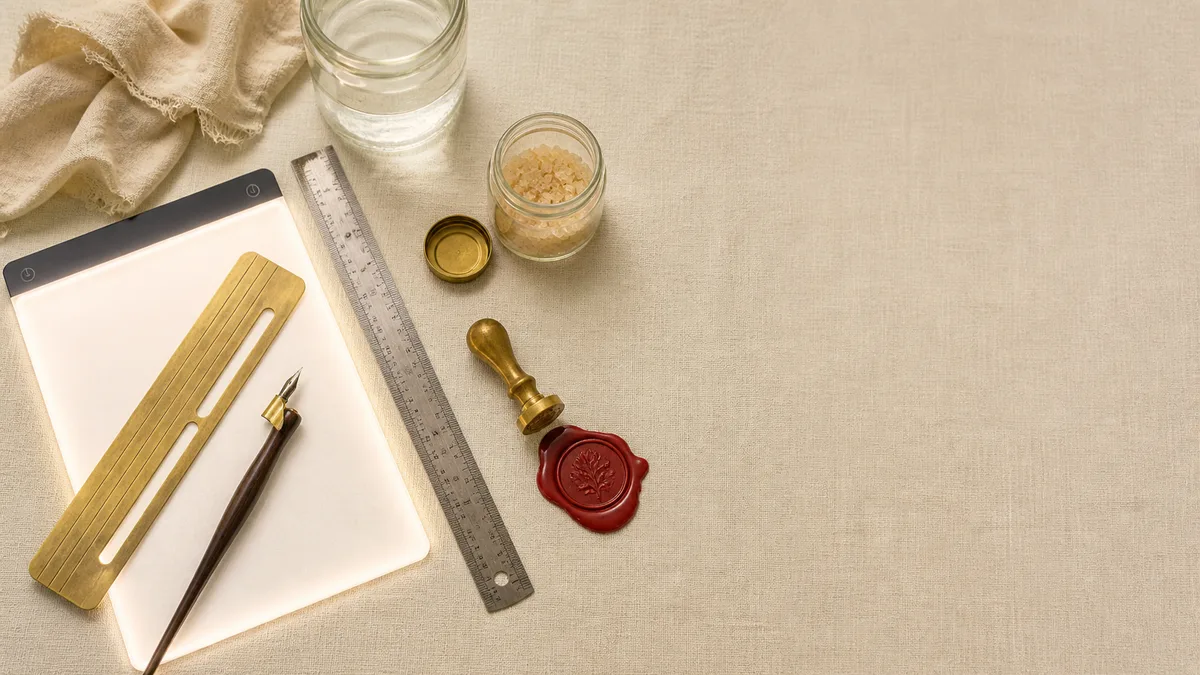
A4 LED light pads transform how you plan compositions and transfer designs. Place your pencil sketch or computer-printed layout on the light pad, overlay your final paper, and the backlight makes the underlying image visible for tracing or positioning reference. This is essential for centering wedding invitations, aligning multi-line certificates, and planning complex illuminated pieces.
Modern LED light pads are thin (5–8mm), lightweight, and powered via USB—a dramatic improvement over the thick, hot fluorescent light boxes from twenty years ago. Brightness is adjustable from dim (for heavy paper) to bright (for thick cardstock). The A4 size (8.3" × 11.7") accommodates standard letter-size work and most European paper formats.
Light pads also excel for learning new scripts. Trace over exemplars from calligraphy books or historical manuscripts to internalize letterform proportions and stroke sequences. This technique—called "skeletal tracing"—helps beginners understand structure before attempting freehand writing.
Precision Rulers and Measuring Tools
Standard office rulers are inadequate for calligraphy layout because they lack the precision and stability required for fine line work. Cork-backed metal rulers solve both problems: the cork prevents slipping during ruling, and stainless steel edges resist wear from repeated pencil or knife use.
Choose rulers with etched (not printed) graduations—printed markings wear off within months of regular use. Etched markings remain legible for decades. For calligraphy work, a 12" (30cm) ruler handles most projects, while an 18" (45cm) ruler accommodates larger formats and diagonal measurements.
T-Squares and Right Angles
Aligning baselines parallel to paper edges requires either a T-square or careful measurement from multiple points. A 12" T-square with cork backing provides quick, repeatable 90° alignment for ruling horizontal baselines. This matters more than you'd think—baselines that drift 1–2° off horizontal create subtle visual tension that readers perceive as "something's wrong" without knowing why.
Pen Cleaning Solutions
Water alone does not remove dried India ink, iron-gall ink, or acrylic formulations from nib surfaces. Speedball Pen Cleaner is an ammonia-free formula specifically designed to dissolve shellac-based ink binders without corroding steel nibs or tarnishing brass flanges.
The alternative—household ammonia cleaners—works but risks nib damage. Ammonia attacks the metal plating on some vintage nibs and accelerates corrosion of steel. If you must use household cleaners, dilute them 1:10 with water and rinse nibs thoroughly within 30 seconds. Professional pen cleaner is gentler and worth the modest cost ($6–$8 for a bottle that lasts 6–12 months).
Cleaning Procedure
For routine cleaning after each session: rinse the nib under lukewarm water, wipe with a soft cloth, and store dry. For stubborn dried ink: soak the nib in pen cleaner for 5–10 minutes, gently agitate with an old toothbrush, rinse thoroughly, and dry. Never soak wooden pen holders in liquid cleaner—the wood will swell and crack. Remove nibs before cleaning.
For detailed material care and maintenance routines, see our comprehensive guides on nibs and inks.
Gum Arabic and Ink Modifiers
Winsor & Newton Gum Arabic is a natural tree resin used to modify ink properties. Adding 2–3 drops of gum arabic per ounce of ink increases viscosity slightly, improves ink adhesion to non-porous papers, and enhances color vibrancy in diluted inks. Historical calligraphers used gum arabic extensively—medieval manuscript illuminators mixed it with pigments to create burnished gold effects and vibrant colors that have lasted centuries.
The practical application for modern calligraphers: use gum arabic when working on coated cardstock, vellum, or other surfaces where standard ink tends to bead up. A few drops transform unusable ink flow into smooth, controlled application. This is particularly valuable for wedding invitations on textured or metallic papers.
Wax Seals and Finishing Tools
Wax seals add historical authenticity and visual impact to finished calligraphy pieces—particularly wedding invitations, certificates, and formal correspondence. Traditional sealing wax (heated with a flame) produces the most authentic appearance but requires practice to avoid drips and burns. Modern self-adhesive wax seals offer convenience at the cost of slightly less convincing texture.
Choose seal designs that complement your script style. Ornate Victorian designs pair beautifully with Spencerian and Copperplate. Simple monograms work better with modern calligraphy. Avoid overly decorative seals on minimalist contemporary work—the clash is jarring.
Adjustable Easels and Writing Surfaces
Adjustable desktop easels improve writing posture and ink flow by tilting your work surface 15–30° from horizontal. This angle reduces neck strain (you're looking slightly down rather than hunching over), improves ink flow from nib to paper via gravity assist, and minimizes hand shadowing across your work.
Professional calligraphers often work at 20–25° angles for extended sessions. The exact angle is personal preference, but some tilt is universally beneficial. Easels range from simple wooden book stands ($15–$25) to professional drafting tables ($200–$500). Start with a basic adjustable easel and upgrade only if you're practicing 10+ hours per week.
Organization and Storage
Proper storage extends the life of your accessories and tools. Store rulers and T-squares flat or hanging vertically—never lean them at angles, which causes warping. Keep light pads in protective sleeves when not in use to prevent surface scratches. Store gum arabic and pen cleaner tightly capped in cool, dark locations.
Organize nibs, pen holders, and small tools in divided storage boxes or tackle boxes. This prevents damage from tools rattling against each other and makes setup faster—you spend time practicing instead of hunting for supplies. A well-organized workspace improves practice consistency because friction disappears—everything is where you expect it to be.
Essential vs. Optional Accessories
If you're building your toolkit gradually, prioritize in this order:
- Essential (buy first)
- Guide sheets or printable guides, cork-backed metal ruler, pen cleaner, soft cleaning cloths.
- High-value (buy within first 6 months)
- LED light pad, Ames lettering guide, adjustable easel, gum arabic.
- Nice-to-have (buy when committed)
- Wax seals, specialty storage, T-square, professional drafting table.
The goal is removing obstacles to consistent practice. Accessories that make practice sessions smoother, faster to set up, and more enjoyable are worth their cost. Accessories that sit unused after initial novelty are not. Be honest about your practice habits and invest accordingly.
Quality Indicators
When evaluating accessories, look for these quality markers:
- Rulers: Etched markings (not printed), cork or rubber backing (not bare metal), stainless steel construction (not aluminum).
- Light pads: Even illumination across entire surface, adjustable brightness (minimum 3 levels), USB-powered with included cable, thin profile (under 10mm).
- Pen cleaner: Ammonia-free formulation, calligraphy-specific (not general art brush cleaner), includes usage instructions.
- Gum arabic: Natural gum arabic (not synthetic substitute), clear or pale amber color (not dark brown), liquid formulation (easier to measure than solid chunks).
Essential Calligraphy Accessories
The supporting kit that keeps your nibs clean, your lines straight, and your posture right
A4 LED Light Pad
Ultra-thin A4 tracing light box with USB power for tracing calligraphy practice sheets, sketching layouts, and transferr…
Falling in Art 5-Position Wood Slant Board
An affordable wood drafting easel that calligraphers use as a slant board. Positioning your work at roughly 30–45° relax…
Pro Art 18-Inch Aluminum T-Square
An 18-inch aluminium T-square for ruling guidelines and baseline grids on practice paper. Pair it with a soft pencil and…
Speedball Pen Cleaner
Professional ink cleaning solution for calligraphy nibs and art tools. 16 oz bottle effectively removes dried ink deposi…
Winsor & Newton Gum Arabic
Watercolor medium that improves flow, increases gloss, and enhances color brilliance. Essential for calligraphy ink adju…
Cork-Backed Metal Ruler (18 inch)
2-pack stainless steel 18-inch rulers with cork backing to prevent slipping. Imperial and metric markings.…
Adjustable Desktop Easel
Adjustable desktop easel for comfortable calligraphy and drawing. Multiple angle settings reduce strain during extended …
Staedtler Ames Lettering Guide
Calligraphy accessory for improving layout and consistency. Staedtler Ames Lettering Guide.…
We may earn a commission when you buy through these links. See all recommendations →
Understanding which accessories genuinely improve your practice versus which are marketing inventions transforms your toolkit from cluttered to purposeful. The masters of traditional calligraphy used simple tools exceptionally well—they understood that accessories serve technique, not replace it. Build your collection thoughtfully, maintain it properly, and these tools will serve you for decades. Combine quality accessories with proper technique, appropriate paper, and our cursive generator for style exploration, and you'll eliminate the common frustrations that derail beginners.