Affiliate Disclosure: This page contains affiliate links to products selected for practical fit. When you purchase through these links, we may earn a commission at no additional cost to you. Recommendations are based on the registry's stated features, price, level, pros, cons, and best-for labels. We do not imply hands-on testing without an explicit page-level record. See our complete Tools Guide for comparison notes and selection criteria.
Your nib choice determines stroke character more than any other variable—the difference between a Nikko G and a Brause EF66 is the difference between forgiving flexibility and uncompromising precision.
Choose a nib for the script and pen setup you plan to use. Compare tip shape, flexibility, holder compatibility, and the maker's intended use. No firsthand comparative nib-testing record or specific historical nib analysis is documented here.
This guide examines every nib category used in professional calligraphy: pointed nibs for Copperplate, Spencerian, and modern script, plus broad-edge nibs for Italic, Gothic, and foundational hands. You'll learn which nibs work best for beginners versus advanced practitioners, how nib width affects letterform proportions, what "springiness" actually means in practical terms, and how to identify quality issues before you waste money on inferior products.
Pointed Nibs vs. Broad-Edge Nibs
Calligraphy nibs divide into two fundamental categories, each producing entirely different stroke characteristics. Pointed nibs have a sharp tip that flexes under pressure to create thick downstrokes and hairline upstrokes—the defining feature of Copperplate, Spencerian, and Engrosser's scripts. Broad-edge nibs have a flat, chisel-shaped tip that maintains constant width throughout each stroke, producing the thick-thin contrast through stroke direction rather than pressure—the hallmark of Italic, Gothic, Uncial, and foundational hands.
This distinction is not just mechanical—it's philosophical. Pointed pen work emphasizes rhythm, pressure modulation, and continuous flow. Broad-edge work emphasizes angle consistency, edge sharpness, and constructed letterforms. Edward Johnston's seminal 1906 text Writing & Illuminating, & Lettering devotes separate chapters to each nib type precisely because the muscle memory and aesthetic principles differ fundamentally.
Pointed Nibs: Flex and Precision
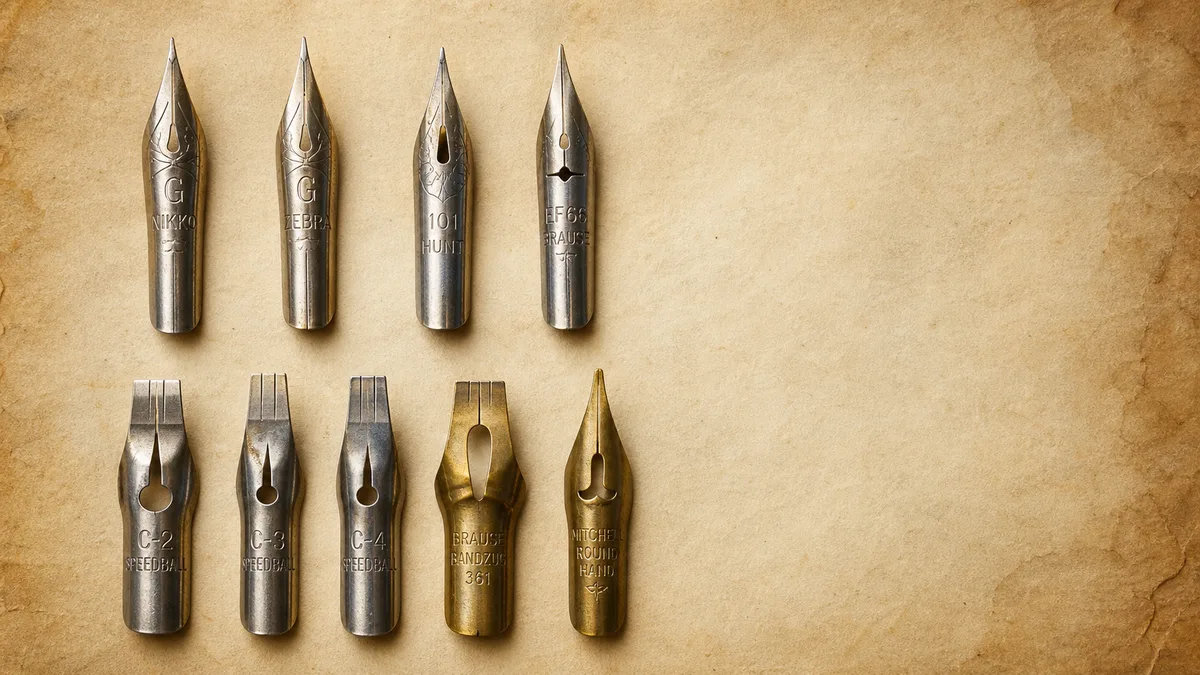
Nikko G: The Beginner's Workhorse
The Nikko G nib dominates beginner recommendations for good reason: it's nearly indestructible, forgiving of inconsistent pressure, and produces clean hairlines even when writing too fast. Originally designed for manga illustration, the Nikko G has a stiffer flex profile than traditional Copperplate nibs, which means beginners can achieve decent thick-thin contrast without the precise pressure control that formal scripts demand.
The trade-off? Less dramatic line variation. A skilled calligrapher using a Hunt 101 or Gillott 303 will produce swells and hairlines that a Nikko G simply cannot match. But for learning proper letterforms, mastering slant angle, and building muscle memory, the Nikko G's stability outweighs its limited flex range. Expect 40–60 hours of practice before a Nikko G feels "worn in" to your personal pressure and starts to develop character.
Zebra G: Smooth Flex for Modern Calligraphy
The Zebra G nib sits between the stiff Nikko G and highly flexible vintage nibs. It offers noticeably smoother ink flow and more responsive flex than the Nikko, making it ideal for modern calligraphy styles where exaggerated flourishes and thick downstrokes create visual impact.
Excessive pressure can permanently splay a pointed nib's tines. Start with light strokes and increase pressure gradually within the nib's response. Nikko G and Zebra G are options to compare, not mandatory stages in a learning sequence.
Brause EF66: Extra-Fine Copperplate Precision
The Brause EF66 Extra Fine nib is the professional standard for formal Copperplate and Engrosser's Script. Its hairlines are finer than any Japanese manga nib, and its flex response is immediate and precise. Master penmen like Michael Sull and Jake Weidmann favor the EF66 for certificate work and formal engrossing because it produces the razor-sharp hairlines that define professional-grade script.
The challenge? The EF66 is unforgiving. Any wobble in your hand, any inconsistency in pressure, any rough spot on your paper—it will catch and skip. I would not recommend the EF66 to anyone with fewer than 100 hours of pointed pen experience. This is a precision instrument that demands precision technique.
Additionally, the EF66 wears faster than other nibs. On toothy paper (anything rougher than Rhodia or HP 32lb), expect the tip to dull after about 6–8 hours of writing. On ultra-smooth paper, you'll get 15–20 hours before replacement. Budget accordingly.
Broad-Edge Nibs: Width and Angle
Understanding Nib Widths
Broad-edge nibs are measured in millimeters of edge width: 0.5mm, 1mm, 1.5mm, 2mm, 2.5mm, 3mm, and upward to 6mm for display work. The nib width determines x-height proportions in traditional scripts. Italic script, for example, specifies an x-height of 5 nib-widths—meaning if you use a 2mm nib, your lowercase letters should measure 10mm tall. Gothic Textura uses 4.5 nib-widths, while Uncial uses 4 nib-widths.
This is not arbitrary. These ratios evolved over centuries to produce optimal readability and aesthetic balance at manuscript scale. When you see historical exemplars that look "wrong," it's often because a modern scribe used incorrect nib widths relative to x-height. Follow the traditional proportions until you understand them well enough to break them intentionally.
Speedball C-Series: American Standard
Speedball C-Series nibs are the most widely available broad-edge nibs in North America. They're affordable ($1–$2 per nib), consistent in manufacturing quality, and available in sizes from C-0 (largest) to C-6 (smallest). The C-2 (approximately 2.5mm) is ideal for learning Italic, while the C-3 (approximately 2mm) works well for Foundational hand.
The main limitation is edge sharpness. Speedball nibs have slightly rounded corners compared to European nibs, which produces less crisp serifs. For practice and informal work, this doesn't matter. For formal pieces or historical reproduction, consider Mitchell or Brause nibs.
Lamy Z50: Fountain Pen Convenience
The Lamy Z50 nib set offers broad-edge calligraphy in fountain pen format—no dipping required beyond normal cartridge or converter refills. The 1.1mm, 1.5mm, and 1.9mm nibs fit Lamy Joy pens and provide consistent ink flow without the mess of traditional dip nibs. This is transformative for beginners who find dip-and-write rhythm frustrating.
The trade-off is limited size range and slightly less crisp edges than traditional dip nibs. But for daily practice, note-taking in calligraphic hands, or sketching letterform ideas, fountain pen nibs eliminate friction and keep you writing. Pair with our practice sheet generator for guided drills.
Nib Selection Matrix
- Beginner pointed pen (first 50 hours)
- Nikko G. Build pressure control and consistent slant before moving to more responsive nibs.
- Intermediate pointed pen (50–200 hours)
- Zebra G for modern styles, Brause EF66 for traditional Copperplate. Experiment with both to understand flex range.
- Advanced pointed pen (200+ hours)
- Hunt 101, Gillott 303, vintage specialty nibs. Match nib characteristics to specific script requirements.
- Beginner broad-edge
- Speedball C-2 or C-3, or Lamy 1.5mm fountain nib. Learn angle consistency and stroke sequence.
- Intermediate broad-edge
- Mitchell Roundhand or Brause Bandzug in multiple widths. Explore different script proportions.
- Advanced broad-edge
- Pilot Parallel pens for color mixing, or handmade quills for historical reproduction.
Quality Issues to Watch For
Not all nibs are created equal, even within the same model. Manufacturing inconsistencies are common, especially in budget-priced nibs. Before committing a new nib to final work, test for these issues:
Misaligned tines: Hold the nib up to light. The two tines should meet perfectly at the tip with no gap. Even a hair-width gap will cause ink flooding and poor hairlines.
Rough spots: Run your fingernail gently across the nib tip. You should feel uniform smoothness. Any catch or roughness will snag on paper.
Inconsistent flex: For pointed nibs, test flex on scrap paper. The tines should spread evenly under pressure and return to original position immediately. Uneven flex indicates metal fatigue or manufacturing defect.
Expect about 1 in 10 budget nibs to have quality issues. This is why buying nibs in bulk (packs of 10 or more) makes economic sense—you'll have backups when you encounter a dud. For detailed technique guidance and common pitfalls, see our comprehensive guides.
Pairing Nibs with Holders and Inks
Nib performance depends heavily on pen holder compatibility and ink viscosity. Pointed nibs designed for oblique holders (like the Brause EF66) perform poorly in straight holders because the angle changes. Broad-edge nibs require holders with sufficient grip diameter to maintain proper edge angle. For holder selection, see our pen holder guide.
Ink viscosity matters equally. Thin, fluid inks (like Japanese sumi ink) work beautifully with fine-pointed nibs but may flood broad-edge nibs. Thicker India inks control well in broad nibs but can skip in extra-fine pointed nibs. Match your ink to your nib—see our ink selection guide for detailed compatibility information.
Understanding nib mechanics, flex characteristics, and quality indicators transforms your tool selection from guesswork to informed choice. The masters documented in calligraphic history spent years testing and refining nib preferences—you can shortcut that process by learning from their collective experience. Pair your nib knowledge with structured practice and you'll progress faster than you thought possible.
Best Calligraphy Nibs
Top pointed and broad-edge nibs for Copperplate, Spencerian, and italic hands
Nikko G Nib
The most recommended beginner pointed pen nib. Offers medium flexibility, excellent durability, and forgiving feedback. …
Zebra G Nib
Similar to Nikko G with slightly more spring and resistance. Popular alternative for beginners learning pointed pen call…
Brause EF66 Extra Fine Nib
European-made nib producing extremely thin hairlines at 0.2mm. Requires very light pressure and advanced technique. Exce…
Hunt Artist Pen Points 103 & 104 (Crow Quill)
The Hunt 103 (Mapping) and 104 (Crow Quill) are the canonical micro-fine pointed nibs used by illustrators and engrosser…
Speedball C-Series Nibs
Round hand nibs for Gothic, Italic, and Uncial scripts. Standard teaching tool in most U.S. calligraphy classes since th…
LAMY Z 50 Nib Set for Joy 1.1mm
Broad-edge calligraphy nib for italic, blackletter, and foundational scripts. LAMY Z 50 Nib Set for Joy 1.1mm.…
We may earn a commission when you buy through these links. See all recommendations →