Affiliate Disclosure: This page contains affiliate links to products selected for practical fit. When you purchase through these links, we may earn a commission at no additional cost to you. Recommendations are based on the registry's stated features, price, level, pros, cons, and best-for labels. We do not imply hands-on testing without an explicit page-level record. See our complete Tools Guide for comparison notes and selection criteria.
The pen holder you choose determines your writing angle, comfort level, and ultimately whether you'll develop proper technique or fight against your tools for years.
After spending the first three years of my calligraphy journey using the wrong pen holder—a cheap straight holder that made achieving the required 52–55° slant angle physically uncomfortable—I understand why so many beginners quit before they experience real progress. The International Association of Master Penmen, Engrossers and Teachers of Handwriting (IAMPETH) archives contain extensive documentation on pen holder design, and one principle emerges consistently: the holder must position the nib at the correct angle naturally, without forcing your wrist into unnatural contortions.
This guide examines straight holders versus oblique holders, explains when each type is appropriate, covers nib fitting and flange adjustment, and provides specific recommendations based on hand size, writing posture, and target scripts. You'll learn why Copperplate and Spencerian practitioners almost universally prefer oblique holders, while Italic and foundational hand scribes use straight holders exclusively.
Straight Holders vs. Oblique Holders
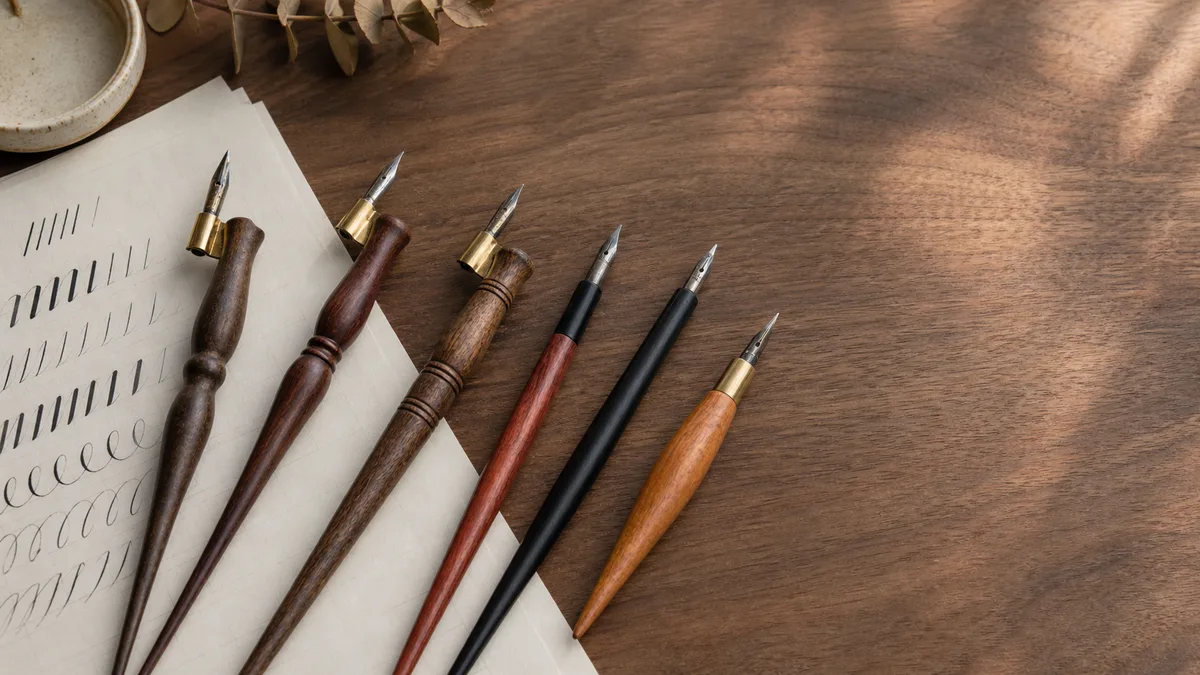
Pen holders divide into two fundamental designs, each solving a different geometric problem. Straight holders position the nib in line with the barrel axis—what you'd expect from a traditional pen. Oblique holders (also called "offset holders") position the nib at a lateral angle to the barrel via a metal flange, allowing right-handed writers to achieve steep slant angles (52–55°) without twisting their wrist uncomfortably.
The critical distinction: straight holders work beautifully for scripts that require minimal slant or no slant (Italic at 5–10°, foundational hand upright, Gothic upright). Oblique holders are essential for scripts requiring steep rightward slant (Copperplate at 52–55°, Spencerian at 52°, Engrosser's Script at 54°). Trying to write Copperplate with a straight holder forces you to either angle your entire paper 30° left or twist your wrist into carpel-tunnel-inducing positions. Neither works long-term.
Oblique Holders: The Copperplate Essential
Speedball Oblique Holder: Entry-Level Standard
The Speedball Oblique Holder is the most commonly recommended oblique for beginners, and for good reason: it's affordable ($8–$12), widely available, uses a standard brass flange that fits most pointed nibs, and the barrel diameter works for average-sized hands. The plastic barrel is lightweight, which reduces hand fatigue during extended practice sessions.
The limitations become apparent after about 100 hours of use. The plastic barrel can crack if dropped, and the flange position is fixed—you cannot adjust the nib angle once it's set. For most beginners working through their first year of Copperplate practice, these limitations don't matter. By the time you've developed enough skill to notice the Speedball's constraints, you'll know exactly what you want in an upgraded holder.
Tachikawa T-36: Japanese Precision
The Tachikawa T-36 oblique holder represents a significant step up in quality and adjustability. The brass flange is repositionable, allowing you to fine-tune nib angle in 1–2° increments—critical for matching your natural hand position to script requirements. The wooden barrel is thicker than the Speedball, providing better grip for larger hands and more substantial weight for those who prefer a heavier pen.
The T-36's flange design accommodates a wider range of nib sizes and shapes than the Speedball, making it ideal if you experiment with multiple nib types. The trade-off is price ($18–$25) and availability—Tachikawa holders are often out of stock at major retailers. But if you're serious about Copperplate or Spencerian, the T-36 is a worthwhile investment.
Artisan Oblique Holders: Premium Options
Handcrafted wooden oblique holders from specialty makers offer superior balance, custom barrel dimensions, and aesthetic appeal. These holders—often turned from exotic hardwoods like cocobolo, ebony, or figured maple—are the calligrapher's equivalent of a custom fountain pen. Prices range from $40 to $150 depending on materials and craftsman reputation.
The functional advantage is precise weight distribution. A well-balanced oblique holder reduces hand fatigue during multi-hour sessions and provides tactile feedback that improves letterform consistency. The aesthetic advantage is personal: a beautiful tool makes practice more enjoyable. After 500+ hours of Copperplate work, treating yourself to a custom holder is a meaningful milestone.
Straight Holders: Simplicity and Versatility
Standard Cork-Grip Holders
A basic cork-grip straight holder is one option for a dip-pen setup. Check the holder's nib-fitting system against the exact nib you plan to use; no holder accepts every size. Compare grip comfort and construction rather than assuming a universal lifespan or price.
The key is barrel diameter. Holders with 8–10mm diameter barrels work for most hands. Thinner barrels (6–7mm) suit smaller hands or those who prefer a lighter touch. Thicker barrels (11–13mm) provide more substantial grip for larger hands or those who tend to grip tightly.
Convertible Holders
The Speedball 2-in-1 Convertible Holder offers both straight and oblique functionality in a single tool via an attachable flange. This is economical for beginners who want to experiment with both Italic and Copperplate without buying separate holders. The downside is compromised ergonomics—the convertible design means neither configuration is optimized for extended use.
Use convertible holders for exploration and experimentation, but once you commit to a specific script family, invest in a dedicated holder. The difference in comfort and control becomes obvious after 20–30 hours of practice.
Nib Fitting and Flange Mechanics
Proper nib installation ensures stable ink flow and prevents wobbling during writing. For straight holders with universal grips, slide the nib shaft into the holder opening until it's firmly seated—typically 8–10mm of insertion depth. The nib should not wiggle side-to-side when shaken. If it does, wrap the nib shaft with a thin strip of paper or adhesive tape to increase diameter slightly.
For oblique holders, the brass flange grips the nib shaft laterally. Insert the nib with the writing surface facing up and the shaft positioned in the flange's curved grip. Tighten the set screw (if present) until the nib is secure but not crushed—over-tightening can deform the nib shaft and affect flex characteristics.
Testing Nib Security
After installing a nib, perform this three-part security check: (1) Gently press the nib tip against paper as if starting a downstroke—it should not shift in the holder. (2) Twist the holder barrel while observing the nib—it should rotate with the barrel, not remain stationary. (3) Tap the holder barrel gently against your palm—the nib should not rattle or move.
A properly seated nib becomes an extension of the holder, creating a unified tool where all forces transmit cleanly from hand to paper. A loose nib creates unpredictable line variation and makes pressure control nearly impossible—you're compensating for mechanical instability rather than focusing on letterforms.
Specialized Holders
Reservoir Holders
Some straight holders feature built-in ink reservoirs that attach to the nib, reducing dipping frequency. The Walnut Tilting Pen Holder set includes integrated ink wells that minimize drips and spills. These systems work well for broad-edge calligraphy where consistent ink volume matters, but they're less suitable for pointed pen work where frequent dipping is part of the rhythm.
Reservoir holders require more cleaning but offer convenience for long sessions. If you're writing wedding invitations or certificates—projects requiring 2–4 hours of continuous work—reservoir systems reduce interruptions and maintain flow consistency.
Ergonomic and Adaptive Holders
Calligraphers with arthritis, carpal tunnel, or other hand conditions benefit from ergonomically-designed holders with cushioned grips, larger diameters, or angled barrels. These specialized tools reduce strain and make extended practice possible for those who would otherwise struggle with standard holders.
Holder Selection by Script
Copperplate and Spencerian: Oblique holder required. Start with Speedball Oblique, upgrade to Tachikawa T-36 after 100 hours. Consider artisan holders after 500+ hours.
Italic and foundational hands: Straight holder. Cork-grip standard holders work perfectly. Match barrel diameter to hand size.
Modern calligraphy: Either straight or oblique depending on your target slant angle. If you're writing upright or minimal slant (0–20°), use straight. For dramatic slant (40–55°), use oblique.
Gothic and Blackletter: Straight holder. These scripts are traditionally written upright or with minimal slant.
Uncial and Celtic: Straight holder. Barrel weight matters less than diameter—choose comfortable grip over heft.
Maintenance and Care
Clean pen holders after each session by wiping with a damp cloth to remove ink residue. For cork grips, avoid soaking—excessive moisture causes cork to swell and crack. For wooden holders, treat with mineral oil or beeswax once every 3–4 months to prevent drying and splitting.
Brass flanges benefit from occasional polishing with a soft cloth to prevent tarnish buildup. Do not use abrasive cleaners on flanges—you'll scratch the brass and create rough spots that damage nib shafts during insertion.
Store holders horizontally in a drawer or pen case rather than vertically in a cup. Vertical storage concentrates weight on the nib connection point and can loosen grip mechanisms over time. For comprehensive tool care, see our complete guide and materials overview.
Understanding pen holder mechanics, flange geometry, and ergonomic fit transforms your practice sessions from frustrating struggles to focused skill development. The historical masters documented in calligraphic traditions understood that the holder is not incidental—it's the interface between your hand and the page. Choose wisely, fit carefully, and your holders will serve you for decades. Combine proper holder selection with quality inks, appropriate paper, and structured practice, and you'll progress faster than you imagined possible.
Best Calligraphy Pen Holders
Reliable straight and oblique holders for pointed-pen calligraphy
Speedball Oblique Holder
Adjustable oblique pen holder with metal flange for Copperplate and Spencerian scripts. Affordable entry point for point…
Tachikawa T-36 Holder
Comfortable straight pen holder with ergonomic grip. Popular upgrade from basic holders for calligraphers who write for …
Wood Calligraphy Oblique Dip Pen Holder Set
Dip pen holder for pointed and broad-edge calligraphy nibs. Wood Calligraphy Oblique Dip Pen Holder Set.…
Walnut Wood Tilting Calligraphy Pen Holder with Ink Bottles
Dip pen holder for pointed and broad-edge calligraphy nibs. Walnut Wood Tilting Calligraphy Pen Holder with Ink Bottles.…
Koh-I-Noor Cork-Grip Wooden Pen Holder (127N)
Koh-I-Noor Hardtmuth's classic 127N straight holder. The split-petal collar takes broad-edge speedball, Brause and Mitch…
Speedball 2-in-1 Convertible Penholder
Dip pen holder for pointed and broad-edge calligraphy nibs. Speedball 2-in-1 Convertible Penholder.…
We may earn a commission when you buy through these links. See all recommendations →