
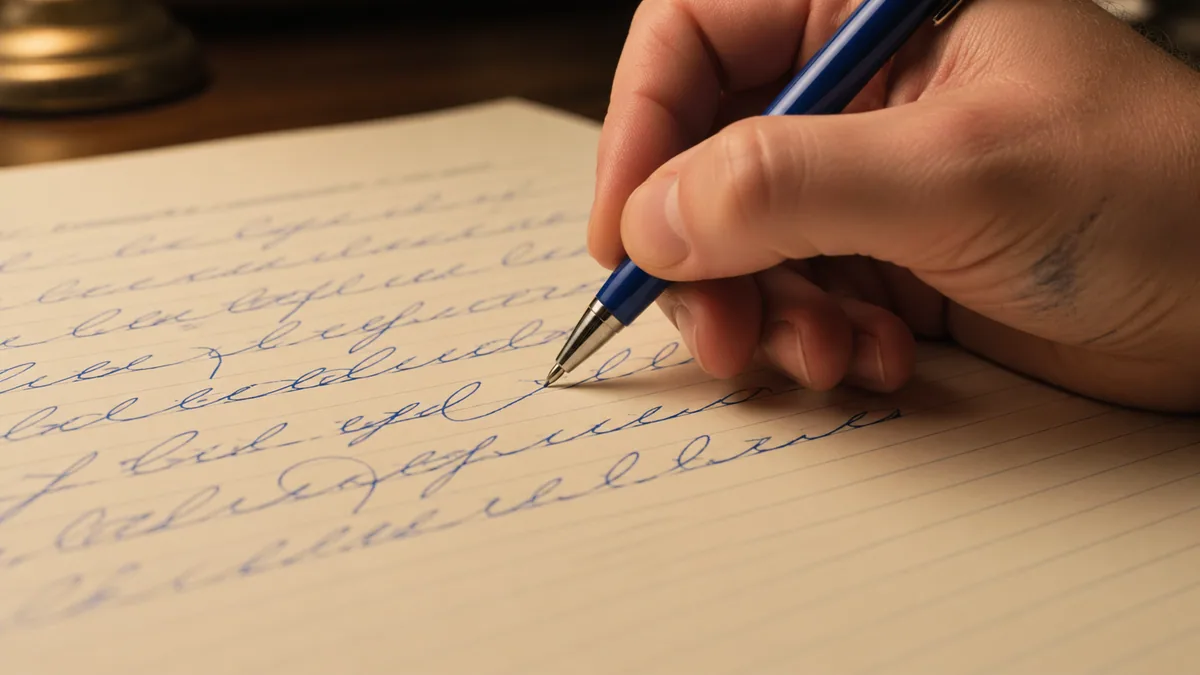
A practical way to read cursive
To read cursive handwriting, scan the whole passage, find a few certain words, and use their letters to decode uncertain ones. Check dots, crossbars, loops, and joins before choosing a word that fits the sentence. Leave a gap when the marks do not support a confident reading.
You do not need to write beautiful cursive to read a family letter or a classmate's notes. Reading means recognizing another person's forms; writing means learning to produce your own. Our cursive writing guide covers that separate skill. Here, the task is to work out what is on the page without quietly replacing it with what you expect.
- Read the heading, date, and surrounding lines first. A shopping list gives different clues from a letter about a journey.
- Write down words you can read without guessing. Short repeated words can give you a starting alphabet for this particular writer.
- Compare an uncertain letter with a clear example elsewhere on the same page. Keep alternatives until the shapes settle the question.
- Read your draft aloud, then look back at the original. A plausible sentence is a useful check, not proof that each word is right.
This comparison method follows the US National Archives' transcription tips: compare similar letters in the same document, preserve what the writer actually wrote, and mark words you cannot read.
Tell similar letters apart
Begin with the letter body, not the flourish. The baseline is where most letters sit; ascenders rise above the small letters and descenders dip below them. Those height differences can narrow a guess before you identify every stroke. The cursive alphabet reference helps you compare forms, but a reference alphabet is not a universal key. Writers often mix printed and joined letters.
- For i, u, n, and m, look for dots and repeated short strokes. Do not count a connecting stroke as a separate letter.
- For a and o, inspect the closing stroke and exit, then compare other round letters by the same writer. An open oval alone may not settle it.
- For e and l, compare height against neighboring letters. A narrow e loop can look tall when the whole word slopes upward.
- For r and s, collect examples in different word positions. A writer's final form may differ from their middle form.
Exercise: separate similar letters
Read the three groups below. Which includes a dot? Which is one letter, and which might be mistaken for one? Compare the m and r references if you need a hint.
Reveal letters and recognition clues
Typed transcript: in / m / rn
The first group is i followed by n; the dot is a useful clue. The middle is a single m. The final group is r followed by n, not m. In cramped handwriting, rn and m may be hard to distinguish. Compare a known r and m in the same document rather than relying on the number of bumps alone.
Read joins and word shapes together
A join carries the pen between letter bodies. It can stretch, rise, or blend into the next stroke, so a word does not always divide neatly into isolated alphabet shapes. Look for an oval, tall loop, or descender as an anchor, then work outward. Our guide to cursive letter joins explains the connections from a writer's side.
Exercise: find the repeated ending
Read both words. Do you see "come home" or "corne horne"? Compare the middle and ending of each word before you use the familiar phrase as a clue.
Reveal words and join clues
Typed transcript: come home
Both words end in o-m-e. The repeated m is evidence for the reading, while the phrase supplies a context check. A long connection does not automatically add another letter. On a real page, search for the writer's known m before ruling out rn.
Context works best after you inspect the marks. If a sentence mentions a station, "train" is a sensible candidate, but it still needs letters that support that reading. Proper names, unfamiliar places, and spelling errors are especially easy to replace with a more familiar word by accident.
How to read handwritten notes
Notes often omit full sentences, mix capitals with lowercase, or squeeze an instruction into a margin. Scan for the recipient, action, objects, place, and time. Then read in line order. Keep abbreviations as written in a transcript; put any expansion in a separate explanation.
Exercise: recover an instruction
Read this invented note. Identify what to bring and when to meet. If the first letter of "blue" gives you trouble, compare it with "bring" and "by". Contrast those with the g in "gate".
Reveal note transcript and comparison
Typed transcript: Mina, bring the blue folder. Meet me by the gate at nine.
Bring the blue folder; meet by the gate at nine. Mina is the recipient, not necessarily the writer. The note does not say morning or evening. Do not add that missing information just because one time seems more likely.
For a longer page, keep a small list of the writer's unusual forms beside your draft. Return to stubborn words after reading the next paragraph. If the note is yours to ask about, asking its writer is often more reliable than repeated guessing. Do not act on an uncertain medication, safety instruction, amount, or deadline; confirm it with the responsible person.
How to read handwritten signatures
A signature offers less context than a sentence, and its strokes may not preserve readable letters. Start with clearly visible initials, separate possible ornament from letter bodies, and compare the sign-off with a printed name elsewhere on the document. Treat that printed name as a clue, not independent proof.
Exercise: read a sign-off without inventing a name
Try this fictional, typeset sign-off. What can you transcribe? What information is absent?
Reveal sign-off and its limits
Typed transcript: M. Lane
The intended text is M. Lane. M does not tell us the full first name. A similar-looking mark on a real document could remain uncertain even with context. Reading a name does not establish who signed it or whether the document is genuine.
When older handwriting still will not resolve
Older records can use forms that differ from modern school cursive. The National Archives' tips illustrate the long s, which can resemble f, and unfamiliar forms of p. Identify the period and compare letters within the document before applying a modern alphabet. Our history guide gives broader script context, not a transcription key.
For a formal transcript, follow the archive or project's conventions. The US National Archives asks contributors to preserve spelling, capitalization, abbreviations, and punctuation, and use [illegible] for unreadable words. Other projects may use different notation. Keep a faithful transcript separate from a corrected, easier-to-read version.
Practice with a checkable answer
Read one short passage, make a transcript, and check it against a trusted reading when available. Record what changed your mind: a repeated letter, a descender, or a word you had assumed too soon. Revisit that feature in the next passage. Accuracy matters more than finishing quickly.
You can use the cursive generator to compare the same short phrase in different labelled fonts. That is controlled type recognition, not handwriting recognition or OCR. Follow it with real archival material if your goal is to read older letters. The UK National Archives' reading old documents resources link to palaeography lessons using documents dated 1500–1800. Their historical scope differs from the modern examples here.
If you prefer a printed alphabet reference, our calligraphy books guide distinguishes alphabet references from writing workbooks. These are optional aids for studying formal letterforms, not keys to an individual person's handwriting. You do not need to buy a book to use the reading method here.
Sources and example notes
- US National Archives: Transcription Tips. Guidance on letter comparison, context, faithful transcription, and unreadable words; also examples of historical letterforms.
- UK National Archives: Reading old documents. A directory of historical reading tutorials for further study.
Sources checked November 10, 2026. Teaching text and annotations were authored for this guide; no archival specimens or personal documents are reproduced.