
Affiliate Disclosure: This page contains affiliate links to products selected for practical fit. When you purchase through these links, we may earn a commission at no additional cost to you. Recommendations are based on the registry's stated features, price, level, pros, cons, and best-for labels. We do not imply hands-on testing without an explicit page-level record. See our complete Tools Guide for comparison notes and selection criteria.
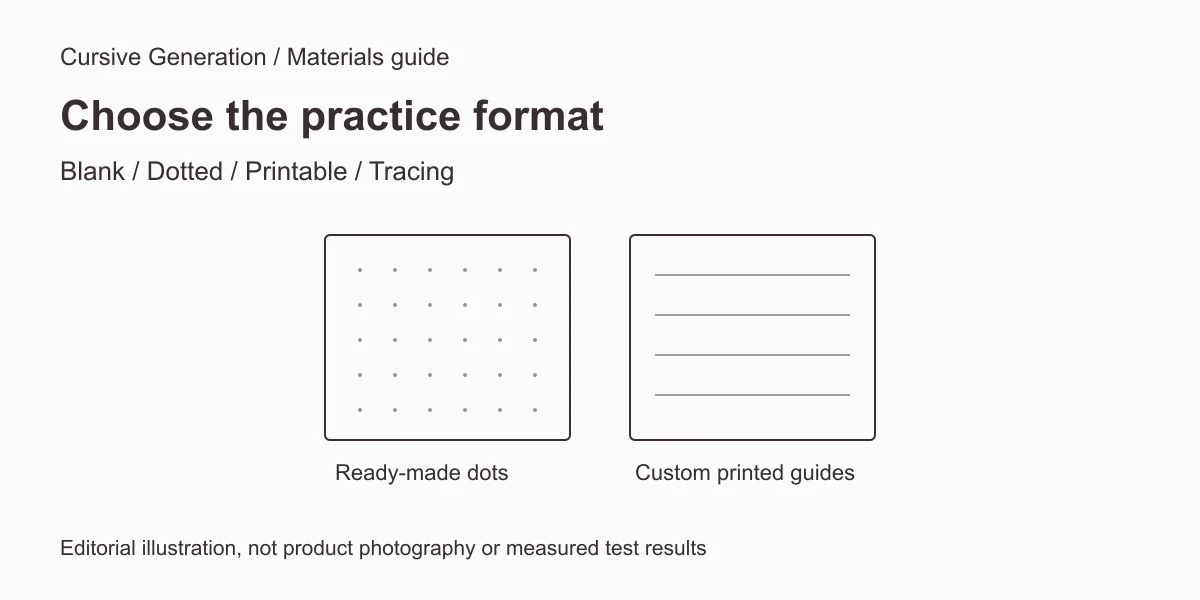
Choose Rhodia DotPad for ready-made spacing guides, Clairefontaine Triomphe for a blank writing pad, or HP Premium32 for printing repeat exercises in a compatible printer. Studio Series is the more direct option when you want printed Italic and Copperplate ruling without preparing a sheet yourself.
There is no universal bleed-proof winner. The same sheet can behave differently with a wet dip nib, a fine fountain pen and a felt brush tip. This shortlist helps choose a format to try; the paper-types guide explains the materials in more depth.
Source review: October 9, 2026. These are research-based buying recommendations, not hands-on comparative tests. Manufacturer and specialist sources are distinguished from retailer specifications. Unknown details stay unknown; a seller's performance claim is not a result measured by us.
Quick picks
| Pick | Best for | Surface | Weight | Format | Pen / working method | Seller |
|---|---|---|---|---|---|---|
| Rhodia Dot Pad A4 | Ready-made spacing guides on smooth pad paper | Smooth; 5 mm dots | 80 gsm | No. 18 A4; 80 sheets | Pen or small brush trials | Check price |
| Clairefontaine Triomphe Paper Pad | Blank correspondence and guide-underlay practice | Smooth and blank | 90 gsm | A4; 50 sheets | Fountain or dip-pen trials | Check price |
| HP Premium 32lb Laser Paper | Printing many copies of a chosen exercise | Manufacturer: super smooth | 32 lb | US Letter; 500-sheet ream | Printer plus pen tests | Check price |
| Strathmore 400 Calligraphy Pad | A natural-white calligraphy pad for pen trials | Natural white; test nib drag | Retailer: 20 lb | Retailer: 8.5 x 11 in; 50 sheets | Calligraphy pens; test wet ink | Check price |
| Tomoe River Paper Pad (52gsm) | Trying thin fountain-pen paper | Retailer: smooth, unruled | Retailer: 52 gsm | Cream A5; 100 sheets | Fountain-pen trials | Check price |
| Apica Premium CD Notebook A5 (7mm Lined) | Keeping dated practice together in a ruled notebook | 7 mm horizontal rules | Not independently verified | Premium C.D. A5; 96 sheets | Everyday pen trials | Check price |
| Strathmore 300 Tracing Pad, 11 x 14 | Reusing an exemplar underneath tracing paper | Transparent tracing paper | Retailer: 25 lb | 11 x 14 in; 50 sheets | Pencil first; test marker or ink | Check price |
| Studio Series Calligraphy Paper Pad | Starting with printed Italic or Copperplate ruling | Smooth; pre-ruled | 140 gsm | 11 x 8.5 in; 50 pages | Pen and calligraphy marker | Check price |
How we chose these options
We checked product identities against the linked listings, then compared documented features with the work a reader wants to do. Prices and stock change, so the links show current seller information instead of a copied price. The order reflects a buying task, not a score from a laboratory test.
- Match the surface to the tool before comparing sheet weight.
- Keep blank, dotted, ruled and script-specific pages separate.
- Identify the linked size and pack instead of borrowing another variant’s specifications.
- Separate a printer-compatible loose ream from a glued pad or bound notebook.
- Treat bleed, drying and show-through as properties to test with the actual ink.
- Label retailer specifications when the manufacturer page could not be verified.
A familiar brand name is not enough to establish the nib, tip, paper format or contents of a particular package. Check the selected variant at checkout. Where a manufacturer page was unavailable, the pick identifies the retailer as its source rather than presenting that listing as independent verification.
Smooth pads for daily pen practice
Rhodia Dot Pad A4
Best for: Ready-made spacing guides on smooth pad paper.
Rhodia's No. 18 A4 DotPad has 80 sheets of 80 gsm paper and a 5 mm dot grid. The manufacturer specifies a smooth surface and microperforated pages. Choose it when dots will help you keep letters aligned without printing an exercise first.
Dots are useful for spacing and rough layout, but they are not a Copperplate slant grid. They also stay on the original after you finish writing. For a letter you intend to give someone, a blank sheet over a separate guide may be the better arrangement.
The stiff backing can support a short session away from the desk. It does not turn the pad into watercolor paper or guarantee that a heavy ink load stays on one side. Compare it with printable paper in HP Premium32 versus Rhodia.
Read the Rhodia Dot Pad A4 review for specifications, package checks, and buying caveats.
- Smooth; 5 mm dots
- 80 gsm
- No. 18 A4; 80 sheets
- Pen or small brush trials
Compared with Triomphe: check the linked variants, task fit and evidence limits.
Compared with HP Premium32: check the linked variants, task fit and evidence limits.
Reasons to consider it
- Dots guide alignment while leaving the letter shapes open.
Trade-offs
- A pad is not a printer-ready ream and dots do not disappear.
Skip it if: Dots must not appear on the finished original.
Source: Rhodia: original dotPad.
Check priceClairefontaine Triomphe Paper Pad
Best for: Blank correspondence and guide-underlay practice.
Triomphe is the blank A4, 50-sheet, 90 gsm version in this listing. It suits a reader who wants an unruled original rather than dots or lines as part of the page. Specialist retailer Goulet documents the paper and a separate guide underlay.
Underlay visibility depends on your lighting and work surface. Check that you can see the guide while sitting comfortably, not only while holding the sheet up to a window. A blank surface is less useful if you keep leaning over to find the baseline.
The Triomphe versus Rhodia comparison is mostly a choice between blank and printed dots, not a claim that one paper makes every ink behave better. Test the exact pen you plan to use for correspondence.
Read the Clairefontaine Triomphe Paper Pad review for specifications, package checks, and buying caveats.
- Smooth and blank
- 90 gsm
- A4; 50 sheets
- Fountain or dip-pen trials
Compared with Rhodia DotPad: check the linked variants, task fit and evidence limits.
Reasons to consider it
- Blank sheets keep the original clear of printed practice marks.
Trade-offs
- Underlay visibility depends on light, ink and working surface.
Skip it if: You want permanent printed guidelines on every sheet.
Source: Goulet Pens: Triomphe A4 blank tablet.
Check priceStrathmore 400 Calligraphy Pad
Best for: A natural-white calligraphy pad for pen trials.
The Strathmore 400 listing is natural-white calligraphy paper, not heavy watercolor stock. The retailer identifies 20 lb, 50 sheets and an 8.5 by 11 inch pad. We could not retrieve the manufacturer's product page, so those figures are labelled as retailer specifications.
Consider one pad when you want to try that particular surface with a calligraphy pen. Do not buy a large supply because the word calligraphy appears on the cover. A sharp nib, thick ink or heavy brush load can expose limits that a general-purpose description does not explain.
Natural white also changes how a color appears compared with bright white. Keep an ink sample on the actual sheet if the final project needs several pieces to match.
- Natural white; test nib drag
- Retailer: 20 lb
- Retailer: 8.5 x 11 in; 50 sheets
- Calligraphy pens; test wet ink
Reasons to consider it
- Loose practice work can stay together in a tape-bound pad.
Trade-offs
- Manufacturer page was unavailable; confirm pack specifications before ordering.
Skip it if: You need heavy card stock or watercolor paper.
Source: Retailer listing, identity checked October 9, 2026.
Check priceTomoe River Paper Pad (52gsm)
Best for: Trying thin fountain-pen paper.
This listing is a Sakae Technical Paper Tomoe River FP pad, cream A5, with 100 unruled sheets. The retailer states 52 gsm. Confirm that exact package; Tomoe River is used across different notebooks, pads and paper generations.
Choose thin paper because you want to explore its writing feel and compactness, not because “fountain-pen friendly” means opaque. Show-through is seeing writing through the sheet; bleed-through is ink reaching the reverse surface. They are different problems and need separate checks.
Use one page to test drying and the reverse side before writing on both sides of a whole pad. We do not establish which current mill made this stock or promise that every Tomoe River product performs identically.
- Retailer: smooth, unruled
- Retailer: 52 gsm
- Cream A5; 100 sheets
- Fountain-pen trials
Reasons to consider it
- Light sheets make a compact pad for ink and handwriting samples.
Trade-offs
- Do not infer opacity or exact current paper mill from the family name.
Skip it if: You need stiff pages or a guaranteed opaque reverse side.
Source: Retailer listing, identity checked October 9, 2026.
Check pricePrinting volume and keeping a practice record
Apica Premium CD Notebook A5 (7mm Lined)
Best for: Keeping dated practice together in a ruled notebook.
The linked Apica is the Premium C.D. A5 notebook with 7 mm rules and 96 sheets, not an unspecified basic C.D. notebook. Use it when keeping dated pages together is more useful than removing every finished exercise.
Horizontal ruling gives you a baseline, but does not establish the proportions or slant for a particular script. We have not independently verified its paper weight, so the table leaves that field unknown rather than borrowing a figure from another notebook.
Bound pages make change over time easier to inspect. Leave a small note with the pen and ink used. If a later page looks different, you can distinguish a new material from a change in your writing.
- 7 mm horizontal rules
- Not independently verified
- Premium C.D. A5; 96 sheets
- Everyday pen trials
Reasons to consider it
- Bound pages make it easy to compare one session with the next.
Trade-offs
- The linked Premium notebook is not every inexpensive C.D. variant.
Skip it if: You need removable blank sheets or a script-specific slant grid.
Source: Retailer listing, identity checked October 9, 2026.
Check priceTracing and pre-ruled practice
Strathmore 300 Tracing Pad, 11 x 14
Best for: Reusing an exemplar underneath tracing paper.
Strathmore 300 tracing paper lets you place a fresh sheet over an exemplar and keep the original unmarked. The linked pad is 11 by 14 inches, 50 sheets, listed at 25 lb. It may need trimming for a smaller work area.
Start with pencil if your goal is studying shape. The retailer lists marker and ink use, but that does not settle drying, nib drag or behavior under a wet shaded stroke. Test those separately. Tracing is a way to inspect a model, not proof that you can yet form the same letter without it.
Keep the underlying model aligned as you work. Then make a second attempt beside the model on ordinary practice paper. The two attempts reveal different things about what you have learned.
- Transparent tracing paper
- Retailer: 25 lb
- 11 x 14 in; 50 sheets
- Pencil first; test marker or ink
Reasons to consider it
- An overlay keeps marks off the original model.
Trade-offs
- A tracing-paper listing does not guarantee smooth wet dip-pen behavior.
Skip it if: You want a heavy final-art sheet.
Source: Retailer listing, identity checked October 9, 2026.
Check priceStudio Series Calligraphy Paper Pad
Best for: Starting with printed Italic or Copperplate ruling.
Peter Pauper Press specifies 25 Italic-ruled and 25 Copperplate-ruled pages in Studio Series, on smooth 140 gsm paper. The pad is 11 inches wide by 8.5 inches high. This is the most direct choice here when you want those printed guidelines without using a printer.
A heavier sheet is not automatically a finished-art stock. The ruling remains visible, and a practice pad does not provide a complete course. Match the guide proportions to the exemplar and tool in your lesson before assuming every Copperplate exercise belongs on the same grid.
- Smooth; pre-ruled
- 140 gsm
- 11 x 8.5 in; 50 pages
- Pen and calligraphy marker
Reasons to consider it
- Twenty-five pages of each ruling remove the need to print a guide.
Trade-offs
- The fixed guidelines still need a matching exemplar.
Skip it if: You need custom x-height or a complete lettering course.
Source: Peter Pauper Press: Studio Series pad.
Check priceChoose the sheet for the pen and the job
For felt brush pens, inspect the surface
A rough decorative paper can drag at a felt tip. A smooth practice sheet is a more sensible place to start with the brush-pen picks. Paper thickness alone does not describe that surface. If a tip feels rough suddenly, check it and the paper before continuing to press.
For fountain and dip pens, test the ink load
A fine point used lightly puts down a different amount of ink from a broad edge or a shaded dip nib. Use the exact pen and ink for your test, then inspect the reverse side. The fountain-pen guide and nib guide help identify which tool you are matching.
Feathering is ink spreading along fibers around the stroke. Show-through alone does not mean the ink has feathered or passed through. Decide which defect matters for the job: a one-sided practice sheet and a two-sided letter have different requirements.
For finished pieces, run a separate paper trial
None of these practice recommendations is a universal invitation-card or watercolor recommendation. Heavy textured stock can catch a pointed nib, while a light smooth sheet may not support a wash. Read wedding calligraphy or watercolor lettering for the project context, then test offcuts of the actual final stock.
Buy spare final sheets for testing and mistakes. Practice on inexpensive suitable paper until the layout works, but do not skip the final-stock test merely because the same ink behaved well in a pad.
Avoid promises the paper cannot make
Do not compare pounds across paper categories as though every number uses the same basis sheet. Cover stock, text paper and drawing paper can use different weight conventions. We keep the supplied units rather than inventing a conversion where the manufacturer did not provide one.
“Acid-free” also does not certify a finished artwork. Ink, light, handling and storage contribute to its behavior. The ink guide separates permanence claims from water resistance. There is no need to demand museum-storage promises from a disposable practice sheet, but do not infer them from one label either.
Print a useful test before buying a case
Use the practice-sheet generator for a repeatable decorative copying layout, or take a script-specific guide from your lesson. Add a few blank areas for ink strokes. Print using the paper size and scaling required by the file. A page squeezed to fit can change the proportions you intended to practice.
Write a light line, a shaded line and a short word. Let them dry normally, check for smearing and turn the sheet over. Record the paper, pen and ink so the result can be repeated. Use the spacing tool for a separate layout exercise rather than changing ink halfway through the paper test.
For a free starting layout, our shop has standard ruled practice paper. The print-settings checklist helps check the setup. Paid copying workbooks are optional content, not premium physical paper; choose one only if its font model and exercises match what you want to practice.
A practice calendar can help you return to the same sample over several sessions. When the paper behaves consistently, stop shopping and use it. A different pad is useful when the current one fails a specific need, not simply because another recommendation exists.