
Affiliate Disclosure: This page contains affiliate links to products selected for practical fit. When you purchase through these links, we may earn a commission at no additional cost to you. Recommendations are based on the registry's stated features, price, level, pros, cons, and best-for labels. We do not imply hands-on testing without an explicit page-level record. See our complete Tools Guide for comparison notes and selection criteria.
Specs-based review: based on published specifications and attributed feedback where available; not tested by us. Last verified: .
Choose it when ready-made dots and a backed pad will get you practising sooner than printing and organizing loose sheets.
Best for: Practice, Layout sketches, Dot-grid notes.
Skip it if: You need blank finished stationery, custom printed slant guides, or watercolor paper.
Check priceCompared with Triomphe: check the linked variants, task fit and evidence limits.
Compared with HP Premium32: check the linked variants, task fit and evidence limits.
At a glance
| Detail | Catalog specification |
|---|---|
| Category | Paper |
| Suggested experience | All Levels |
| Listed feature 1 | 80 gsm paper; 80 sheets |
| Listed feature 2 | 5 mm dot grid |
| Listed feature 3 | Microperforated sheets |
| Listed feature 4 | No. 18 A4 format |
The No. 18 A4 pad reviewed here
The linked product is the black Rhodia No. 18 A4 DotPad. Its retailer listing identifies 80 detachable sheets of 80 gsm paper, with light grey dots at 5 mm intervals. Rhodia's own description confirms the paper weight, sheet count, dot spacing, perforation, scored cover, and stiff backing.
Those details are useful because DotPad is a range. A5 and other formats are also sold, and a similarly named Rhodia notebook may have a different construction. Check the reference, size, and ruling rather than buying by the familiar orange or black cover alone.
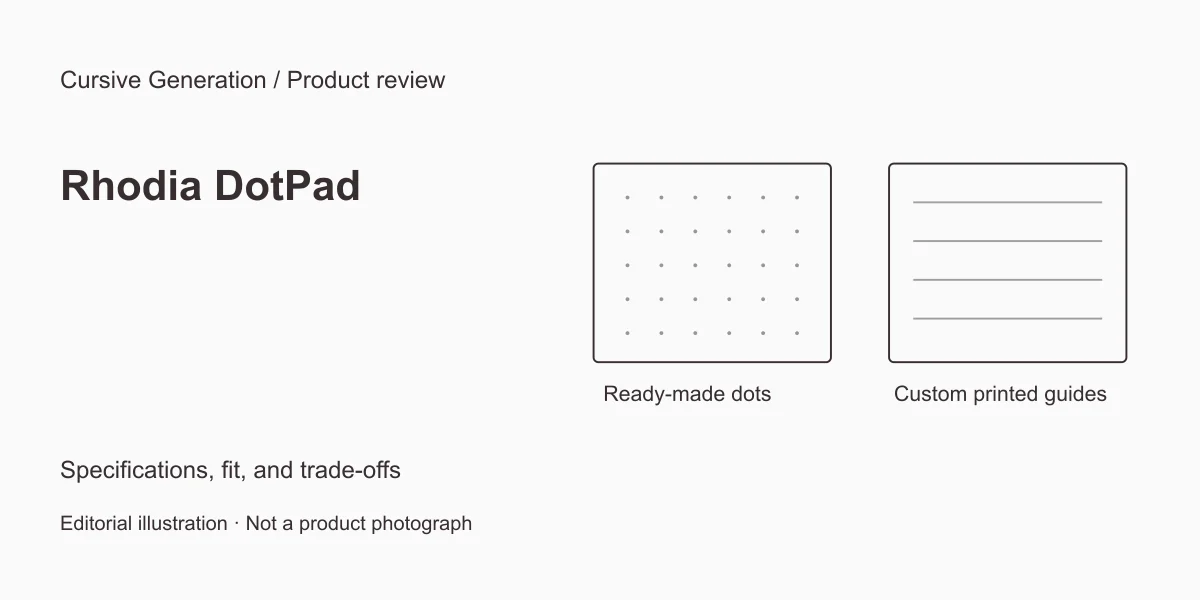
The pad is a ready-made writing surface. You can open it, fold back the cover, and begin using the dots for alignment. That is its clearest advantage over a loose ream when you do not want to print and organize guidelines before every session.
It is not a promise that your calligraphy will improve just because the paper is more expensive. The paper guide explains the properties that matter to ink and nibs. The beginner guide helps you choose a lesson to use on the page.
What the dots help with
A 5 mm grid provides repeated points for comparing height, alignment, and spacing. It is less visually dominant than a heavy square grid, while still giving you references across the page. That makes it useful for practice rows, layout sketches, and notes beside an exercise.
The dots do not tell you the correct height or slant for a particular script. In Italic, for example, the lesson may specify proportions in nib widths. In Copperplate, the exemplar may require its own slant and height relationships. A fixed dot interval is a measuring aid, not a substitute for those instructions.
Choose an exercise size deliberately. You can use a multiple of the grid interval where that suits the lesson, or add the required guides separately. Do not distort an alphabet to make every letter fit between two convenient dots.
Dots and finished work are different needs
The original sheet contains printed dots. Rhodia says the pale grid can disappear when copied or scanned, but do not assume that will happen with every scanner, camera, exposure, or editing workflow. Test your own setup before promising a clean digital file.
If the finished physical page must be blank except for your lettering, choose blank stock. The pad can still help you plan the composition, but a subtle grid is not an invisible grid on the original artwork. Our wedding calligraphy guide is a reminder to match materials to the deliverable, not just to the practice routine.
Ink behavior: what specifications cannot settle
Rhodia describes the surface as super smooth and the paper as acid-free and pH neutral. Those are manufacturer specifications. They do not establish that every wet nib, ink mixture, marker, or wash will behave identically on it.
Test the actual combination. Write a normal stroke and a heavier area representative of your project. Let them dry, inspect the edges, and check the reverse side. Show-through, bleed-through, and feathering are different observations. Do not call a sheet unusable for one task because you can see a dark mark through it, or call it perfect because the front looks neat.
The ink guide explains different ink uses. Our Nikko G and Zebra G reviews make the same point about setup: a nib's feel cannot be judged independently of the paper and ink.
Brush pens and broad edges
A smooth surface is a sensible starting point for small brush lettering. The Fudenosuke review cites Tombow's smooth-paper advice. The Pentel Fude Touch review explains why blendable ink needs a separate water test. Neither establishes a product-specific durability result on this pad.
A broad-edge pen can lay down a much wider mark than a fine writing point. The Parallel bundle review covers widths up to 6 mm. Before using a wide pen on a whole page, check a sample at the actual width and ink load. An 80 gsm specification is not a waterproof barrier.
For watercolor techniques, choose paper intended for the amount of water you plan to use. A DotPad is not watercolor stock. The watercolor lettering guide discusses that different workflow.
A comparison sheet before buying more pads
Use one sheet for the tools you expect to use most. Label each area with the pen and ink. Keep enough space between samples to see the edge of the mark clearly. Let everything dry before turning the sheet over and noting what happened.
If you already own another smooth paper, repeat the same short exercise there. Compare the results that matter to your work: control, appearance, drying behavior, and whether you need to use both sides. Do not make one dramatic over-inked sample the only basis for a routine practice decision.
The spacing tool can help plan an exercise. A generated practice sheet is better treated as a separate printed resource than as a reason to feed a top-stapled pad sheet into a printer. Our HP Premium32 review covers the loose-sheet route.
The practice calendar can help you use the pad consistently. Date a few pages so you can compare progress. A pad kept for “good work only” is less useful than one you are willing to make mistakes in.
Who should buy it?
A learner who wants to open a pad and practise
Yes, if the fixed dot grid suits your exercises. The backing and detachable sheets make a practical format for short sessions. You still need a suitable pen and lesson; our starter guide covers those choices.
A teacher printing repeated custom drills
Loose printer-compatible paper is the more direct choice. A ready-printed dot pad solves a different problem. Buy the format that reduces preparation for your actual routine rather than choosing a brand on reputation alone.
A maker producing finished blank stationery
Use the pad for planning, then move to appropriate blank stock. Confirm the final paper with the intended ink before making a batch. The grid, page size, and perforated format may be useful in a notebook but wrong for the deliverable.
Price and value are about the routine
Compare the actual pad size and sheet count when checking prices. A cheaper smaller pad is not necessarily a better deal for wide lettering, and a large pad is wasteful if you only use a corner for tiny headings.
The value here is convenience and a documented paper format, not a measured claim of superior calligraphy performance. If you already print guides happily on suitable loose paper, you may not need it. If printing is the step that keeps stopping you from practising, a ready-made pad has a clear job.
Pros and cons
Reasons to consider it
- 5 mm dot grid for spacing and alignment
- Microperforated detachable sheets
- Manufacturer specifies a smooth writing surface
- Stiff backing supports writing away from a desk
Trade-offs
- Dots remain part of the original written page
- Not watercolor paper or a printable loose-sheet ream
Alternatives worth comparing
Choose by the job you need to do, not by how many accessories fit in the box. These are different buying options, not winners from a side-by-side test.
- HP Premium 32lb Laser Paper: Loose printer paper lets you choose your own guidelines and print repeat exercises.
- Clairefontaine Triomphe Paper Pad: Consider a blank writing pad when a visible dot grid would distract from the finished piece.
Price and where to buy
Check the current item title, selected variant, pack quantity, delivery charge, and return terms before paying. A familiar product name can cover several packages. We do not display a fixed price because the retailer can change it independently of this article.
Check priceSources and review method
This is a buying assessment, not a test report. We checked product identity against the retailer through Amazon CreatorAPI and used the references below for specifications and attributed observations. Seller copy can contain errors: specifications describe the intended product, not a guarantee about every delivered unit. Recommendations about practice are editorial advice.
- Rhodia: original dotPad 80 gsm, 80 sheets, 5 mm dot spacing, perforation, backing, and size references.
No star score, measured durability, water-resistance result, or first-person testing claim is attached to this review. Illustrations are explanatory drawings, not product photographs or measured writing samples. Customer comments, where discussed, remain the opinions of their authors; no review average has been calculated.