
Affiliate Disclosure: This page contains affiliate links to products selected for practical fit. When you purchase through these links, we may earn a commission at no additional cost to you. Recommendations are based on the registry's stated features, price, level, pros, cons, and best-for labels. We do not imply hands-on testing without an explicit page-level record. See our complete Tools Guide for comparison notes and selection criteria.
Choose Pilot Parallel for broad-edge lettering at several sizes, LAMY joy for a desk-based 1.1 mm italic pen, or the linked 1.0 mm Pilot Metropolitan stub for a more compact everyday format. None is a substitute for a flexible dip nib in a traditional pointed-pen Copperplate lesson.
Fountain pens carry ink inside the body, which avoids repeated dipping. That convenience does not make all their nibs behave alike. This shortlist separates the pen systems before comparing brands. If you are still choosing between a brush, dip pen and fountain pen, begin with the complete pens guide.
Source review: October 9, 2026. These are research-based buying recommendations, not hands-on comparative tests. Manufacturer and specialist sources are distinguished from retailer specifications. Unknown details stay unknown; a seller's performance claim is not a result measured by us.
Quick picks
| Pick | Best for | Nib type | Filling system | Width / linked version | Starting level | Seller |
|---|---|---|---|---|---|---|
| Pilot Parallel Calligraphy Pen Set | Exploring broad-edge scripts at several scales | Parallel plates | Pilot cartridges | 1.5 / 2.4 / 3.8 / 6 mm bundle | Beginner with an exemplar | Check price |
| Lamy Joy Fountain Pen | Desk-based italic practice with a shaped grip | Steel italic nib | LAMY cartridge / compatible converter | Linked pen: 1.1 mm | Beginner to intermediate | Check price |
| Pilot Metropolitan Fountain Pen | A capped everyday pen with stub contrast | Steel stub | Pilot cartridge / compatible converter | Linked pen: 1.0 mm stub | Beginner | Check price |
| TWSBI Eco Fountain Pen | Bottled-ink practice without buying a converter | Stub nib | Built-in piston | Linked pen: 1.1 mm | Writers ready to bottle-fill | Check price |
| Sailor Fude De Mannen Fountain Pen | Angle-controlled expressive strokes | Bent fude nib | Sailor-compatible filling supplies | 55-degree Wakatake variant | Practice needed for angle control | Check price |
| Noodler's Ahab Flex Fountain Pen | Writers who specifically want to experiment with fountain-pen flex | Flex nib | Piston filling for bottled ink | Black Ahab; no measured flex range | Experienced or willing to troubleshoot | Check price |
| Platinum Preppy Fountain Pen | Ordinary cursive and monoline fountain-pen practice | Round medium point | Platinum-compatible cartridge | Linked pen: medium 05 | Beginner | Check price |
How we chose these options
We checked product identities against the linked listings, then compared documented features with the work a reader wants to do. Prices and stock change, so the links show current seller information instead of a copied price. The order reflects a buying task, not a score from a laboratory test.
- The nib must make the contrast required by the script: broad edge, bent fude and flex are different.
- The linked nib width matters more than the range of nibs sold under the family name.
- A cartridge, converter and built-in piston require different refill purchases.
- Pack contents are checked separately from the features of the pen family.
- A beginner option should be understandable without promising perfect flow or effortless flex.
- A normal round nib is labelled as a monoline alternative, not sold as a calligraphy nib.
A familiar brand name is not enough to establish the nib, tip, paper format or contents of a particular package. Check the selected variant at checkout. Where a manufacturer page was unavailable, the pick identifies the retailer as its source rather than presenting that listing as independent verification.
Broad edges and stubs for angle-based contrast
Pilot Parallel Calligraphy Pen Set
Best for: Exploring broad-edge scripts at several scales.
The linked Pilot Parallel bundle contains four widths: 1.5, 2.4, 3.8 and 6 mm. Separate pens are useful when you want to explore the same hand at different scales. If a course specifies one width, a single pen can be the more sensible purchase. A bundle is not automatically better value just because it contains more equipment.
Parallel plates create a broad edge. Hold and move that edge as your exemplar directs rather than pressing it like a pointed nib. The wider pens need larger practice spaces and can put more ink on the page. Match the sheet to the exercise before deciding the largest pen looks best.
Our Parallel set review separates the verified bundle from the wider product range. Start with Italic or blackletter instruction if that is the style you want to learn.
Read the Pilot Parallel Calligraphy Pen Set review for specifications, package checks, and buying caveats.
- Parallel plates
- Pilot cartridges
- 1.5 / 2.4 / 3.8 / 6 mm bundle
- Beginner with an exemplar
Reasons to consider it
- Separate pens keep several broad-edge sizes ready.
Trade-offs
- Four pens cost and take up more space than the one a lesson requires.
Skip it if: Your lesson needs only one width or a flexible pointed nib.
Source: Yoseka: Pilot Parallel Calligraphy Pen.
Check priceLamy Joy Fountain Pen
Best for: Desk-based italic practice with a shaped grip.
LAMY joy has a tapered body and triangular grip. The linked version has a 1.1 mm steel italic nib. It is not the three-nib gift set, so do not count extra nibs when comparing its cost with a boxed calligraphy kit.
A shaped grip can make finger placement repeatable, but only if you like the positions it gives you. The long body is better judged as a practice-desk format than as a pocket pen. These are practical trade-offs; we have not measured comfort or writing accuracy against other bodies.
LAMY uses its own cartridge system. A compatible converter lets you use bottled fountain-pen ink, but check whether one is included. A generic cartridge bundle from another manufacturer is not a safe assumption.
Read the Lamy Joy Fountain Pen review for specifications, package checks, and buying caveats.
- Steel italic nib
- LAMY cartridge / compatible converter
- Linked pen: 1.1 mm
- Beginner to intermediate
Compared with Pilot Metropolitan: check the linked variants, task fit and evidence limits.
Reasons to consider it
- A defined grip gives repeatable finger positions for practice.
Trade-offs
- The linked pen is not the three-nib calligraphy set.
Skip it if: You dislike a triangular grip or need a compact pocket pen.
Source: Goulet Pens: LAMY joy black.
Check pricePilot Metropolitan Fountain Pen
Best for: A capped everyday pen with stub contrast.
Metropolitan is a family name covering different nibs. This link is the Black Classic 1.0 mm stub, with a brass barrel and stainless steel clip. A photograph of an ordinary medium Metropolitan does not establish that it makes the same marks.
Choose the stub when you want some angle-based variation in an everyday capped pen. It will not produce pointed-pen hairlines and swells just because you press harder. If you already write small, leave enough room for the broader strokes before deciding a stub is suitable for daily notes.
Converter contents need seller confirmation. The joy versus Metropolitan comparison is useful if your real choice is shaped desk pen versus a more portable body, rather than one millimeter label versus another.
Read the Pilot Metropolitan Fountain Pen review for specifications, package checks, and buying caveats.
- Steel stub
- Pilot cartridge / compatible converter
- Linked pen: 1.0 mm stub
- Beginner
Compared with LAMY joy: check the linked variants, task fit and evidence limits.
Reasons to consider it
- The brass-bodied format is suited to carrying as well as desk writing.
Trade-offs
- Confirm converter inclusion rather than assuming it is in the box.
Skip it if: You want a flexible nib for pressure-based Copperplate.
Source: Retailer listing, identity checked October 9, 2026.
Check priceTWSBI Eco Fountain Pen
Best for: Bottled-ink practice without buying a converter.
The clear TWSBI ECO listing is a 1.1 mm stub. Its built-in piston draws ink from a bottle, so there is no separate converter to buy. TWSBI explicitly says ink is not included. Add a suitable bottle to the purchase cost instead of treating the pen as a ready-inked starter kit.
The transparent barrel makes the remaining ink visible. That is useful feedback during practice, but it does not establish a number of pages per fill. Consumption depends on nib, paper and how much lettering you put on the page. We do not claim it has the largest capacity among all calligraphy fountain pens.
Follow the filling instructions and leave routine disassembly alone unless the manufacturer calls for it. Switching between bottles also takes cleaning time. Cartridge convenience and bottle choice are different priorities, not two rungs on a quality ladder.
- Stub nib
- Built-in piston
- Linked pen: 1.1 mm
- Writers ready to bottle-fill
Reasons to consider it
- The transparent barrel lets you see the remaining ink.
Trade-offs
- Ink is not included; piston filling requires a suitable bottle.
Skip it if: You want to change colors by swapping cartridges.
Source: TWSBI: ECO Clear.
Check priceBent-nib and flex options for specific interests
Sailor Fude De Mannen Fountain Pen
Best for: Angle-controlled expressive strokes.
The green Sailor Fude de Mannen has the 55-degree bent nib in the linked listing. Varying the writing angle changes the area touching the paper. That differs from both a broad edge held at a consistent angle and flexible tines spreading under pressure.
Try it because you want that angle-controlled mark. Do not interpret “55 degrees” as a requirement to slant all your letters by that amount. It describes the nib variant. A fude nib is also not a bristle brush, even when sellers describe its lines as brush-like.
Confirm the supplied cartridge and compatible converter with the seller. If your lesson teaches brush-pressure technique, the brush-pen guide offers tools that match the exercise more directly.
- Bent fude nib
- Sailor-compatible filling supplies
- 55-degree Wakatake variant
- Practice needed for angle control
Reasons to consider it
- Writing angle changes the contact area without forcing the nib open.
Trade-offs
- The 55-degree bend is not a prescribed handwriting slant.
Skip it if: Your instructions require a flat italic edge or springing pointed tines.
Source: Retailer listing, identity checked October 9, 2026.
Check priceNoodler's Ahab Flex Fountain Pen
Best for: Writers who specifically want to experiment with fountain-pen flex.
Noodler's Ahab is an experimenter's choice here, not the default for a first calligraphy lesson. The linked black pen has a flex nib and piston filling. We have no controlled measurement of its pressure requirement, maximum line width or feed behavior under repeated shading.
If you buy it, keep the first strokes conservative and follow the maker's instructions. Do not force the nib to imitate the width of a dip-nib sample. When a class expects a pointed dip nib, buying the specified nib and compatible holder is usually a clearer starting decision.
Read the nib guide and holder guide before paying for fountain-pen flex solely to avoid choosing those parts. Fewer separate pieces do not always mean less troubleshooting.
- Flex nib
- Piston filling for bottled ink
- Black Ahab; no measured flex range
- Experienced or willing to troubleshoot
Reasons to consider it
- A refillable option for exploring pressure variation.
Trade-offs
- This is not a promise of dip-nib hairlines or effortless shading.
Skip it if: You want an uncomplicated first Copperplate tool.
Source: Retailer listing, identity checked October 9, 2026.
Check priceAn ordinary writing option, clearly labelled
Platinum Preppy Fountain Pen
Best for: Ordinary cursive and monoline fountain-pen practice.
The Platinum Preppy in this listing is a medium round point, model 05. It belongs here as a budget-oriented alternative for ordinary cursive and monoline work. It is not a stub, flex or broad-edge nib and should not be bought to produce those effects directly.
A round point can be exactly what you need when the exercise is consistent letter shape and spacing. See monoline calligraphy if you want decorative writing without a changing nib width. Use compatible Platinum filling supplies and check the selected pack rather than assuming every Preppy listing is identical.
- Round medium point
- Platinum-compatible cartridge
- Linked pen: medium 05
- Beginner
Reasons to consider it
- A simple round point removes nib-angle contrast from the exercise.
Trade-offs
- It is an everyday writing alternative, not a calligraphy nib.
Skip it if: You need thick-and-thin italic strokes from the nib itself.
Source: Retailer listing, identity checked October 9, 2026.
Check priceMatch the nib to the letters
Broad-edge contrast comes from the edge
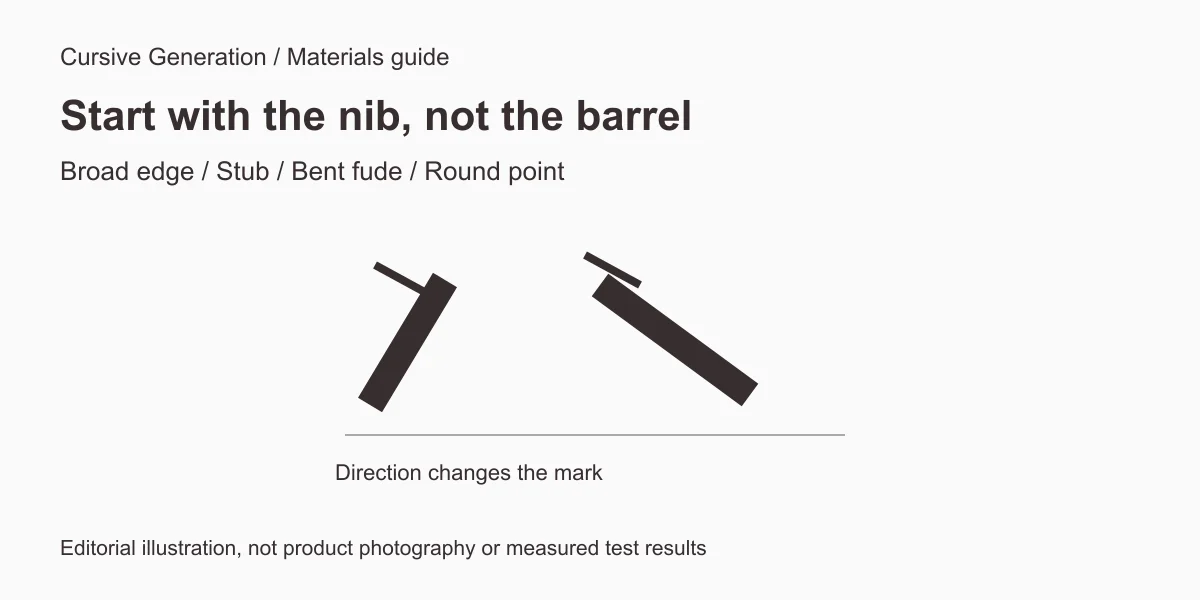
A stub or italic nib changes the mark as the edge moves in different directions. Follow the angle in the chosen exemplar. Rotating the pen randomly to chase a thicker downstroke makes the result harder to repeat. For a new hand, one nib width and one model alphabet are enough to begin.
The practice-sheet tool can help plan page space, but its decorative font outlines do not establish a correct broad-edge stroke sequence. For a word-composition exercise, use the spacing guide after you can form the letters consistently.
Pointed Copperplate needs a different response
A normal fountain nib is built for writing with light pressure. An italic nib does not become a flex nib when pressed harder. Soft and flex fountain nibs also have their own limits; neither label guarantees the hairlines and shading of a traditional pointed dip nib.
For a Copperplate course, follow the specified tools before experimenting with substitutes. If the goal is attractive everyday handwriting instead, a stub or round fountain pen may suit it without being described as a true Copperplate tool.
Check the whole refill system
Before checkout, list the pen, selected nib, cartridge or converter, compatible ink and practice paper. A converter is an accessory for a particular pen system; a piston is built into the pen described here. Neither makes unsuitable drawing ink safe for a feed.
If you travel with the pen, think about how you will refill and clean it away from the desk. Spare compatible cartridges may be simpler than carrying a bottle. At a fixed practice space, bottled ink may give you more choice. Compare those habits before comparing decorative trim.
Protect the feed and check the selected nib
The ink buying guide separates dip-pen products from fountain-pen refills. A bottle that says calligraphy on the label is not enough. The same caution applies to a bottle advertised for technical pens; that does not approve it for every fountain-pen feed.
Paper can make a pen appear broader, rougher or wetter than expected. Use the paper-types guide to understand the surface, then compare the practice-paper picks. Test a few lines before filling a whole notebook with an unfamiliar ink.
A first writing check before you buy accessories
Make the first test before planning a whole invitation batch. Write the actual names or words at the intended size, not just a row of impressive thick strokes. Look at the small openings in letters and the spaces between joins. If those fill in, increase the lettering size or choose a narrower edge rather than changing ink immediately.
Clean between incompatible or unfamiliar inks according to the pen maker's instructions. Goulet's fountain-pen cleaning guide explains the general process, but model-specific instructions take precedence. Keep removable parts together, do not force a stuck mechanism, and allow the pen to drain as directed before refilling. Routine care is a better reason to choose a familiar filling system than a promise of maintenance-free writing.
Fill or insert the cartridge as instructed, let the feed start normally and write without forcing the point. Try straight strokes, curves and a short word. Check the front and back of the sheet after drying. If the pen skips, investigate seating, filling and paper before applying more pressure.
Keep one sample for each ink and paper combination. The practice calendar can help vary the words without changing all the equipment at once. When you need instruction, choose a book matched to the script, not another nib size merely because the family sells one.
Our current shop workbooks do not teach fountain-pen maintenance or broad-edge pen angle. They are not required accessories for these recommendations. Start with a suitable pen, ink, paper and an exemplar you can actually follow.