
Affiliate Disclosure: This page contains affiliate links to products selected for practical fit. When you purchase through these links, we may earn a commission at no additional cost to you. Recommendations are based on the registry's stated features, price, level, pros, cons, and best-for labels. We do not imply hands-on testing without an explicit page-level record. See our complete Tools Guide for comparison notes and selection criteria.
Specs-based review: based on published specifications and attributed feedback where available; not tested by us. Last verified: .
A useful candidate for printing lots of custom practice sheets if your printer accepts 32 lb paper. Buy a ream before committing to a case.
Best for: High-volume practice, Budget option, Pointed pen work.
Skip it if: Your printer cannot feed this weight or you need guaranteed performance with wet dip-pen ink.
Check priceCompared with Rhodia DotPad: check the linked variants, task fit and evidence limits.
At a glance
| Detail | Catalog specification |
|---|---|
| Category | Paper |
| Suggested experience | All Levels |
| Listed feature 1 | 120gsm / 32lb weight |
| Listed feature 2 | 100 brightness |
| Listed feature 3 | ColorLok technology |
| Listed feature 4 | 500 sheets per ream |
Check that the ream is actually HP Premium32
This review covers HP Premium32 US Letter paper, 32 lb, in a 500-sheet ream. The verified retailer title identifies HP and model 113100R; the manufacturer and retailer descriptions list 100 brightness, a super-smooth surface, ColorLok technology, and acid-free paper.
It is not Hammermill Premium Laser Print. The two products can appear beside each other in searches, and our earlier catalog link incorrectly opened a Hammermill ream. That destination has been corrected. Check the brand and model at checkout rather than assuming every 32 lb white sheet is the same paper.
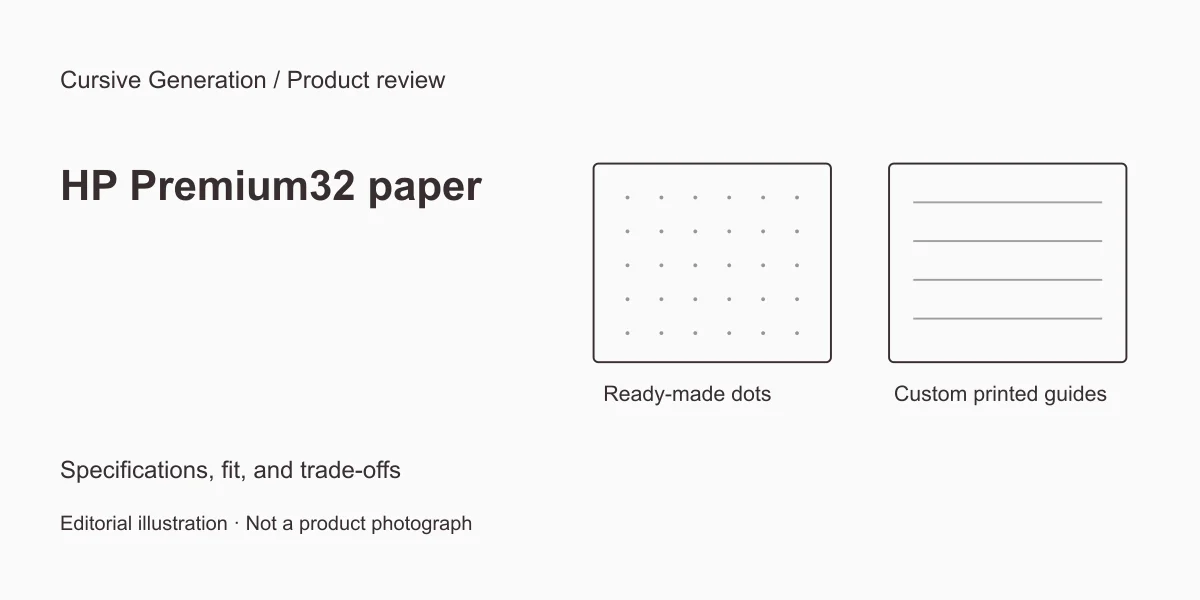
The important format difference is loose sheets. You can print the exact guidelines, letter sizes, or copying layouts you need and keep the same exercise across several sessions. That is a practical reason to consider a ream for calligraphy. It is not evidence that office paper is the best surface for every ink.
Our paper guide explains how weight, surface, and ink behavior differ. The Rhodia DotPad review covers the alternative: open a ready-ruled pad instead of setting up a printer.
What the heavier sheet offers
Premium32 is heavier than common 20 lb office paper. That changes the feel and handling of the sheet, but paper weight alone does not prove resistance to every calligraphy ink. Surface treatment and the ink application matter too.
A printed practice page is the most straightforward use. Choose a lesson, set the guideline size, and print a small batch. Keep the layout consistent while you work on the movement. Reprinting the same exercise can make comparison easier than drawing a slightly different set of lines each day.
For small brush-lettering drills, start with the pressure pattern taught by a brush-specific lesson. For Italic, set proportions from the exemplar and nib width. A ready-made font outline does not turn those different techniques into the same activity.
Your printer has the first vote
Check the printer's manual for supported paper weight, tray, and feed path. Do not infer compatibility merely because the ream is marketed for printing. A printer that accepts a heavy sheet through a manual feed may have different limits in its main tray or duplex path.
Start with a few sheets and the settings the printer maker recommends. Check alignment, feeding, and the printed guide size before making a large batch. If the lesson depends on physical dimensions, print at the intended scale and measure the result rather than trusting an automatic “fit to page” setting.
The practice-sheet generator is useful for making a printable copying layout. Use the correct paper-size option in the print dialog. A US Letter ream is not A4, and automatic resizing can quietly change the dimensions of an exercise.
Printed guides should support the writing
Choose a guide color or lightness that remains readable without competing with the ink. Run a trial with your pen before printing hundreds of sheets. A layout that looks faint on a screen can print differently depending on the printer and its settings.
Keep the printing step separate from ink evaluation. If toner, printed color, or page coverage affects how your writing looks, compare with an unprinted area of the same sheet. That helps you distinguish the base paper from the printed exercise.
Test calligraphy ink separately from printer claims
ColorLok and brightness describe aspects of the paper's printing proposition. They do not establish a measured result for a wet dip nib or a broad calligraphy edge. This review has no ink test, drying-time comparison, or guarantee against bleed-through.
Make a small sample with the tool you intend to use. Include an ordinary stroke and a heavier area representative of the real exercise. Let it dry before judging the edge and reverse side. Do not compare one paper immediately after writing and another after it has dried.
Our ink guide explains the range of writing inks. The Nikko G and Zebra G reviews explain why a pointed nib's behavior depends on the rest of the setup. A paper recommendation cannot remove those variables.
For water-heavy work, use a surface intended for that technique. The watercolor lettering guide is the relevant reference. A heavier office sheet does not become watercolor paper because it feels substantial in the hand.
A small batch is more informative than a case
Print a few copies of one exercise. Label the tool and ink on each page, and keep an unprinted sample nearby. Compare feathering, show-through, drying behavior, and how comfortable the surface feels for the specific movement. These are observations to make, not results supplied by this review.
If the sheet works well for a Fudenosuke but poorly for a very wet dip-pen exercise, keep it for the former task. Materials do not need to pass every imaginable use to be useful. The Pentel review adds a separate caution about water-blendable color.
Use the spacing tool to plan a short repeated word exercise. The practice calendar can help schedule it. Our technique guide helps keep the focus on improving a movement rather than changing supplies every session.
Who should buy a ream?
A learner who prints custom drills often
It is worth considering if the printer supports the weight and a sample suits the chosen pen. The ability to repeat an exact layout is the useful feature. Keep the first purchase small enough to learn whether the paper fits your routine.
A teacher preparing many practice sheets
Check the classroom printer, storage, and actual consumption before buying in volume. Compare the delivered cost per usable sheet rather than a historical price quoted in an article. A slightly heavier sheet is not automatically necessary for every pencil exercise.
A maker producing final calligraphy pieces
Choose by the final medium and presentation requirements. Acid-free paper is a manufacturer specification, not a complete permanence guarantee for the ink-and-paper artwork. Test the final combination and use a more suitable drawing or stationery stock when the job requires it.
Storage and waste
Store the ream flat and protected, following the paper and printer guidance for your environment. Keep practice sheets organized by exercise so the blank reverse side is not lost beneath a pile of abandoned attempts. Use both sides only if the ink and intended task make that practical.
Do not print a month's worth of one layout before you know whether its letter size suits the pen. A few trial pages can reveal that the guidelines need changing. The beginner guide and starter choices guide help you settle the tool and lesson first.
The value question
Check the current delivered price and divide by the actual sheet count if cost per sheet matters. There is no fixed five-cent promise here. Pack size, delivery, and regional availability change the calculation.
Buy Premium32 because printable loose sheets solve a recurring practice need and your setup accepts them. If you rarely print, a pad may be simpler. If your ink trial fails, choose another surface rather than ordering more of a paper on the strength of its office-printing specifications.
Pros and cons
Reasons to consider it
- Loose sheets for printing your own guidelines
- 100 brightness and a super-smooth surface
- 500 sheets per ream
Trade-offs
- Printer must support 32 lb paper
- No guarantee against feathering with every calligraphy ink
Alternatives worth comparing
Choose by the job you need to do, not by how many accessories fit in the box. These are different buying options, not winners from a side-by-side test.
- Rhodia Dot Pad A4: A backed dot-grid pad avoids printer setup and gives you a ready-made spacing guide.
- Strathmore Bristol Smooth 300 Series: Investigate a heavier drawing surface for final work rather than assuming office paper suits every medium.
Price and where to buy
Check the current item title, selected variant, pack quantity, delivery charge, and return terms before paying. A familiar product name can cover several packages. We do not display a fixed price because the retailer can change it independently of this article.
Check priceSources and review method
This is a buying assessment, not a test report. We checked product identity against the retailer through Amazon CreatorAPI and used the references below for specifications and attributed observations. Seller copy can contain errors: specifications describe the intended product, not a guarantee about every delivered unit. Recommendations about practice are editorial advice.
- Staples: HP Premium32 113100 HP brand, model, 32 lb weight, US Letter size, 100 brightness, and 500-sheet ream.
- HP Papers Manufacturer product context. Printing claims do not establish dip-pen ink performance.
No star score, measured durability, water-resistance result, or first-person testing claim is attached to this review. Illustrations are explanatory drawings, not product photographs or measured writing samples. Customer comments, where discussed, remain the opinions of their authors; no review average has been calculated.