
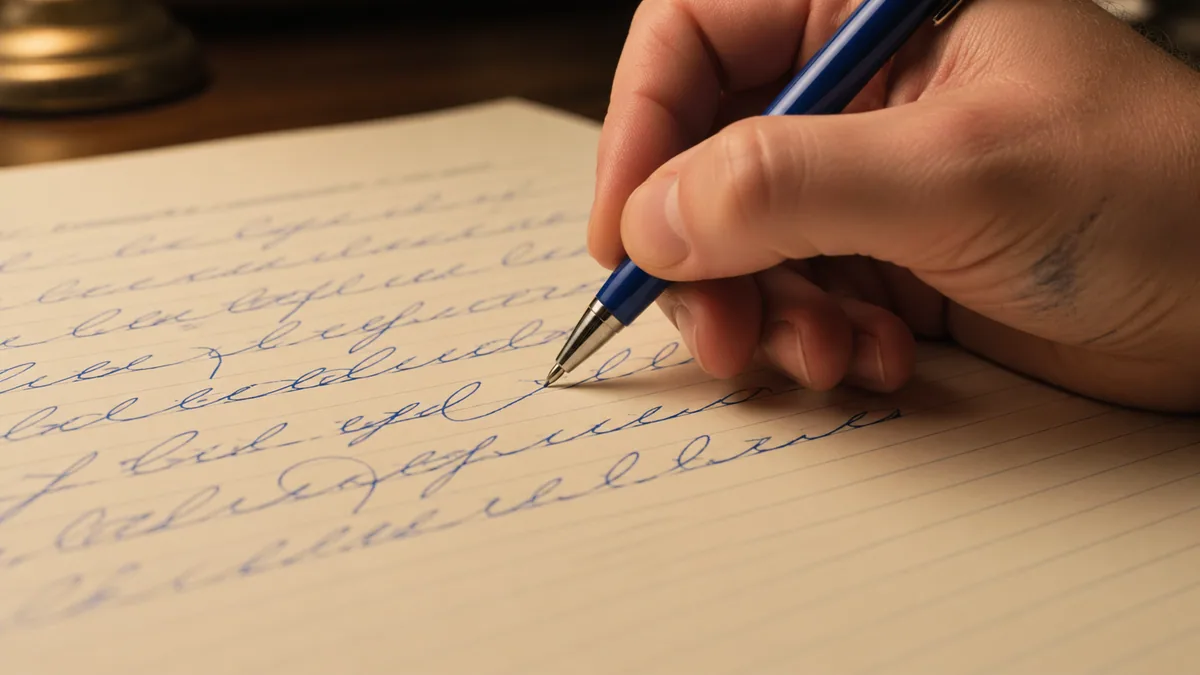
The best pens for cursive writing are the ones that let you form connected letters without squeezing the barrel or dragging your hand through wet ink. Keep a working Pilot G2 if you already like it. Consider a 0.5 mm EnerGel RTX when you want a finer needle point, or a 0.5 mm Sarasa Dry as another paper-specific drying candidate.
You do not need a special calligraphy pen to learn ordinary cursive. Before buying anything, write a few lines with your current pen using our cursive writing lesson. If the shapes are unfamiliar, changing ink will not teach them. The adult relearning guide helps separate a practice problem from a tool problem.
How this shortlist was chosen
This is a specification-based shortlist, not a hands-on tested review or a performance ranking. On November 2, 2026, we checked the exact EnerGel and Sarasa listing titles through Amazon CreatorAPI, requesting titles and available features. We also consulted the manufacturer sources linked below. The API returned no feature block for the Sarasa pack; its title confirms the model, color, size, and count only.
Our criteria are an identifiable writing point, a clear everyday handwriting use, and a practical way to compare against a familiar pen. We have not measured smoothness, fatigue, drying time, ink mileage, or left-handed smear resistance. We did not collect price, stock, or ratings evidence for the new listings. Product links are affiliate links: we may earn a commission if you buy through them.
Compare three gel pens for cursive
| Pen | Linked point and pack | Reason to consider it | What still needs checking |
|---|---|---|---|
| Pilot G2 | 0.7 mm; ten pens, five black and five blue | A familiar refillable baseline for everyday cursive | Whether the fuller mark suits your letter size |
| Pentel EnerGel RTX | 0.5 mm needle tip; three black pens, BLN75BP3A | A finer nominal point for compact writing | Drying on your paper and comfort at your writing angle |
| Zebra Sarasa Dry | 0.5 mm; five black pens, JJ31-BK | An alternative gel formulation to compare on your paper | Actual transfer before your hand crosses the line |
Our recommendation is to change one thing at a time. If your G2 leaves small loops crowded, try the finer nominal point before replacing your notebook. If the mark looks right but smears, test the same pen on a different sheet first. The comparison above includes different point sizes, so it cannot isolate ink formulation as the cause of any future difference.
EnerGel RTX is the needle-tip choice here because that exact tip is identified in the listing. Sarasa Dry earns a place as a distinct model worth comparing, not because its name proves a result. Zebra describes faster drying relative to its own earlier product under stated conditions. That is a manufacturer claim, not evidence that it beats these other pens or stays smear-free on every notebook.
Point size, refills, and the mark you want
A 0.5 mm or 0.7 mm label refers to nominal point size. Paper, ink flow, and how you hold the pen affect the visible stroke. Write the same lowercase height with each pen and check the openings in e, a, and o. A darker, wider line can look satisfying while quietly closing those spaces. Our letter-join exercises help you inspect connections without adding decorative flourishes.
Pilot documents refillability for G2. Pentel lists LRN5 0.5 mm needle-tip EnerGel refills, and Zebra lists JLV-0.5 refills for Sarasa Dry. Match the exact barrel, refill model, point, and ink color before ordering; similar-looking tubes do not establish compatibility. A refill from another Sarasa family may also change the ink you meant to compare. Compare replacement costs locally rather than assuming a multipack is cheaper to keep using.
All three choices make ordinary fixed-point strokes. Pressing harder does not turn them into flexible brush pens. For filled-in downstrokes, draw the extra outline deliberately; for a pressure-based lesson, choose the correct tool from the calligraphy pen types guide. Our tools guide covers those other systems without treating every pen as an essential purchase.
Gel pens for left-handed writing: test contact, not a label
Left-handed writers do not all cross fresh writing in the same way. Note whether your hand travels below, beside, or above the line and how soon it touches the last word. A drying claim measured on one plain paper does not settle what happens on coated stationery. The left-handed setup guide explains paper position; the pen grip tutorial distinguishes tool alignment from gripping harder.
Do not force an unfamiliar wrist position just to accommodate a pen. First rotate the sheet a little and check whether your view and hand path improve without strain. If writing hurts, stop and reassess the setup. A faster-drying ink cannot correct an uncomfortable grip, and a slower sample is not automatically unusable if your hand never touches it while wet.
A repeatable paper and drying check you can run
This is a proposed test recipe, not a report of results. Choose your normal notebook and one smooth practice sheet. Label the paper brand and finish, pen model, point size, ink color, and date. Keep paper samples in the same room and note unusually warm or humid conditions. Our paper guide explains why weight alone does not describe the writing surface.
Use the practice-sheet tool to print matching guidelines on each test paper, or rule them by hand. Keep the line spacing and print scale unchanged so differences in letter size do not become another variable in your comparison.
- Use the same text, such as "minimum waves, little loops," at the same letter height and pace. Use your normal light writing pressure, with the same backing sheets underneath.
- Make a fresh sample for each interval: 1, 3, 5, and 10 seconds after the last stroke. Time with a phone. Do not rub the same sample four times; the first contact changes it.
- State the contact method. For a repeatable comparison, draw the same clean strip of plain paper across each sample once, in the same direction and distance, using the same light pressure. Use a fresh strip each time. This checks transfer under that method, not skin contact.
- Make a separate real-hand check using the part of your hand that normally crosses the line. Record which part, its direction of travel, and whether contact was a light glide or a firmer drag. Keep those samples separate from the paper-strip series.
- Repeat each pen, paper, interval, and contact condition at least three times. Alternate the order of pens. Record visible transfer, streaking, and readable loops; keep the sheets rather than relying on memory.
Describe an observation narrowly: no visible transfer at five seconds on this sheet under light paper-strip contact. Do not turn that into "dries in five seconds" for everyone. If you compare the G2 0.7 mm with these 0.5 mm pens, label it a comparison of complete setups, not an ink-only experiment. A true formulation comparison would need matched point sizes and controlled ink deposition too.
When a ballpoint or fountain pen makes more sense
Keep an ordinary ballpoint in the comparison if it already works on your school or office paper. Conventional oil-based ballpoints often suit everyday notes, but formulations vary and the same contact test still applies. You do not lose any cursive-learning benefit by using one. Avoid compensating for a reluctant pen by bearing down until your hand tires.
A fountain pen with a round writing nib is another option if you want a cartridge or bottled-ink routine and are willing to clean it. Choose its nib and compatible ink deliberately. A broad stub is a different mark, and "fountain pen" does not mean flexible nib. The pen comparison tool can help organize tool types; it is not a measured drying benchmark.
White gel is a separate project choice. The broad white Signo UM153 three-pack is for monoline or drawn faux calligraphy on suitable dark paper, not pressure shading or ordinary black-on-white drills. Test the actual card before lettering a finished piece.
Make the next purchase answer one question
Choose EnerGel if the question is whether a 0.5 mm needle point suits your compact letters. Choose Sarasa Dry if you want to compare that formulation with your current setup. Keep G2 if neither problem exists. Buy a single pen locally when possible before committing to a linked multipack.
Once the setup works, spend the next session on spacing rather than shopping. Use the letter-spacing guide tool to plan a short practice line, then write it at a comfortable pace. Readable joins and open counters are a more useful outcome than owning all three pens.
Sources and what they establish
- Pilot gel ink pen documentation: G2 family, 0.7 mm writing point, grip, and refillability. Regional color ranges are not the contents of our linked pack.
- Pentel EnerGel refill specifications: 0.5 mm needle-tip LRN5 refill options, not independent speed or smoothness results.
- Zebra Sarasa Dry product documentation and gel refill compatibility listings: manufacturer drying claims and JLV refill identification. The drying claim compares with Zebra's earlier product on plain paper, not with Pilot or Pentel in our own test.
Sources checked November 2, 2026. Exact new pack identities came from CreatorAPI listing titles. Recommendations above are editorial judgments about suitability; no personal testing, expert review, or laboratory results are implied.