
Affiliate Disclosure: This page contains affiliate links to products selected for practical fit. When you purchase through these links, we may earn a commission at no additional cost to you. Recommendations are based on the registry's stated features, price, level, pros, cons, and best-for labels. We do not imply hands-on testing without an explicit page-level record. See our complete Tools Guide for comparison notes and selection criteria.
Specs-based review: based on published specifications and attributed feedback where available; not tested by us. Last verified: .
Consider one Gillott 303 for smaller Copperplate if you already control your upstrokes and have a holder that fits it.
Best for: Small Copperplate, Writers with controlled pressure.
Skip it if: You are still pressing on upstrokes or need a guaranteed universal fit in your current holder.
Check price at John Neal Books (non-affiliate)Compared with Hunt 101: check the linked variants, task fit and evidence limits.
At a glance
| Detail | Catalog specification |
|---|---|
| Category | Pointed Nib |
| Suggested experience | Advanced |
| Listed feature 1 | Pointed steel nib |
| Listed feature 2 | Blue finish |
| Listed feature 3 | Made in England |
| Listed feature 4 | Holder and ink separate |
A small point with a specific job
Gillott 303 is worth considering when smaller Copperplate is the task, not because it carries a romantic reputation. John Neal Books describes a fine point, thin hairlines and useful swells, with a warning that it can catch on upstrokes. That combination is a reason to approach it with control rather than extra force.
The retailer identifies blue-finish steel made in England. The nib is a replaceable metal point, not a complete pen: add a compatible holder, suitable ink and paper. The nib guide explains why a pointed nib differs from a broad edge. Check that distinction before buying it for an alphabet taught with an Italic pen.
We did not find a trustworthy matching Amazon result during this check. The purchase link goes to the verified John Neal Books page and is labeled non-affiliate. It would be misleading to send you to an unrelated assortment simply because an affiliate link was available for it.
Read the specialist advice in context
John Neal Books recommends the 303 for small writing and describes both flexibility and fine hairlines. Those are experienced retail observations, not a measured force curve or a promise about every nib in a batch. A sharp point can feel precise in one setup and troublesome in another. The ink, sheet and movement all contribute to what you feel.
The same source notes that a firmer Nikko G can be a better beginner choice. Our Nikko G review explains that option without turning firmness into durability. If you are still pressing through an upstroke, a finer point is unlikely to solve the underlying habit.
Fine lines do not require an invented width
This review does not give the hairline a fixed decimal measurement. The visible line changes with ink, paper, contact and the condition of the point. For Copperplate practice, the useful question is whether you can make consistent light strokes at the size of your chosen exemplar, not whether a marketing number sounds smaller than another nib’s number.
Start with the movements in a reliable lesson. The technique guide provides context, but a font preview is not a substitute for seeing how pressure is released. Do not force the tines apart to chase a dramatic shade that the exercise does not require.
Confirm the holder before buying spares
Small changes in nib shape can matter to the fitting. Ask the holder supplier to name Gillott 303 explicitly. An oblique format and a universal-looking insert are not compatibility evidence. The nib should sit securely without being twisted, packed with improvised material or pressed into a fitting that resists it.
Use the holder guide to understand the options, but verify the exact model. The Speedball holder review lists the maker’s supported nibs; it does not add Gillott 303 to that list by assumption. A cheap nib is not a bargain if it needs an unexpected second holder.
If you are left-handed, consult the left-handed guide and choose the setup for your hand position. Copying a right-handed photograph can leave you with an awkward relationship between the nib and the line. The paper angle and instruction deserve attention before the shopping list grows.
Paper and preparation can dominate the first impression
Follow the supplier’s preparation directions for a new nib. Use a suitable cleaning method rather than a flame or an improvised abrasive treatment. You want the ink to behave on an intact point, not to damage the metal in an attempt to make it more responsive.
The paper guide is a useful companion to the ink guide. Begin with one smooth sheet and one suitable dip-pen ink. If the point catches, first lighten the upstroke and inspect the surface. If the ink beads or refuses to form a line, revisit preparation and ink loading before changing the nib brand.
These checks are a way to narrow the problem, not a remote diagnosis for every failure. A visibly bent, corroded or damaged point should be replaced. Continuing to struggle with it does not demonstrate better technique or make the purchase more economical.
A short exercise before a full page
Write the nib, holder, ink and paper names at the top of a trial sheet. Make a small row of light strokes and modest shaded strokes from your lesson. Then write a few repeated letter groups at one size. Keep the page when you are done, even if it is uneven; it is a more useful reference than trying to remember the first session.
The practice-sheet generator can provide a copying layout, not authenticated Copperplate movement. Use the spacing tool when the shapes are repeatable enough to compare gaps. A reminder from the practice calendar is useful for a short repeat trial without making each session a test of maximum flex.
Who should try a 303?
You already write controlled small Copperplate
One nib is a reasonable trial if your holder fits. Keep the existing ink and paper so you can identify what the new point changes. Buy a larger quantity only after the point works for your ordinary practice, not just one impressive shaded stroke.
You want large, expressive writing
Read the Hunt 101 review as another candidate. Its specialist description leans toward larger writing, although published accounts disagree about its pressure response. That is a reason for a modest trial, not for declaring one nib a universal winner.
You have not used a dip pen before
Start with the equipment specified in the beginner lesson you choose. A fine point adds demands to pressure control and paper selection. There is no need to begin with a nib described as advanced to prove that you take the craft seriously.
Replace it by condition, not a slogan
There is no measured lifespan comparison here. Clean and dry the nib after use, protect the point in storage, and inspect changes in behavior. No hour count can account for every surface, grip, cleaning routine or accidental knock.
Before ordering several replacements, compare the delivered cost of one trial nib with a small group order for your class. Postage can outweigh the cost of an individual point. Ask the teacher whether the class uses this exact model and whether the supplied holders fit it. Combining a confirmed equipment list into one order is more useful than buying a dozen unfamiliar nibs to make the unit price look attractive.
Pros and cons
Reasons to consider it
- Specialist recommendation for small Copperplate
- Fine point for light hairlines
- Replaceable steel nib
Trade-offs
- Sharp point can catch on upstrokes
- Requires controlled pressure and a compatible holder
Alternatives worth comparing
Choose by the job you need to do, not by how many accessories fit in the box. These are different buying options, not winners from a side-by-side test.
- Hunt 101 Imperial Nib: A specialist retailer suggests this larger-writing option; its pressure response still needs a trial.
- Nikko G Nib: A relatively firm G-nib option when basic pressure control is the priority.
Price and where to buy
Check the current item title, selected variant, pack quantity, delivery charge, and return terms before paying. A familiar product name can cover several packages. We do not display a fixed price because the retailer can change it independently of this article.
Check price at John Neal Books (non-affiliate)Sources and review method
This is a buying assessment, not a test report. We checked product identity with the named specialist retailer and used the references below for specifications and attributed observations. Seller copy can contain errors: specifications describe the intended product, not a guarantee about every delivered unit. Recommendations about practice are editorial advice.
- John Neal Books: Gillott 303 Specialist retailer describes blue-finish steel, small Copperplate, fine hairlines and upstroke catching. This is attributed advice, not our testing or a manufacturer durability specification. Purchase link is non-affiliate.
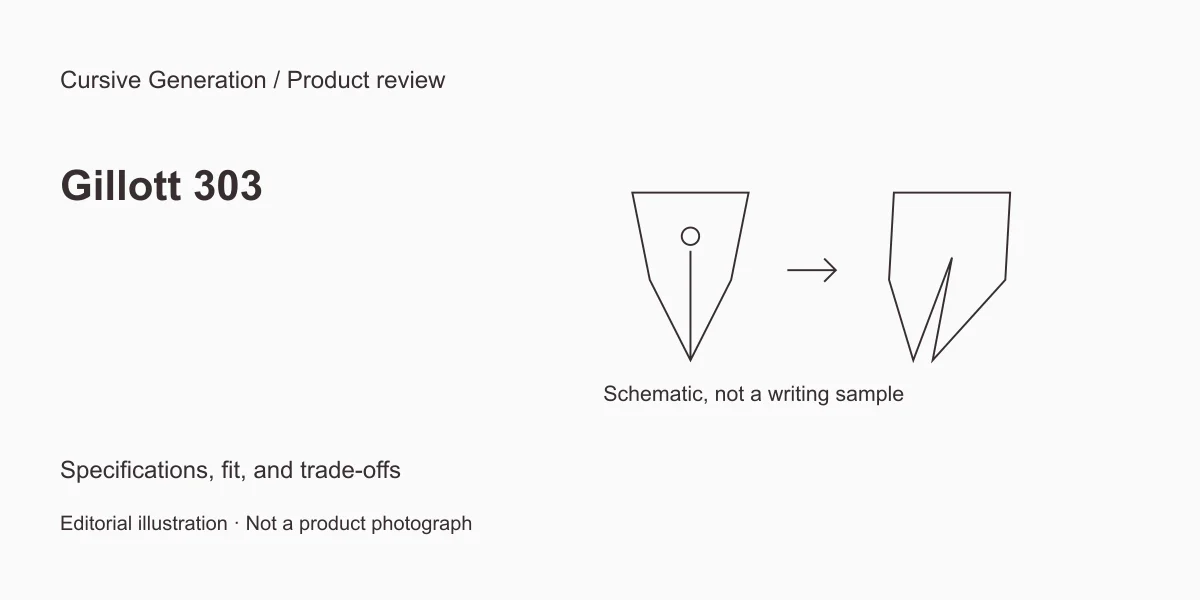
No star score, measured durability, water-resistance result, or first-person testing claim is attached to this review. Illustrations are explanatory drawings, not product photographs or measured writing samples. Customer comments, where discussed, remain the opinions of their authors; no review average has been calculated.