
Affiliate Disclosure: This page contains affiliate links to products selected for practical fit. When you purchase through these links, we may earn a commission at no additional cost to you. Recommendations are based on the registry's stated features, price, level, pros, cons, and best-for labels. We do not imply hands-on testing without an explicit page-level record. See our complete Tools Guide for comparison notes and selection criteria.
Specs-based review: based on published specifications and attributed feedback where available; not tested by us. Last verified: .
A reasonable nib to try when you want a relatively firm pointed nib and are prepared to manage a separate holder, ink, and paper.
Best for: Copperplate beginners, Practice, Learning pressure control.
Skip it if: You want a self-contained pen or expect a guaranteed hairline width or service life.
Check priceCompared with Zebra G: check the linked variants, task fit and evidence limits.
At a glance
| Detail | Catalog specification |
|---|---|
| Category | Pointed Nib |
| Suggested experience | Beginner |
| Listed feature 1 | Pointed dip-pen nib |
| Listed feature 2 | Pressure-dependent line variation |
| Listed feature 3 | Holder and ink sold separately |
| Listed feature 4 | Linked listing names five nibs |
A nib, not a ready-to-write pen
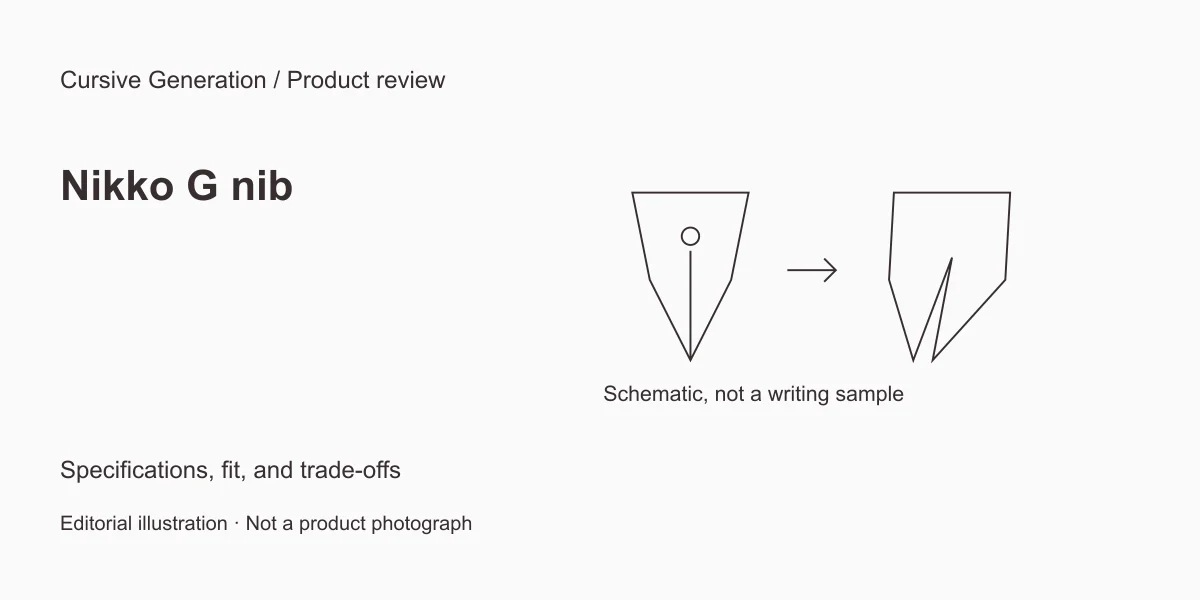
Nikko G is a pointed dip-pen nib used for drawing and lettering. The linked retailer title names a five-piece pack. You still need a compatible holder, suitable ink, paper, and a way to clean and dry the nib. The small price of a replacement point is not the total cost of a first setup.
The retailer's structured feature field returned unrelated bottle copy during verification. We discarded it. Product identity came from the title and specialist references instead. That is why this review does not turn every catalog field into a confident specification.
A pointed nib creates line variation when its tines open under controlled pressure. It works differently from a broad-edge pen and from a small brush tip. Our nib guide explains those distinctions. Read it before buying a G nib for a lesson that might actually require an Italic edge.
The format is relevant to Copperplate practice, pointed modern lettering, and pen-and-ink drawing, provided the lesson and setup suit it. That does not mean one nib is the best choice for every version of those activities.
What published feedback says about its feel
Nijomu's G-nib comparison describes Nikko as relatively stiff, with less line modulation than the other G nibs in that writer's comparison. The writer thought that firmness could help a beginner control the point, but also reported scratchiness and preferred other nibs for experienced drawing.
That mixed assessment is more useful than calling Nikko universally beginner-friendly. A firmer nib may give a writer a more manageable starting point. It may also feel unresponsive to someone accustomed to a softer tool. Those are published impressions, not a measured force curve or a result from our own hand.
We do not attach a fixed hairline width to Nikko G. The ink, paper, pressure, and direction of travel all affect the visible line. A number without a documented test setup would imply a precision this review cannot support.
Firm does not mean indestructible
Begin with light contact and add only enough pressure for the exercise. Do not force the tines wide apart to chase a dramatic shaded stroke. If the line breaks into two tracks, stop and investigate the ink supply, paper contact, and pressure rather than pushing harder.
Follow a pointed-pen exemplar for the movement. Our technique guide and beginner guide provide context, but a font preview cannot tell you how to load a nib or distribute pressure through a stroke.
Choose the holder before the pack arrives
Check compatibility with the exact holder model. “Universal” is not a useful guarantee unless the seller identifies which nibs it accepts. The nib should seat securely without being forced, twisted out of alignment, or left loose enough to move while you write.
Our holder guide explains straight and oblique formats. The Walfront holder review is deliberately cautious because its nib-fit documentation is missing. Do not assume that two products appearing in the same catalog have been tested together.
If you are left-handed, read the left-handed calligraphy guide and follow an appropriate lesson. Hand position, page rotation, and the chosen script matter. Buying an oblique holder because a right-handed demonstration uses one is not enough to establish that it is the right setup for you.
Ink and paper can change the experience
Use ink intended for the dip-pen task and follow the maker or supplier's preparation directions for a new nib. Do not improvise a flame-cleaning procedure. Heat is unnecessary for this recommendation and can damage the point or create a safety risk.
The ink guide helps distinguish dipping inks from fountain-pen inks. The paper guide explains why a rough or absorbent sheet can change how a fine point behaves. Neither a more expensive ink nor thicker paper automatically solves every writing problem.
Start on a smooth practice surface and make a small sample. Let it dry, inspect the edge, and check the back. The Rhodia DotPad review and HP Premium32 review describe two practical formats without promising that every dip-pen ink will behave on them.
A diagnostic first practice session
Keep the first sheet simple. Write the nib name, holder, ink, and paper at the top. Make light strokes, then modest shaded strokes following your lesson. Add a short group of letters only after the separate movements feel controllable. Keep another sheet beside you for excess ink and small trials.
If the nib catches, reduce pressure and check direction, alignment, and paper. If the ink does not stay on the nib, revisit the supplier's preparation instructions. If a mark starts well and stops, look at the ink load and pause to redip. Those observations help you isolate a problem; they do not diagnose every fault from one symptom.
The practice-sheet tool can supply a copying layout, not authenticated Copperplate stroke order. Use the spacing tool after you have a readable letter group. The practice calendar is useful for returning to the same drill without turning a nib into a daily performance test.
Who should try Nikko G?
A beginner who presses heavily
A relatively firm nib is worth considering, but it should not be used to justify heavy pressure. Start gently and compare results with a teacher's guidance. If the whole exercise requires strain, check the setup instead of assuming you need stronger fingers.
A writer who wants very soft, expressive shading
Nikko may feel restrictive. The Zebra G review discusses a published comparison that found more flex. Try a small quantity when possible and keep the paper and ink constant. A softer nib is a different response, not an automatic improvement in lettering quality.
Someone who wants a portable, low-maintenance pen
A dip nib is not the obvious choice. A self-contained Fudenosuke brush pen avoids open ink and drying loose metal points, though it changes the technique. The starter guide compares those setup costs honestly.
Replacement: inspect the nib, not a stopwatch
There is no verified 15–20-hour lifespan here. Wear depends on the surface, pressure, cleaning, storage, and how the nib is used. Replace a visibly damaged or persistently malfunctioning nib rather than keeping it because a made-up schedule says it should last longer.
Clean and dry the nib as instructed after the session, and store it where the point will not be knocked against other equipment. If performance changes, first compare the setup with your earlier notes. A fresh nib cannot fix every ink or paper problem, but a damaged point should not become a test of your patience.
Pros and cons
Reasons to consider it
- Replaceable pointed nib for dip-pen practice
- Published comparisons describe a relatively firm feel
- Can be used for drawing and shaded lettering
Trade-offs
- Separate compatible holder and ink required
- Some published feedback reports scratchiness
Alternatives worth comparing
Choose by the job you need to do, not by how many accessories fit in the box. These are different buying options, not winners from a side-by-side test.
- Zebra G Nib: Published comparisons describe more flex; try it when Nikko feels too firm rather than treating it as a universal upgrade.
- Tombow Fudenosuke Brush Pens: A self-contained brush pen removes dipping and nib preparation, although it teaches a different tool.
Price and where to buy
Check the current item title, selected variant, pack quantity, delivery charge, and return terms before paying. A familiar product name can cover several packages. We do not display a fixed price because the retailer can change it independently of this article.
Check priceSources and review method
This is a buying assessment, not a test report. We checked product identity against the retailer through Amazon CreatorAPI and used the references below for specifications and attributed observations. Seller copy can contain errors: specifications describe the intended product, not a guarantee about every delivered unit. Recommendations about practice are editorial advice.
- Nijomu: G nibs, a comparison A named published comparison describes Nikko as relatively stiff and reports scratchiness. These are the writer’s impressions, not our measurements.
- Tachikawa Pin: manufacturer Manufacturer identity and dip-pen product context, not a published wear-life specification.
No star score, measured durability, water-resistance result, or first-person testing claim is attached to this review. Illustrations are explanatory drawings, not product photographs or measured writing samples. Customer comments, where discussed, remain the opinions of their authors; no review average has been calculated.