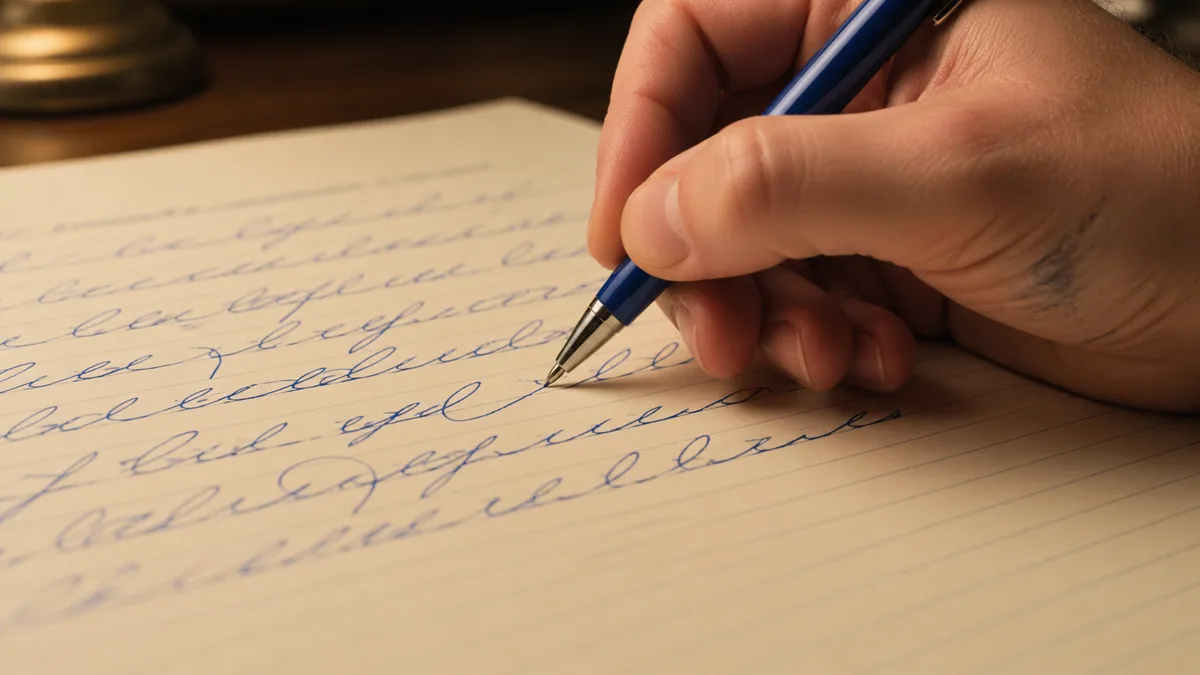
California and South Carolina both require instruction in joined handwriting, with different wording in their laws. California requires cursive or joined italics at appropriate grade levels within grades 1 through 6. South Carolina requires instruction aimed at legible cursive documents by the end of fifth grade. Neither provision names a particular commercial handwriting program.
Verified examples of state cursive requirements
| State | Requirement | Official source |
|---|---|---|
| California | Cursive or joined italics in appropriate grade levels within the grades 1-6 course of study | Education Code 51210(a)(1) |
| South Carolina | Instruction so students can create readable documents through legible cursive by the end of fifth grade | Code 59-29-15 |
California: joined italics is expressly included
California's AB 446 was approved on October 13, 2023. It added explicit language about cursive or joined italics to the required English course of study. The enacted bill records that change; the current Education Code linked in the table retains the wording. Later amendments also appear in the code's history. To find when the cursive wording was added, follow AB 446 rather than relying on the most recent amendment date.
The phrase “in the appropriate grade levels” matters. The law names the grades 1-6 course of study, but it does not say that every first grader must already write cursive. Nor does this provision select a commercial handwriting program. Families comparing models can read D'Nealian, Zaner-Bloser, and italic handwriting and ask the school which forms it teaches. Everyday joined italic is not the same task as decorative broad-edge italic calligraphy.
South Carolina: a fifth-grade outcome
South Carolina Code 59-29-15 directs districts to provide cursive instruction with the outcome of readable, legible documents by the end of fifth grade. Its history identifies Act 275 of 2014 and an effective date of June 9, 2014. This is an existing requirement being reviewed for 2026, not a new law passed in 2026. The section also directs the education department to help districts integrate instruction and review materials.
A fifth-grade outcome does not tell a parent exactly when each classroom introduces each letter. Ask about the local sequence, practice materials, and how legibility is evaluated. If a learner is joining a new school, bring a recent writing sample rather than guessing from their age. Our cursive writing guide explains useful questions about letter formation and joins, but it does not certify compliance with a state standard.
Why nationwide cursive-law counts disagree
A list may count only enacted statutes, while another includes state learning standards, agency guidance, or local district policies. Some combine measures already in effect with signed laws that start in a future school year. Others repeat a headline about a proposed bill as though it became law. Those categories answer different questions. A reliable count needs a definition, a date, and a source for every state.
To check a state outside the table, begin at the legislature's official code and the state education department's current standards. Search for both “cursive” and “handwriting.” Read the surrounding section, since an optional resource requirement is different from a student-learning requirement.
Check a bill before sharing the headline
- Find the bill on the official legislature website, including its session year.
- Read the status or history. Introduction, committee approval, passage, and enactment are different stages.
- Find the final enacted text and its effective-date clause, including any school-year start.
- Check the current code for later amendments and the education department for implementation guidance.
- Record which schools, grades, and skills the provision actually covers.
Save the source URL and review date with your notes. A social post that says “cursive is back” may refer to a proposal, a standard revision, or a requirement that has existed for years. Before changing your practice plans, find out which one it is. When an official page is unavailable, leave the claim unresolved instead of filling the gap from an undated list.
What to ask your school
Ask which handwriting model is used, when instruction begins, and whether the current goal is reading cursive, forming letters, or writing connected sentences. Those are related but separate skills. Ask for the approved alphabet and one example of the expected work. The letter reference and word library can support discussion, but the school's exemplar should govern assessed practice.
Discuss accommodations and individual support with the school team. A general state requirement does not settle the right approach for a child who experiences pain or has a documented learning or motor need. The left-handed writing guide has paper-position and desk-setup suggestions to try. If writing is painful, stop the session and ask for individual advice. Extra rows of practice will not tell you what is causing the discomfort.
Support practice without buying a new curriculum
Start with the teacher's material and a comfortable pencil. If paper is the problem, compare the ruling and surface in our paper guide before purchasing a large workbook. Our children's and beginner book guide separates creative lettering books from school handwriting needs. An attractive calligraphy book may be a good hobby gift while being the wrong resource for a classroom task.
The practice-sheet generator offers font-based tracing and writing space, not educator-validated stroke-order instruction. Use it only where a decorative model suits the activity. For creative exploration, the cursive generator can compare a name in different fonts. The calligraphy roadmap is a separate hobby-learning resource organized by tool and style.
Reading cursive and making decorative lettering
What does the learner need to do? Reading a handwritten family letter, writing a legible paragraph, and decorating a birthday card require different practice. Our cursive and calligraphy comparison explains the distinction. Exploring historical scripts can make the subject interesting. Save the ornate capitals for a project that calls for them; an everyday paragraph needs to be readable.
Editorial source review, not legal advice or an educator endorsement. Recheck before each school year and after a relevant law or standards change. Next scheduled source review: January 2027.