
Affiliate Disclosure: This page contains affiliate links to products selected for practical fit. When you purchase through these links, we may earn a commission at no additional cost to you. Recommendations are based on the registry's stated features, price, level, pros, cons, and best-for labels. We do not imply hands-on testing without an explicit page-level record. See our complete Tools Guide for comparison notes and selection criteria.
Specs-based review: based on published specifications and attributed feedback where available; not tested by us. Last verified: .
Choose the joy for a dedicated broad-edge practice pen if its shaped grip suits the way you hold a pen.
Best for: Practice calligraphy, Everyday writing, Gift giving.
Skip it if: You need a flexible pointed nib or a compact pen chosen mainly for carrying in a pocket.
Check priceCompared with Pilot Metropolitan: check the linked variants, task fit and evidence limits.
At a glance
| Detail | Catalog specification |
|---|---|
| Category | Fountain Pen |
| Suggested experience | Beginner to Intermediate |
| Listed feature 1 | Linked variant: 1.1mm nib |
| Listed feature 2 | Interchangeable steel italic nib |
| Listed feature 3 | Triangular grip |
| Listed feature 4 | Long tapered resin body |
The 1.1 mm listing is one pen
The linked LAMY joy title specifies a 1.1 mm pen. The joy family includes other nib widths, and there are sets with additional parts, but this listing is not being presented as all of them in one package. Check the nib field before buying; the model name alone does not tell you how many widths arrive.
Goulet Pens describes a long tapered resin body, a triangular grip and an interchangeable steel italic nib. Those details make it a recognizable desk-practice format. They do not establish that its shape is comfortable for every writer, or that an interchangeable nib is included as a spare.
The pen guide helps place the joy among other broad-edge tools. If you are unsure whether you want broad-edge or pressure-sensitive writing, read cursive versus calligraphy and choose a lesson before choosing a barrel style.
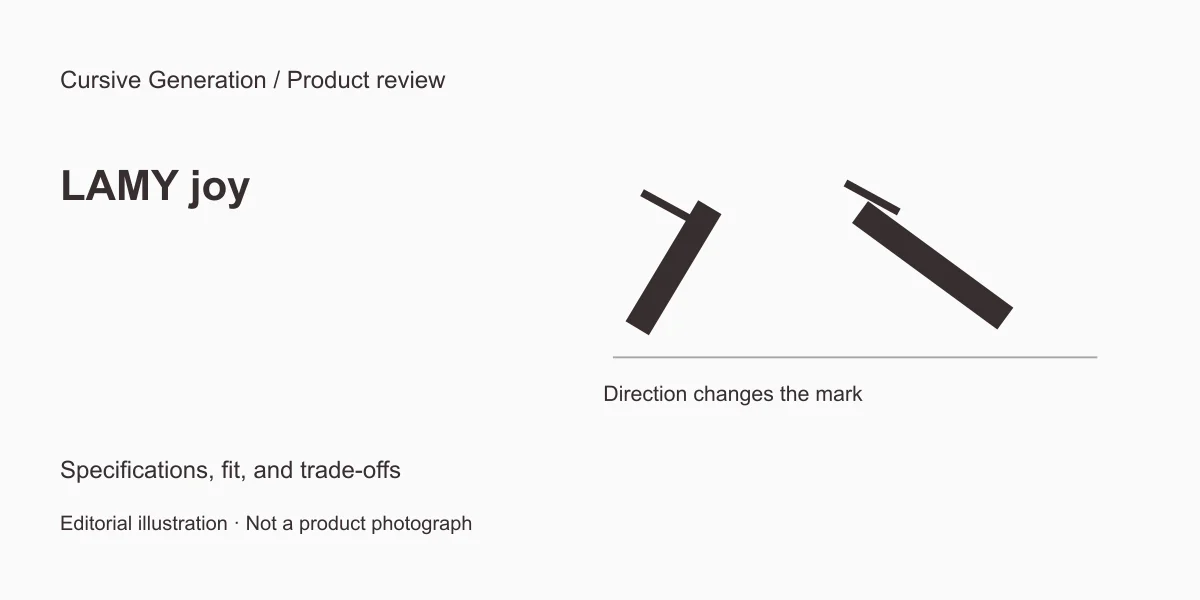
A broad edge changes the direction of the question
With a rigid calligraphy edge, line variation comes mainly from the edge angle and direction of travel. It is not an invitation to press until the tines spread. The joy’s small broad edge can support deliberate lettering, but it is not a flexible pointed nib for pressure-shaded Copperplate.
Follow an Italic exemplar or another broad-edge lesson that specifies proportions. A 1.1 mm edge sets a different working scale from a much wider teaching pen. If the exemplar measures letter height in nib widths, preserve that relationship rather than copying a large printed letter at an arbitrary size.
The grip is a choice, not a universal correction
A shaped grip gives your fingers a defined place to sit. Some learners may appreciate that repeatability; others may find it conflicts with the way they hold a pen. This review has no comfort trial and makes no medical or ergonomic guarantee. Trying the grip or buying with suitable return terms is more useful than accepting the word ergonomic as proof.
Read the left-handed guide if the standard demonstration does not match your posture. Page rotation and hand position can affect how the edge contacts the sheet. Do not twist the wrist into an uncomfortable angle simply to match a photograph of somebody else’s grip.
Cartridges first, converter only if you need it
The joy uses LAMY cartridges. The specialist retailer also describes compatibility with a Z28 converter, sold separately. A converter lets you use suitable bottled fountain-pen ink, but it adds a separate purchase and cleaning step. Confirm the selected seller package instead of assuming every pen box contains one.
The ink guide distinguishes fountain-pen formulations from India inks and other dipping media. Never fill the joy with waterproof India ink simply because you want a darker stroke. A cartridge pen’s feed and reservoir need an appropriate ink, even when another bottle is marketed for calligraphy.
For a first session, one compatible cartridge keeps setup simple. Read the pen instructions for insertion and filling, and keep ink away from the grip while assembling it. If flow is absent, follow the maker’s troubleshooting process rather than pressing the nib harder against the paper.
Paper and scale before more nibs
A small stub can still put down more ink than a fine round writing point. Use the paper guide to choose a starting sheet and test the actual ink. Smoothness, drying time and resistance to feathering are separate observations, not a single paper-quality score.
The Triomphe review describes blank writing paper for finished letters. The Rhodia review describes a dotted practice format. Either decision should begin with your layout needs, followed by a small writing trial, rather than a promise that one brand works perfectly with every fountain pen.
A first practice page for this width
Write the nib width, ink and paper at the top. Make a few strokes in the directions your exemplar uses while keeping the edge orientation consistent. Add a repeated letter group. If the thick and thin pattern changes unpredictably, inspect whether you rotate the pen as you write before blaming the ink.
The practice-sheet generator can help lay out a copying exercise, but a decorative font is not an authenticated Italic lesson. Keep the actual broad-edge exemplar beside it. The spacing tool is useful once the basic shapes repeat, and the practice calendar can prompt another short session with the same setup.
Only after that trial should you decide whether a wider nib would help. Wider is useful for larger work, not automatically better work. If you need visibly broad strokes for a teaching exercise, the Pilot Parallel review covers a different range of widths and the cost of buying several at once.
Who should choose the joy?
You can check a worksheet's scale before buying. If a particular lesson calls for an x-height of five nib widths, the nominal 1.1 mm edge gives a starting height of 5.5 mm. That is an example of using the lesson's proportions, not a rule for every Italic alphabet. Measure several adjacent edge marks on scrap paper if you want to lay out guides around the mark your own pen makes.
Compare that height with the notebook ruling you intend to use. Leave room above and below for ascenders and descenders. If the layout is crowded, changing the worksheet is cheaper than buying another nib and hoping the spacing problem disappears.
You want a dedicated practice pen
The long body and shaped grip are coherent choices for a pen that mostly stays at a desk. Start with the linked width if it matches the lesson. You do not need a complete width collection to begin learning consistent edge angle.
You want one pen for notes and lettering
Read the Metropolitan stub review too. Its capped brass-barrel format offers a different carrying arrangement. Neither comparison proves that a stub is the best choice for tiny fast notes; a round writing nib may be more appropriate for that job.
You want flexible shaded script
Choose another system. The beginner guide can help you separate brush pressure, pointed-nib pressure and broad-edge direction. Buying a joy and pushing harder will not turn the edge into the tool used in a Copperplate demonstration.
Keep maintenance ordinary
Cap the pen when you pause, use compatible ink, and follow the maker’s cleaning directions when changing ink or storing it. Do not treat interchangeable parts as a reason for frequent unnecessary dismantling. The joy is worth buying for its format and edge, not for an unverified claim that it outperforms every other beginner fountain pen.
Pros and cons
Reasons to consider it
- Interchangeable steel italic nib
- Triangular grip gives defined finger positions
- Cartridge filling for desk practice
Trade-offs
- Long body is less compact for carrying
- Proprietary cartridge system
Alternatives worth comparing
Choose by the job you need to do, not by how many accessories fit in the box. These are different buying options, not winners from a side-by-side test.
- Pilot Metropolitan Fountain Pen: The linked 1.0 mm stub offers a capped brass-barrel alternative for everyday carrying.
- Pilot Parallel Calligraphy Pen Set: Consider wider broad edges when the lesson calls for larger letters, not a narrower writing stub.
Price and where to buy
Check the current item title, selected variant, pack quantity, delivery charge, and return terms before paying. A familiar product name can cover several packages. We do not display a fixed price because the retailer can change it independently of this article.
Check priceSources and review method
This is a buying assessment, not a test report. We checked product identity against the retailer through Amazon CreatorAPI and used the references below for specifications and attributed observations. Seller copy can contain errors: specifications describe the intended product, not a guarantee about every delivered unit. Recommendations about practice are editorial advice.
- Goulet Pens: LAMY joy black Retailer product description: tapered resin body, triangular grip, interchangeable steel italic nib, LAMY cartridge and separately sold Z28 converter.
- Amazon: linked joy variant CreatorAPI title identifies a 1.1 mm pen, not a complete multi-nib set.
No star score, measured durability, water-resistance result, or first-person testing claim is attached to this review. Illustrations are explanatory drawings, not product photographs or measured writing samples. Customer comments, where discussed, remain the opinions of their authors; no review average has been calculated.