
Affiliate Disclosure: This page contains affiliate links to products selected for practical fit. When you purchase through these links, we may earn a commission at no additional cost to you. Recommendations are based on the registry's stated features, price, level, pros, cons, and best-for labels. We do not imply hands-on testing without an explicit page-level record. See our complete Tools Guide for comparison notes and selection criteria.
Specs-based review: based on published specifications and attributed feedback where available; not tested by us. Last verified: .
Consider this Metropolitan when you want a small stub for ordinary writing as well as deliberate italic practice.
Best for: Budget beginners, Everyday calligraphy, First fountain pen.
Skip it if: You want pressure-flexed Copperplate shades, a very broad teaching nib, or verified converter contents without checking the seller.
Check priceCompared with LAMY joy: check the linked variants, task fit and evidence limits.
At a glance
| Detail | Catalog specification |
|---|---|
| Category | Fountain Pen |
| Suggested experience | Beginner |
| Listed feature 1 | Linked variant: 1.0mm stub |
| Listed feature 2 | Brass barrel |
| Listed feature 3 | Stainless steel clip |
| Listed feature 4 | Retailer lists Pilot gift box |
Check the word stub in the listing
The black Metropolitan reviewed here has a 1.0 mm stub in the verified retailer title. That is a different purchase from a Metropolitan with a round fine or medium nib. If you want broad-edge line variation, make sure the selected offer still names the stub before you pay.
The returned product features identify a brass barrel, stainless steel clip and Pilot gift box. They do not establish converter inclusion, so this review does not promise one. A pen-family guide elsewhere may describe a different market or bundle. Use the current seller’s contents to decide whether you need a cartridge or filling accessory.
Our pen guide explains where small stubs fit. The attraction here is a familiar capped writing-pen format with an edge that can add directional contrast, rather than a specialist dip-pen setup with an open bottle beside the page.
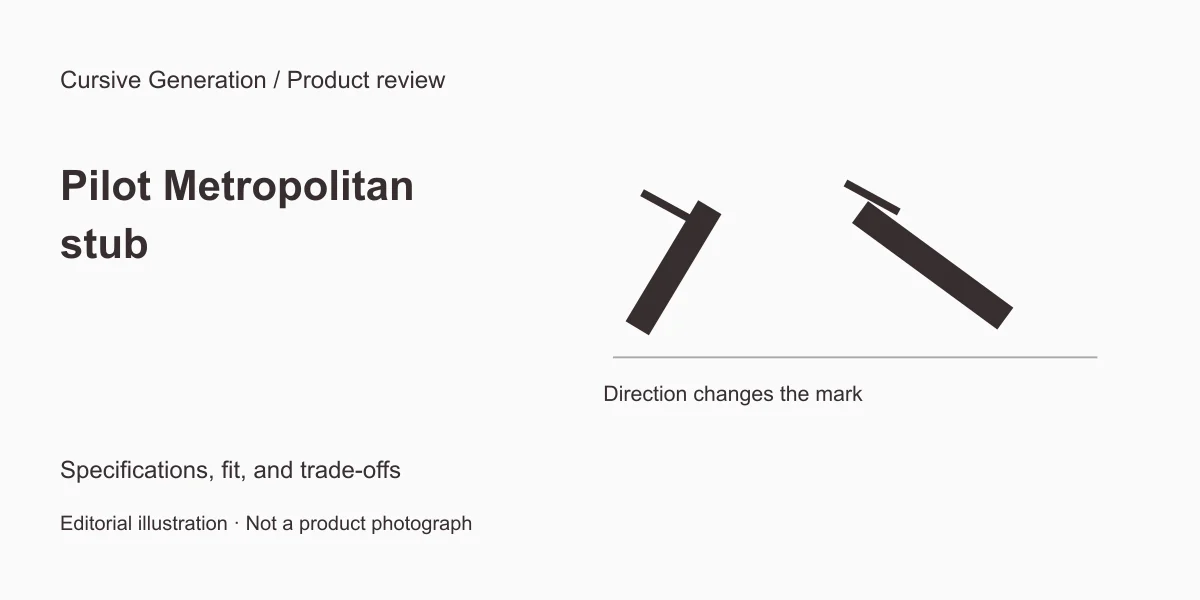
The edge does the work, not extra pressure
A stub is not a soft pointed nib. Keep the edge in the orientation your lesson calls for and let direction change the width of the mark. Pressing harder to make a shaded Copperplate stroke is the wrong movement for this recommendation. If pressure-shaded script is the goal, choose the separate nib system used by a suitable lesson.
For Italic practice, use an exemplar designed around a broad edge. A 1.0 mm nib gives you a smaller working scale than a broad teaching pen. Letter height, counters and spacing still need deliberate planning; a small edge does not automatically make cramped handwriting more legible.
Everyday format does not mean every writing task
The Metropolitan’s capped shape is a reasonable starting point for carrying a stub pen, but that is not a comfort test. Brass can feel substantial, and the balance can change depending on whether the cap is posted. If you can try one, write several ordinary lines rather than judging it only by the feel of lifting it.
For very small, quick notes, a round writing nib may be more practical than either this stub or the LAMY joy. The useful distinction is the intended writing, not a contest over which pen is more serious. Our cursive and calligraphy guide helps separate everyday handwriting from deliberate letter construction.
Filling: verify the package instead of guessing
Ask the seller which compatible cartridge or converter is included, if any. The checked title establishes the nib, not every accessory inside the box. An old review of another Metropolitan package is not enough evidence to buy bottled ink as your only refill.
Choose ink explicitly suitable for fountain pens. The ink guide explains why India ink belongs with different tools. A bottle of waterproof dip-pen ink may look appealing for dark lettering, but it is not a substitute for a suitable fountain-pen formulation in this reservoir.
Follow the pen instructions for fitting a cartridge or converter. If the pen does not start normally, investigate the filling and cleaning guidance rather than dragging the nib repeatedly under heavy pressure. A writing fault can have several causes, and a new scratch on the point makes troubleshooting harder.
Give the small stub room on the page
Choose paper from the paper guide and make a trial at the size you actually write. A stub that looks attractive in a large sample may close the spaces inside your small letters. Increase the writing size or reconsider the nib rather than assuming all line variation improves readability.
The Rhodia DotPad provides ready-made alignment points. Triomphe offers a blank finished page with an underlay option. Neither review proves which paper dries faster with your particular ink; check smearing and the reverse on a spare area.
For left-handed writing, the left-handed guide is a useful starting point. Consider paper angle and the route your hand takes across fresh ink. Do not solve a smearing problem by forcing an uncomfortable wrist position or assuming a different brand name guarantees faster drying.
A first-page exercise
Label the paper with the pen, nib and ink. Make repeated straight strokes and simple curves at a consistent edge angle, following your chosen lesson. Then write a short phrase twice: once slowly enough to observe the edge, and once at your normal deliberate pace. Compare the shapes and gaps, not just the darkness of the line.
The practice-sheet generator supplies a layout for copying, not guaranteed calligraphy stroke order. The spacing tool can help you examine a short phrase separately from the pen mechanics. Use the practice calendar to repeat the same exercise before deciding that you need more equipment.
If the mark becomes inconsistent, notice whether the edge rotates or lifts during curves. The technique guide provides context for contact and movement. That observation is more useful than immediately swapping the ink, sheet and nib all at once.
Who should buy this variant?
You want a small stub in a familiar pen body
This is the clearest reason to choose the linked Metropolitan. Confirm the 1.0 mm nib and filling accessories, then start with one suitable paper. The brass barrel is a material fact, not proof that it will be more comfortable than a lighter pen.
You want a dedicated broad-edge teaching tool
Compare the joy and the Pilot Parallel set. A wider edge may make a lesson’s thick-thin relationship easier to see. The width should follow the exemplar rather than the idea that buying the smallest pen is always more practical.
You want flexible Copperplate swells
Do not select this stub for that purpose. Read the pointed-nib guide and choose the system your lesson specifies. A fountain pen’s convenient reservoir does not make its rigid edge interchangeable with a pressure-responsive dip nib.
Care without a performance promise
When asking a seller about the box, name both the nib and the filling accessory: "Is this the 1.0 mm stub, and which cartridge or converter comes with it?" Keep the answer with the order. That avoids discovering that your separately purchased bottle needs another part before the pen can be used.
Cap the pen during pauses and follow suitable fountain-pen cleaning instructions before a long period of storage or an ink change. We have not measured smoothness, leak resistance or long-term wear. The recommendation rests on the verified variant and useful format, with the uncertain package details left visible.
Pros and cons
Reasons to consider it
- 1.0 mm stub in the linked variant
- Brass barrel
- Capped format for everyday carrying
Trade-offs
- Not a flexible pointed nib
- Converter inclusion must be checked with the seller
Alternatives worth comparing
Choose by the job you need to do, not by how many accessories fit in the box. These are different buying options, not winners from a side-by-side test.
- Lamy Joy Fountain Pen: A dedicated desk-practice format with a shaped grip and 1.1 mm linked nib.
- Pilot Parallel Calligraphy Pen Set: Choose wider broad-edge pens if your exemplar needs large, clearly visible strokes.
Price and where to buy
Check the current item title, selected variant, pack quantity, delivery charge, and return terms before paying. A familiar product name can cover several packages. We do not display a fixed price because the retailer can change it independently of this article.
Check priceSources and review method
This is a buying assessment, not a test report. We checked product identity against the retailer through Amazon CreatorAPI and used the references below for specifications and attributed observations. Seller copy can contain errors: specifications describe the intended product, not a guarantee about every delivered unit. Recommendations about practice are editorial advice.
- Amazon: black Metropolitan 1.0 mm stub CreatorAPI title and features confirm stub variant, brass barrel, stainless steel clip and gift box. Converter inclusion was not returned; do not treat it as verified.
- Goulet Pens: fountain pen cleaning General maintenance reference, not a comparative test or exact package specification.
No star score, measured durability, water-resistance result, or first-person testing claim is attached to this review. Illustrations are explanatory drawings, not product photographs or measured writing samples. Customer comments, where discussed, remain the opinions of their authors; no review average has been calculated.