
Affiliate Disclosure: This page contains affiliate links to products selected for practical fit. When you purchase through these links, we may earn a commission at no additional cost to you. Recommendations are based on the registry's stated features, price, level, pros, cons, and best-for labels. We do not imply hands-on testing without an explicit page-level record. See our complete Tools Guide for comparison notes and selection criteria.
Specs-based review: based on published specifications and attributed feedback where available; not tested by us. Last verified: .
The four-pen bundle makes sense for exploring broad-edge lettering at different scales. One pen is enough for a lesson that specifies one width.
Best for: Modern calligraphy, Block lettering, Intermediate practice, Professional projects.
Skip it if: Your course teaches flexible pointed-pen Copperplate or you only need one nib width.
Check priceAt a glance
| Detail | Catalog specification |
|---|---|
| Category | Fountain Pen |
| Suggested experience | Beginner to Intermediate |
| Listed feature 1 | 4 pen sizes (1.5mm, 2.4mm, 3.8mm, 6mm) |
| Listed feature 2 | Bundle includes extra ink refills |
| Listed feature 3 | 12 ASST refills + 6 black refills |
| Listed feature 4 | Great for variety of projects |
The four-pen bundle, not the whole Parallel range
This review covers the linked bundle of 1.5, 2.4, 3.8, and 6 mm Pilot Parallel pens. Its retailer title also lists an extra pack of twelve assorted cartridges and a pack of six black refills. That is a particular seller bundle, not a claim that every Parallel package contains four pens and the same extras.
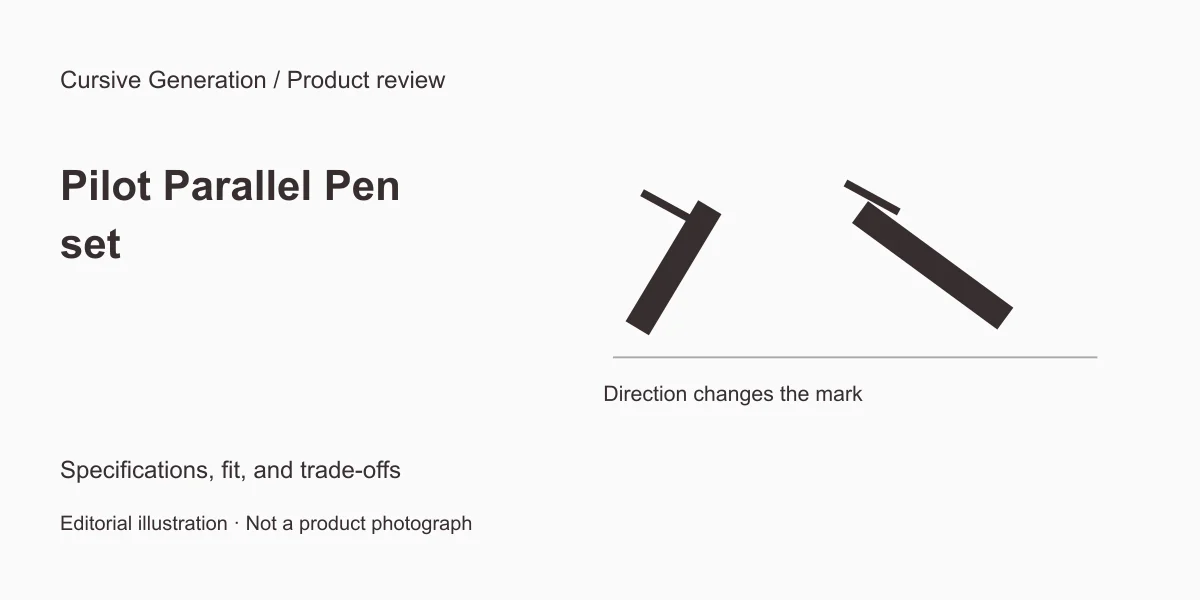
The Parallel uses two metal plates to form its writing edge. It is a broad-edge tool: stroke width changes with the direction of movement relative to that edge. It is not a flexible pointed nib that opens under pressure. That distinction matters more than the number of pens in the box.
Our calligraphy pen guide explains the tool families. For Italic, blackletter, and other broad-edge hands, this format is relevant. A lesson in flexible Copperplate calls for a different setup. A product title saying “calligraphy” does not make all scripts interchangeable.
Individual Parallel pens and other width combinations are available. If your teacher specifies one width, start with that width rather than treating a four-pen bundle as the minimum entry cost. The bundle earns its place when you genuinely want to work at several scales.
What the widths change in practice
A nib width changes the scale at which a letter can be built. Broad-edge exemplars often express letter height in nib widths. Follow the proportions in your chosen lesson, then draw guidelines to match the pen you use. Do not keep the same tiny writing line and expect a 6 mm edge to behave like a 1.5 mm edge.
The wider pen can make the relationship between the edge and the stroke easier to see. It also needs more room. A large exercise might use much of a sheet for only a few letters. The smaller widths suit more compact work, but leave less room to hide an uneven join or a crowded counter.
These are consequences of tool geometry, not results from a timed writing test. We have not measured flow consistency, ink consumption, or the sharpness of this bundle against other pens. The decision is whether its size range fits your lessons and projects.
Keep the writing edge working, not the pressure
Set the angle your exemplar requires and keep the full writing edge in contact where the stroke calls for it. If part of a broad stroke disappears, look at how the edge meets the page before pressing harder. A rigid broad edge should not be forced to open like a dip-pen point.
Our technique guide covers hand position and controlled practice. The beginner guide helps you choose one script and lesson instead of combining unrelated instructions. A Parallel can make many kinds of marks, but you will learn more from one consistent model than from switching styles every line.
Cartridges, cleaning, and bundle checks
Read the individual pen instructions for cartridge installation and cleaning. A cleaning bulb, if supplied, is not automatically an invitation to use the pen as an eyedropper reservoir. Use the filling method and ink type the maker specifies rather than following an unrelated fountain-pen modification video.
The extra cartridge packs are part of the linked retailer title. Check that they remain included in the selected listing. Product pages can merge variants or show photos from another bundle. If the refill count matters to your purchase, save the order description and compare it with what arrives.
Do not put an ink into the feed simply because its bottle says calligraphy ink. Some inks intended for dipping are unsuitable for fountain-pen systems. The ink guide explains that distinction. Start with the specified cartridges while you learn the pen; it removes one source of uncertainty if a stroke skips.
Paper for a broad, wet mark
A wide edge puts down a different mark from an ordinary writing pen. Test the exact pen, ink, and paper together before making a final card. Check the edges of the stroke, the drying surface, and the back of the sheet. A paper described as smooth may still behave differently with a broad application of ink.
The paper guide explains feathering, bleed-through, and surface texture. Our Rhodia review covers a convenient practice pad, while the HP paper review covers printable loose sheets. Neither review supplies a universal no-bleed guarantee for a 6 mm pen.
For a final piece, test on an offcut of the actual stock. If the paper has two different surfaces, label which one you used. Waiting for the trial to dry takes less effort than rewriting a finished invitation because the last line smeared.
A first exercise for the bundle
Start with one pen and one lesson. Rule a baseline and height guide, then draw a few simple strokes at the prescribed edge angle. Add a small group of letters that share those strokes. Once you can see their structure, repeat the exercise at a second width with proportionally adjusted guidelines.
Use the spacing tool to study the spaces around letters, not as a replacement for a broad-edge exemplar. The practice-sheet generator can provide a copying layout, but a font outline does not describe which edge angle or stroke sequence to use. Keep the physical lesson beside it.
The practice calendar can turn that exercise into a short recurring session. Record the width used on each page. Without that note, it becomes difficult to tell whether a later improvement came from steadier movement or simply from a larger letter.
Who should buy the four-width set?
A beginner following a broad-edge course
Buy the bundle if the course explores several widths or you know you want to vary scale. Otherwise, an individual pen in the requested size is the more focused purchase. The starter-kit guide compares this with narrower cartridge sets rather than assuming the biggest package is best.
A hobbyist making headings and display lettering
The spread of widths is useful when the project changes from a compact card to a larger heading. Separate pen bodies make switching convenient. That convenience is the argument for the bundle; we have no measured evidence that buying four together improves the quality of a stroke.
A writer practising shaded pointed script
Choose a pointed-pen or brush setup instead. You can draw a shape resembling shaded script with many tools, but that does not make their mechanics equivalent. The nib guide is the better buying reference when the lesson depends on opening and closing flexible tines.
What would change this recommendation?
A different refill count, a changed width combination, or an unclear seller description would change the value of the bundle. So would a course requiring only one pen. Inspect those practical details before comparing prices.
Long-term flow, cap sealing, and wear would need documented hands-on work. Until then, this is a recommendation about format and fit, not a claim that the Parallel beats every alternative. Start with the script and scale you want to learn, then buy the amount of equipment that serves it.
Pros and cons
Reasons to consider it
- Four broad-edge widths in the linked bundle
- Separate pens let you keep different widths ready
- Extra cartridge packs listed in the bundle
- Parallel-plate nib design for broad-edge lettering
Trade-offs
- Buying four widths is unnecessary for a single-size lesson
- Rigid broad edges do not behave like flexible pointed nibs
- Bundle may be excessive for casual users
Alternatives worth comparing
Choose by the job you need to do, not by how many accessories fit in the box. These are different buying options, not winners from a side-by-side test.
- Speedball Calligraphy Set: The listed 1.1, 1.5, and 1.9 mm nibs cover a narrower range for smaller broad-edge work.
- Manuscript Deluxe Calligraphy Set: Consider interchangeable nib sections when you prefer one pen body and several widths.
Price and where to buy
Check the current item title, selected variant, pack quantity, delivery charge, and return terms before paying. A familiar product name can cover several packages. We do not display a fixed price because the retailer can change it independently of this article.
Check priceSources and review method
This is a buying assessment, not a test report. We checked product identity against the retailer through Amazon CreatorAPI and used the references below for specifications and attributed observations. Seller copy can contain errors: specifications describe the intended product, not a guarantee about every delivered unit. Recommendations about practice are editorial advice.
- Yoseka: Pilot Parallel Calligraphy Pen Specialist retailer description of the parallel-plate design and individual pen contents; not a test of this bundle.
- JetPens: Pilot Parallel range Specialist range reference. The four-width bundle is a subset of available Parallel sizes.
No star score, measured durability, water-resistance result, or first-person testing claim is attached to this review. Illustrations are explanatory drawings, not product photographs or measured writing samples. Customer comments, where discussed, remain the opinions of their authors; no review average has been calculated.