
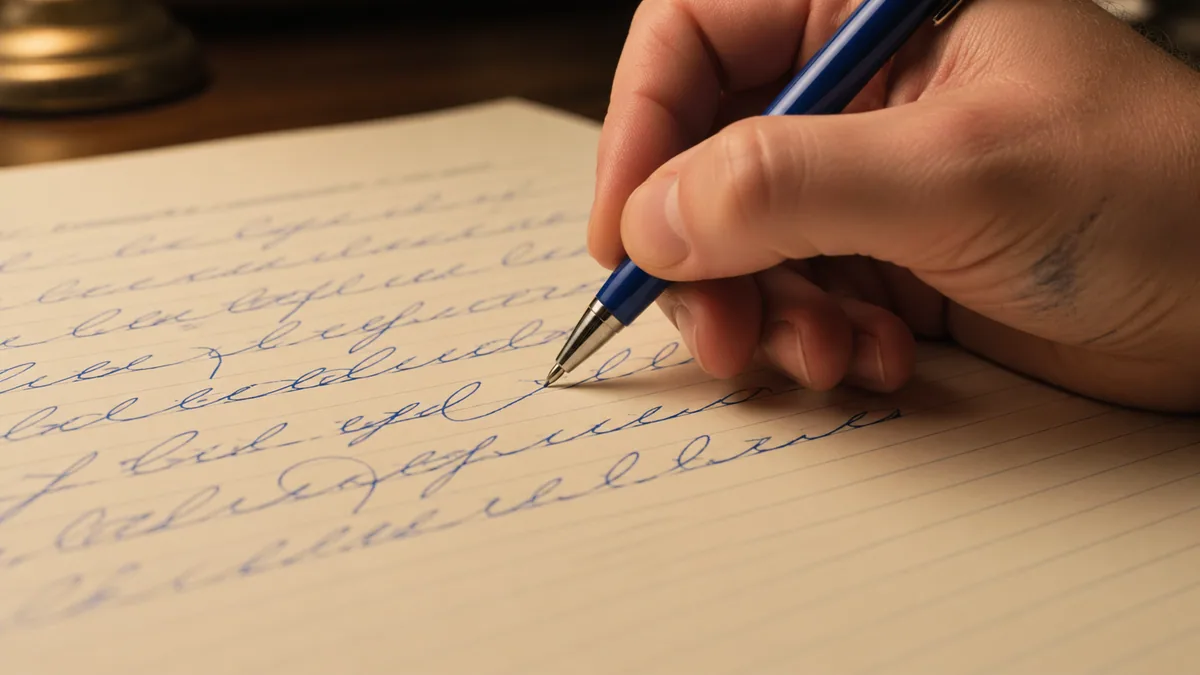
Choose practice sheets when you need repeatable exercises on your own paper. Choose an instructional book when you need explanations and a sequence to follow. A printable workbook can combine both, but its file format tells you nothing about the quality of its teaching.
Start with the problem on your desk. Do you need to understand an oval, repeat a difficult join, or make time for practice without a printer? Our practice guide helps define a session; the beginner guide helps if you have not chosen a tool yet. Buying more pages will not settle either question.
Compare teaching before comparing formats
Look inside the resource. Does it name the script, explain tool position, show individual strokes, and leave room for independent writing? A reference alphabet, tracing workbook, and full course serve different jobs. A book can contain little instruction; a short PDF can explain one movement carefully. Check that the model belongs to the script family you want to study.
In her practice-sheets and books comparison, lettering educator Haley Heinen distinguishes instructional books from write-in workbooks and discusses printing and binding. That distinction is useful; broad claims that either format always has better paper or costs less need checking against the actual edition and your setup.
Choose by the need you have today
| Your need | Consider | Check first |
|---|---|---|
| Understand construction | An instructional book or taught PDF | Stroke explanations, tool choice, lesson sequence |
| Repeat one drill | Printable sheets or a reusable digital layer | Printing permission, scale, space for freehand attempts |
| Practice without a printer | A printed book with separate writing paper | Binding comfort and readable models beside your hand |
| Use a tablet | A compatible digital worksheet | Import support, stylus behavior, and file license |
| Control the writing surface | Loose sheets or a book used as a reference | Your pen-and-paper test, not weight alone |
Paper and printing change the comparison
Print one page before a whole workbook. Select actual size when a lesson specifies measurements, then measure its guideline spacing. Fit-to-page settings can shrink a model intended for a particular nib width. The practice-sheet generator is useful for custom tracing text, while the guideline builder helps prepare ruled practice. Neither replaces a script-specific lesson.
Test a few strokes on the printed surface. Feathered edges, ink showing through, or a brush tip dragging suggest a mismatch. Read the paper guide and practice-paper comparison before assuming heavier means smoother. With a book, write on separate paper unless its pages suit your pen. A reference book need never become an ink-testing pad.
Match the printed model to the pen's working size. A broad brush cannot comfortably follow a tiny pointed-pen exercise. If the lines merge even with light contact, choose a larger exercise instead of pressing harder or treating every cramped attempt as a technique failure.
Count the whole cost, including the awkward bits
For a printable workbook, add paper, ink or toner, and any printing service charge to the download price. For a book, include delivery and separate practice paper. Repeat printing can be economical, but a small number of exercises at a paid print shop may change that calculation. Library borrowing or a used reference can also make sense; check whether a used workbook already has filled-in pages.
Binding affects comfort rather than instructional quality. A coil can keep a page open but may sit where your wrist wants to rest. A glued spine may resist opening. Try the writing position, especially if you write left-handed; our left-handed guide discusses adapting the setup. Keep the model visible without bending around the book.
Reuse depends on permission and the medium
Read the license before copying or sharing. Permission to reprint for yourself does not automatically include a class. A tracing overlay may preserve a page, but its surface feels different from the final paper. On a tablet, keep the model separate from your writing layer. The Procreate introduction explains the digital setup; tablet tracing does not reproduce a dip nib's contact with paper.
Try one lesson before choosing a library
- Choose one goal, such as evenly sized ovals. Read its explanation and identify where to start, lift, and change pressure.
- Try a few guided attempts, then write beside the model without tracing. Compare shape and spacing against the model, with the tracing sheet moved aside.
- Note what was missing: instruction, repetition space, suitable paper, or convenient access. Choose the next resource to fix that specific gap.
For a no-purchase format check, try our free Letterpaths first lesson, a lowercase cursive lesson with numbered starts, rather than a pointed-pen calligraphy course. Our free Marck Script sentence sample is font-based tracing. The Letterpaths workbook extends its own model, not every decorative script.
For book-led study, compare the book guide. A learner choosing Copperplate could examine Eleanor Winters' Mastering Copperplate Calligraphy; someone choosing brush lettering could examine Jenn Coyle's Getting Started with Brush Lettering. These are affiliate links; purchases may earn a commission. Check an edition's sample before buying. Then schedule one repeat session in the practice calendar.