
Affiliate Disclosure: This page contains affiliate links to products selected for practical fit. When you purchase through these links, we may earn a commission at no additional cost to you. Recommendations are based on the registry's stated features, price, level, pros, cons, and best-for labels. We do not imply hands-on testing without an explicit page-level record. See our complete Tools Guide for comparison notes and selection criteria.
Specs-based review: based on published specifications and attributed feedback where available; not tested by us. Last verified: .
Consider the chrome G nib if you want to try more flex than Nikko G without jumping straight to a very flexible specialist nib.
Best for: Copperplate beginners, Alternative to Nikko G, Pointed pen practice.
Skip it if: You need a complete pen, a titanium-coated nib, or a guarantee that every paper will feel smooth.
Check priceCompared with Nikko G: check the linked variants, task fit and evidence limits.
At a glance
| Detail | Catalog specification |
|---|---|
| Category | Pointed Nib |
| Suggested experience | Beginner |
| Listed feature 1 | Chrome G nib |
| Listed feature 2 | Pressure-dependent line variation |
| Listed feature 3 | Compatible G-nib holder required |
| Listed feature 4 | Ten nibs in the linked pack |
The chrome G nib, not the titanium version
The linked product is the Zebra PG-6B-C-K chrome G nib, ten pieces in a pack. Zebra G appears in more than one product description and coating variant. A claim about a titanium-coated nib should not be carried over to this chrome pack, especially a claim about service life.
This is a set of loose dip-pen points. It does not include a ready-to-write pen system. You need a holder that accepts the nib, ink appropriate for the task, and suitable paper. Buying ten spare points is useful only after you know the format works for your setup.
The retailer describes an elastic point for pressure-dependent line variation and says to use a compatible holder. It does not supply a universal compatibility promise. Our nib guide and holder guide explain the two decisions separately.
A G nib is relevant to pen-and-ink drawing and pointed-pen lettering. For Copperplate, follow a lesson that teaches the movement and proportions. For modern lettering, keep the tool mechanics distinct from a brush-pen demonstration.
Why choose Zebra rather than Nikko?
The clearest reason in the published evidence is feel. Nijomu's comparison describes Zebra as more flexible than Nikko, producing a finer line in that writer's setup, but still scratchy. The same writer preferred another G nib overall. That is not an endorsement to reduce to “Zebra wins.”
The comparison suggests a useful trial for someone who finds Nikko too firm. It does not establish an exact spring force, a guaranteed line width, or the best nib for every beginner. We have not repeated the comparison, and different inks, papers, and hands may produce different impressions.
Our Nikko G review gives the other side of that buying choice. If you already own one, use it long enough to identify what you want to change. “I need less effort for a shaded stroke” is a clearer reason to try Zebra than “another review gave it more stars.”
More flex asks for control
Start with modest pressure. A nib that opens readily can exaggerate an uneven movement if you treat it like a rigid writing pen. Keep the point aligned with the intended stroke and use the pressure pattern from your lesson. Do not force shaded upstrokes simply because the metal can bend.
If a shaded stroke splits into separate tracks, stop and inspect the ink load and pressure. If it catches, look at the paper, direction, and alignment. Neither symptom proves that the nib is defective, but neither should be ignored while you repeat a whole page of the same mistake.
Fit is a buying requirement
Confirm the holder's compatibility before ordering a pack. A loose fit can let the nib move; an over-tight fit can encourage you to force it into position. The name G nib does not make every holder socket interchangeable.
The Walfront oblique-holder review explains why we withhold an unconditional recommendation when a fit chart is missing. A seller who can name the exact compatible nib gives you more useful information than a photograph of a decorative wooden handle.
For left-handed writing, use a lesson and setup suited to your hand. The left-handed guide covers page position and practical choices. An oblique holder is not a universal requirement, and a left-handed writer should not be forced to copy a right-handed grip.
Preparation, dipping, and clean storage
Follow the nib supplier's preparation instructions before the first session. If ink beads rather than coating the working area, investigate preparation and ink choice. Do not assume that pressing harder will make the ink adhere, and do not use an open flame as a shortcut.
Choose an ink intended for your dip-pen task. The ink guide distinguishes those uses from fountain-pen filling. Keep the bottle stable and dip only as instructed for the nib and holder. Ink entering a holder fitting can create a separate cleaning problem.
At the end, clean and dry the nib according to its care instructions. A chrome finish is not a reason to leave a wet nib loose in a closed container. Store spare points so the tips cannot collide, and keep sharp parts away from young children.
Paper tests before judging the point
Choose one smooth surface for the first comparison. Changing the nib, ink, paper, and lettering size at once makes the result hard to interpret. The paper guide explains the different signs of feathering, bleed-through, and surface resistance.
A Rhodia DotPad is convenient for alignment. HP Premium32 is an option when you want printed guidelines. Neither is established here as the perfect partner for every Zebra-and-ink combination. Test a small area, let it dry, and inspect both sides.
A controlled comparison you can make
If you already have Nikko G, give each nib its own labeled area on the same paper. Use the same ink and letter size. Make light strokes, controlled shaded strokes, then a short word. Note effort and repeatability rather than measuring the widest mark you can force from the point.
Use a copying sheet for layout only; follow a pointed-pen teaching model for strokes. The spacing tool helps with the gaps after the shapes are readable. A recurring exercise in the practice calendar gives you a better comparison than an isolated first impression.
Our technique guide can help identify habits worth changing. If you are new to dipping, the beginner guide is a useful orientation before comparing nib brands.
Who should buy the ten-pack?
A regular dip-pen user who already likes Zebra G
A pack of replacements is a reasonable purchase. Confirm the chrome model so you receive the version you intended. Inspect new nibs before use and do not treat the ten pieces as guaranteed identical writing experiences.
A Nikko user wanting a more flexible response
Zebra is worth investigating based on the published comparison. If a smaller quantity is available from a suitable seller, it may be the more informative first purchase. The goal is to learn whether the response suits you, not to stock a drawer before that is known.
A beginner seeking the least setup
Choose a self-contained pen instead. The Pentel Fude Touch review covers a portable brush option, and the starter guide compares the different equipment paths. They teach different tools, but that may be a better fit for where you practise.
No fixed lifespan or automatic upgrade
We have no measured replacement interval for this nib. Inspect its condition, follow care instructions, and replace a damaged point. Do not borrow durability numbers from another coating or from a different writer's routine.
The useful recommendation is modest: try the chrome Zebra G when its reported response addresses a specific frustration with your present nib. Keep the rest of the setup stable long enough to learn whether it actually helps.
Pros and cons
Reasons to consider it
- Replaceable chrome G nib
- Published comparisons describe more flex than Nikko G
- Ten nibs in the linked listing
Trade-offs
- Separate compatible holder and ink required
- Some published feedback reports scratchiness
Alternatives worth comparing
Choose by the job you need to do, not by how many accessories fit in the box. These are different buying options, not winners from a side-by-side test.
- Nikko G Nib: Published feedback describes a firmer feel, which may suit someone who over-flexes a softer nib.
- Pentel Fude Touch Sign Pen: A small brush pen is easier to carry when separate nibs, ink, and cleaning are impractical.
Price and where to buy
Check the current item title, selected variant, pack quantity, delivery charge, and return terms before paying. A familiar product name can cover several packages. We do not display a fixed price because the retailer can change it independently of this article.
Check priceSources and review method
This is a buying assessment, not a test report. We checked product identity against the retailer through Amazon CreatorAPI and used the references below for specifications and attributed observations. Seller copy can contain errors: specifications describe the intended product, not a guarantee about every delivered unit. Recommendations about practice are editorial advice.
- Nijomu: G nibs, a comparison Published impressions of greater flex than Nikko and some scratchiness; no universal performance ranking.
- Zebra: product catalog Manufacturer catalog context. The linked PG-6B-C-K chrome ten-pack is identified separately by the retailer.
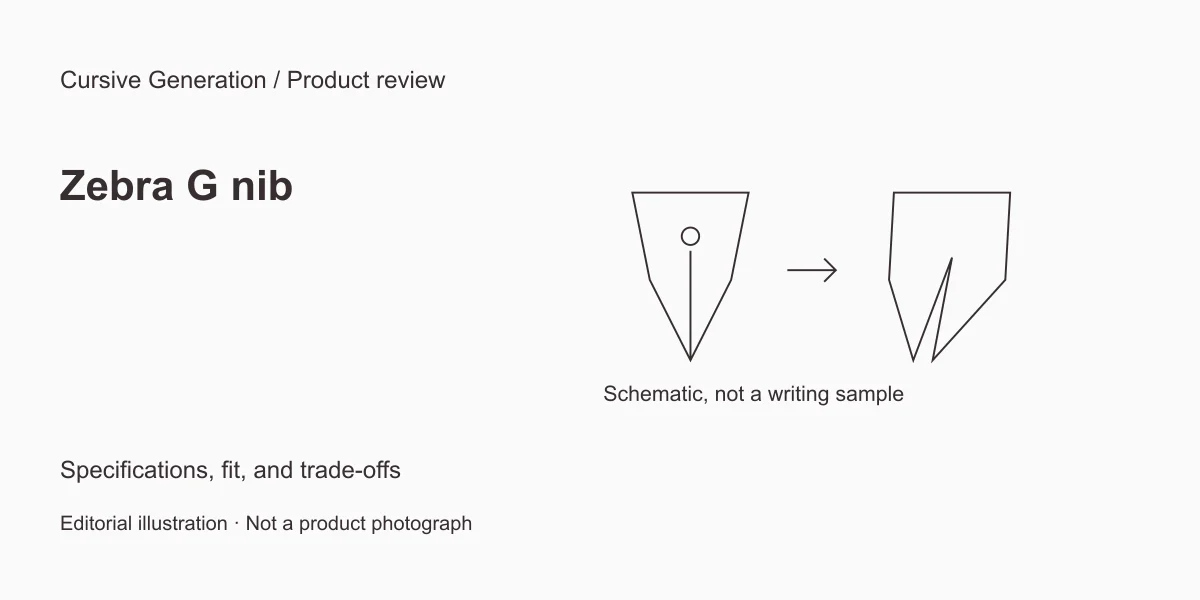
No star score, measured durability, water-resistance result, or first-person testing claim is attached to this review. Illustrations are explanatory drawings, not product photographs or measured writing samples. Customer comments, where discussed, remain the opinions of their authors; no review average has been calculated.