
Affiliate Disclosure: This page contains affiliate links to products selected for practical fit. When you purchase through these links, we may earn a commission at no additional cost to you. Recommendations are based on the registry's stated features, price, level, pros, cons, and best-for labels. We do not imply hands-on testing without an explicit page-level record. See our complete Tools Guide for comparison notes and selection criteria.
Specs-based review: based on published specifications and attributed feedback where available; not tested by us. Last verified: .
Worth considering for a learner who wants several broad-edge widths and will take time to learn cartridge and converter care.
Best for: Beginners, Style experimentation, Multiple scripts, Practice sessions.
Skip it if: You want a brush pen, a flexible pointed nib, or the fewest possible setup decisions.
Check priceCompared with Speedball Calligraphy Set: check the linked variants, task fit and evidence limits.
At a glance
| Detail | Catalog specification |
|---|---|
| Category | Complete Kit |
| Suggested experience | Beginner |
| Listed feature 1 | 1 deluxe classic calligraphy pen |
| Listed feature 2 | 6 nibs (fine, medium, broad, 2B, 3B, 4B) |
| Listed feature 3 | Converter and 4 color cartridges |
| Listed feature 4 | Storage tin with instructions |
Deluxe is not Masterclass
This page covers the Manuscript Deluxe fountain-pen set. The catalog describes a classic pen, six nibs, a converter, four colored cartridges, and a storage tin with instructions. Cult Pens independently identifies the Deluxe format as a classic pen with six nibs spanning 0.85 to 2.8 mm, cartridges, and a converter, while warning that packaging may vary.
The retailer link now names the Deluxe set. A similarly branded Masterclass listing is not the same product. Before buying, check the actual contents and handedness option, not a search thumbnail. If the seller gives only a title, ask for the current packing list, especially if the tin or cartridge colors matter to you.
These are fountain-pen nib sections, not six loose dip-pen points. The converter is for an approved bottled fountain-pen ink; it does not make every calligraphy ink suitable for the pen. The difference is covered in our pen guide and ink guide.
Six widths are an opportunity to compare scale, not six separate skills in a box. The main reason to choose Deluxe is that you want to explore several broad-edge sizes in one pen system. If your first lesson needs only one size, you can begin with less equipment.
Learning with interchangeable broad edges
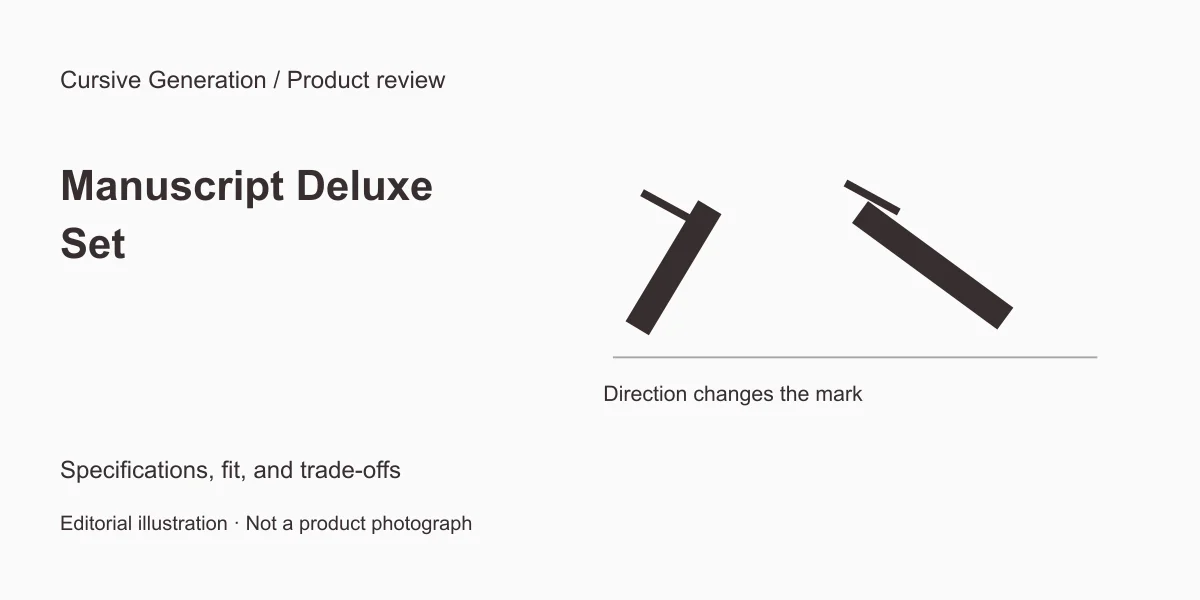
A broad edge makes different stroke widths as it moves in different directions. Keep the edge at the angle specified by your exemplar and use the letter proportions taught there. Pressing harder is not the intended way to turn a narrow stroke into a shaded one.
That makes the set relevant to Italic, blackletter, and other broad-edge lessons. It is not a direct substitute for a flexible pointed nib in Copperplate. Match the equipment to the lesson before judging whether the set is complete.
Start with one nib section. Changing sections every few words makes it hard to tell whether you are improving your movement or merely responding to a different width. Finish a small exercise, label the width, and then repeat it at another size with adjusted guidelines.
Six nibs also mean six setup choices
For someone who likes comparing tools, the range is useful. For a complete beginner, it can become a distraction. A good first session is not one in which every nib gets wet. It is one in which you understand what one nib does when its edge meets the page correctly.
Our beginner guide helps you choose a learning direction. The technique guide covers the habits behind steadier practice. Neither requires you to collect a new width each time a letter is awkward.
Cartridges first, converter when you need it
A cartridge is a straightforward starting point because it removes the choice of bottled ink from the first session. Follow the pen's instructions for fitting it. If ink does not appear immediately, use the prescribed troubleshooting method rather than forcing the nib against the paper.
The converter becomes useful when you have a reason to choose an approved bottled ink. It brings filling and cleaning into the routine. Work over a surface you can wipe, keep the bottle stable, and follow Manuscript's directions for the installed nib section. A converter is a filling accessory, not a filter that makes an unsuitable ink safe.
Do not mix leftovers from different inks simply to avoid cleaning. If you want another color, first check the maker's care instructions. We have not run a clogging or long-term storage test, so there is no evidence here for a shortcut that departs from them.
What the set leaves for you to choose
Practice paper is a separate purchase unless the seller explicitly includes it. So is a suitable teaching resource if the included instructions do not cover your intended script. A tin full of tools does not supply an entire learning sequence.
The calligraphy book guide distinguishes broad-edge manuals from pointed-pen books. The starter-kit guide compares this set with simpler cartridge and pen-only options. Use those differences to decide whether six nibs solve a real need.
For paper, begin with a smooth sheet and test the pen-and-ink combination. The paper guide explains feathering and bleed-through. A Rhodia DotPad offers alignment points, while HP Premium32 offers a route to printing your own guidelines. Neither is a measured performance claim for this set.
A first page for comparing widths
Pick one simple letter group from a broad-edge lesson. Rule the page to the specified proportions, write a few strokes, and then the letters. Mark the nib width at the top. Repeat the group with a second nib on a separately ruled area rather than squeezing the wider letters into the first row.
The comparison should answer a practical question: which scale fits the card, label, or exercise you want to make? It does not need to prove that one nib is the best. Different widths exist because projects have different sizes.
You can use the practice-sheet generator for copying layouts, with a separate broad-edge exemplar for stroke order. The spacing tool helps you examine the spaces around completed letters. Add the exercise to the practice calendar if a recurring reminder helps you keep the pen in use.
Who should buy Deluxe?
A learner who wants to explore several scales
Yes, if you are happy to learn one width before switching. The range and converter make sense for someone who expects to keep experimenting. Do not confuse that flexibility with a promise of better writing straight out of the tin.
A buyer seeking the simplest possible first session
Consider a smaller cartridge set or an individual pen. A lower number of parts can be an advantage when the goal is simply to sit down and follow a lesson. The best value is not necessarily the largest accessory count.
A gift buyer unsure which script the recipient likes
Find that out before choosing. This set is a broad-edge purchase. A recipient who wants small brush lettering or flexible pointed script may appreciate a different tool more than a larger tin. If you cannot establish the script, a clearly described beginner resource may be a safer starting gift.
Limits of this assessment
We verified the Deluxe identity and compared published package descriptions. We did not measure flow, test every nib, or assess comfort over long writing sessions. The current retailer identification is thinner than a full manufacturer packing specification, so the exact package should still be confirmed before purchase.
That uncertainty does not make every part of the decision unknowable. The format is clear: one fountain-pen system, several broad edges, cartridges, and a converter. Buy it for that combination, not for a promise that six nibs will accelerate progress or replace instruction.
Pros and cons
Reasons to consider it
- Comprehensive deluxe set with storage tin
- 6 different nibs including specialty sizes
- Multiple color cartridges included
- Good for practicing various styles
Trade-offs
- Several nib widths add setup choices for a first session
- Cartridges and converter require compatible fountain-pen ink
- Practice paper is a separate purchase
Alternatives worth comparing
Choose by the job you need to do, not by how many accessories fit in the box. These are different buying options, not winners from a side-by-side test.
- Speedball Calligraphy Set: Three listed widths reduce the number of nib choices for the first session.
- Pilot Parallel Calligraphy Pen Set: Separate pen bodies let you switch sizes without changing a nib section.
Price and where to buy
Check the current item title, selected variant, pack quantity, delivery charge, and return terms before paying. A familiar product name can cover several packages. We do not display a fixed price because the retailer can change it independently of this article.
Check priceSources and review method
This is a buying assessment, not a test report. We checked product identity against the retailer through Amazon CreatorAPI and used the references below for specifications and attributed observations. Seller copy can contain errors: specifications describe the intended product, not a guarantee about every delivered unit. Recommendations about practice are editorial advice.
- Cult Pens: Manuscript Deluxe Calligraphy Set Specialist retailer specification: classic pen, six nibs spanning 0.85–2.8 mm, cartridges, converter, and variable packaging.
- Blick: Manuscript Deluxe Calligraphy Set Retailer identification of the Deluxe fountain-pen set, distinct from Masterclass.
No star score, measured durability, water-resistance result, or first-person testing claim is attached to this review. Illustrations are explanatory drawings, not product photographs or measured writing samples. Customer comments, where discussed, remain the opinions of their authors; no review average has been calculated.