
Affiliate Disclosure: This page contains affiliate links to products selected for practical fit. When you purchase through these links, we may earn a commission at no additional cost to you. Recommendations are based on the registry's stated features, price, level, pros, cons, and best-for labels. We do not imply hands-on testing without an explicit page-level record. See our complete Tools Guide for comparison notes and selection criteria.
Listing-based review: retailer identity checked; manufacturer compatibility documentation unavailable. Not tested by us. Last verified: .
Do not buy this holder on appearance alone. Get confirmation that your exact nib fits; otherwise choose a holder with documented compatibility.
Best for: Copperplate, Spencerian, Traditional scripts, Buyers able to confirm nib fit with the seller.
Skip it if: You need a verified ready-to-use Nikko or Zebra G setup and the seller cannot confirm fit.
Check priceCompared with Speedball: check the linked variants, task fit and evidence limits.
At a glance
| Detail | Catalog specification |
|---|---|
| Category | Pen Holder |
| Suggested experience | Intermediate to Advanced |
| Listed feature 1 | Walfront retailer identity |
| Listed feature 2 | Wooden holder |
| Listed feature 3 | Oblique format |
| Listed feature 4 | Nib compatibility not independently verified |
What we could verify, and what we could not
The linked listing identifies this as a Walfront wooden oblique dip-pen holder. That corrects the catalog's earlier generic name. It does not establish the wood species, exact weight, length, flange adjustment range, or which pointed nibs fit. We have not handled this holder and could not verify a manufacturer compatibility chart.
That missing information changes the verdict. This is a listing-based assessment with a conditional recommendation, not a hands-on review dressed up as one. If the seller cannot confirm that your intended nib fits, buy a holder with clearer documentation instead.
There is also no reliable evidence here that ink or a nib comes with the handle. Treat them as separate purchases unless the current packing list explicitly includes them. An attractive product photograph showing a completed writing setup is not always a photograph of the included contents.
Our holder guide covers the wider choice between straight and oblique formats. The nib guide helps identify the point you want to use. Make those decisions together rather than ordering a handle and hoping the nib will fit when it arrives.
What an oblique holder changes
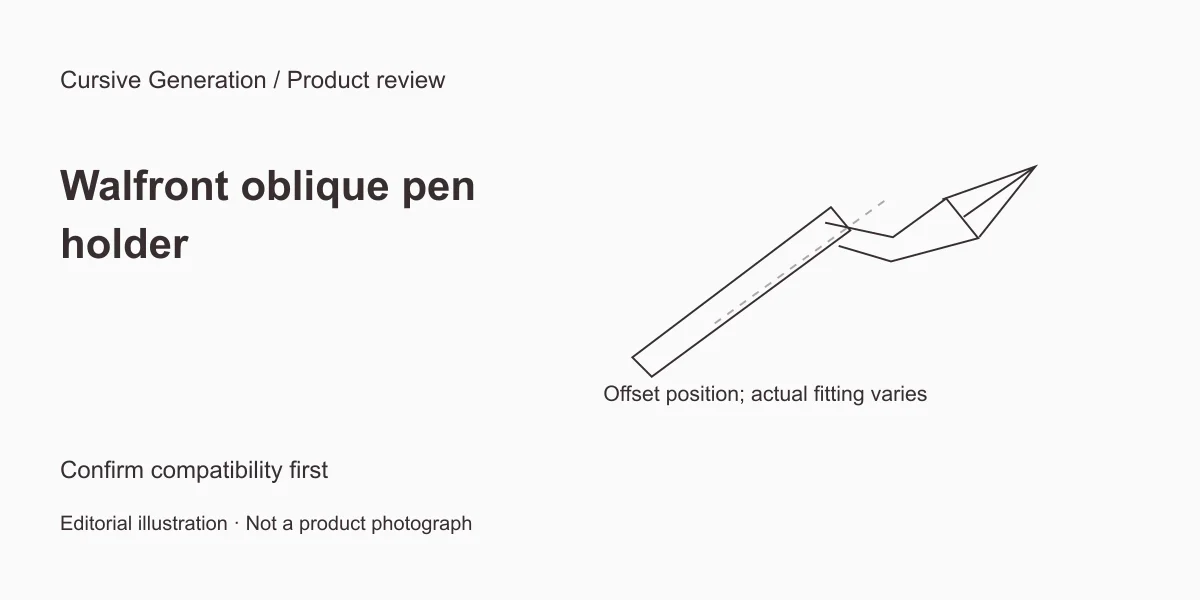
An oblique holder positions the nib to the side of the handle's main axis. That offset can help a writer align a pointed nib with the required stroke direction while keeping a workable hand position. It does not automatically set the correct slant, make both tines touch evenly, or correct a tight grip.
Those are general observations about the format, not claims about this Walfront product's performance. We have no writing sample from it and no measured comfort comparison. A handle that looks comfortable in a photograph may not suit your grip or your way of resting the hand.
For Copperplate or Spencerian, follow the holder and posture advice in a suitable lesson. The same handle is not automatically right for both a large shaded exercise and small everyday script. Our cursive-versus-calligraphy guide explains why those tasks should not be collapsed into one.
Handedness is not a small detail
A left-handed writer should not assume that an oblique holder shown in a right-handed demonstration is the required purchase. Page position and the direction from which the hand approaches the line can change the choice. The left-handed guide is the relevant starting point.
For either hand, discomfort is a reason to stop and reassess the setup. Do not bend your wrist into an awkward position simply because a handle was marketed for professional calligraphy. A holder should support the movement you are learning, not become a posture test you must pass.
Questions to send the seller
Name the exact nib, not just its category. Ask whether the holder accepts Nikko G or Zebra PG-6B-C-K without modification. Ask whether the fitting is adjustable and whether instructions are included. If it needs adjustment, ask who is expected to make it and whether doing so affects returns.
Then ask for the current dimensions and a clear view of the fitting. A seller's answer should distinguish the holder being shipped from a generic oblique-holder explanation. A statement such as “fits most nibs” leaves the original question unanswered.
Check what is included, how the nib is retained, and whether there is a return route if the promised fit is wrong. Avoid buying additional nibs or inks solely to make an undocumented handle usable. The total cost of the setup matters more than a small discount on the handle.
Our Nikko G review and Zebra G review identify the nib variants discussed here. Neither page claims those nibs have been tested in this holder.
Inspecting it when it arrives
Before adding ink, compare the delivery with the seller's description. Check the handle for visible damage and the fitting for obvious looseness or distortion. Follow the supplied fitting instructions. Do not force a nib into a socket that does not accept it cleanly.
A secure fit should not require you to crush the nib or bend a metal part by guesswork. If fit differs from the seller's promise, contact the seller before making irreversible adjustments. A return is preferable to damaging both the holder and the point while trying to salvage a cheap purchase.
When the dry setup is correct, try a short writing sample using a familiar ink and paper. Keep the session brief enough to notice whether you are gripping harder to compensate for movement. We cannot supply a product-specific adjustment procedure without documentation of this fitting.
Do not make the holder responsible for every problem
A scratchy line can involve the nib, writing direction, paper, or alignment. Ink that will not coat a new point can involve preparation or ink choice. Changing the handle may not solve either issue. The ink guide and paper guide explain those separate variables.
Start with a smooth surface you already know, or make a small trial on a Rhodia DotPad. Use the same nib and ink while checking the holder. If you change the whole setup, you will not know which change caused the result.
The technique guide gives general practice advice. The beginner guide helps establish a learning sequence. Neither should be read as evidence that this specific handle has passed a comfort or durability test.
Who should buy it?
An experienced writer who can verify the fitting
It may be worth considering if the seller answers the compatibility questions and the return terms are acceptable. An experienced buyer can make a more informed decision from detailed photographs and measurements. Experience does not make missing information irrelevant.
A beginner ordering a first pointed-pen setup
Choose a clearly documented holder-and-nib combination instead if this listing remains vague. The starter choices guide explains what a complete setup needs. Your first session should not begin with deciding whether a loose metal flange needs bending.
A gift buyer choosing by the wooden finish
Skip it unless you know the recipient's nib and preferred holder format. Finish and presentation are secondary to fit. A familiar, correctly specified accessory is more useful than a decorative handle that never leaves its box.
Practising without buying a holder first
You can work on letter shapes and spacing with a familiar pencil while choosing the physical equipment. The practice-sheet tool provides copying layouts, and the spacing tool helps you study gaps. Neither simulates nib pressure or authenticates a historical script.
The practice calendar can hold those sessions while you gather the right supplies. There is no need to rush an uncertain purchase just to begin looking closely at letters.
What would earn a stronger recommendation?
A manufacturer fit chart, a confirmed packing specification, and documented use with named nibs would materially improve the evidence. Original notes about grip, fitting, and cleaning would then support a hands-on assessment. None of those can be replaced by a star rating copied from a marketplace.
Until that evidence exists, the recommendation remains conditional. The holder's purpose is clear; its suitability for your exact setup is not. Ask the fit question before checking out, and choose another seller or model if the answer stays vague.
Pros and cons
Reasons to consider it
- Wooden oblique holder identified in the retailer title
- Offset holder format for pointed-pen setups
Trade-offs
- No verified manufacturer nib-compatibility chart
- Exact flange adjustment and dimensions are unverified
- Nib and ink inclusion must be checked before purchase
Alternatives worth comparing
Choose by the job you need to do, not by how many accessories fit in the box. These are different buying options, not winners from a side-by-side test.
- Tachikawa T-36 Holder: Investigate this straight-holder option if a straight setup fits your hand; confirm its nib compatibility separately.
- Speedball Oblique Holder (Pen Set): A named alternative to investigate, not a promise that it accepts every G nib.
Price and where to buy
Check the current item title, selected variant, pack quantity, delivery charge, and return terms before paying. A familiar product name can cover several packages. We do not display a fixed price because the retailer can change it independently of this article.
Check priceSources and review method
This is a buying assessment, not a test report. We checked product identity against the retailer through Amazon CreatorAPI and used the references below for specifications and attributed observations. Seller copy can contain errors: specifications describe the intended product, not a guarantee about every delivered unit. Recommendations about practice are editorial advice.
- Walfront retailer listing B07FT2MVXN CreatorAPI identifies a Walfront wooden oblique holder. No manufacturer fit chart, confirmed dimensions, or credible performance review was available.
- IAMPETH learning resources General pointed-pen learning context only. IAMPETH is not an endorsement of this holder.
No star score, measured durability, water-resistance result, or first-person testing claim is attached to this review. Illustrations are explanatory drawings, not product photographs or measured writing samples. Customer comments, where discussed, remain the opinions of their authors; no review average has been calculated.